Editor's note: The New Britain Museum of American
Art provided source material to Resource Library for the following
article. If you have questions or comments regarding the source material,
please contact the New Britain Museum of American Art directly through either
this phone number or web address:
Nelson H. White: Scenic
Spirit
July 12 - October 14, 2012
The White family is
best known for its long legacy as one of Connecticut's most accomplished
dynasties of artists. Generation after generation, the Whites 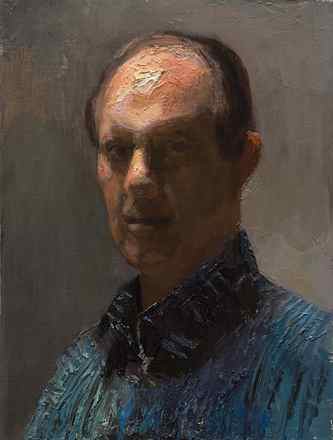 have produced breathtaking landscapes in oil, pastel,
and watercolor. Nelson Holbrook White (b. 1932), inspired by his time in
Florence and the years of traditional schooling, continues to paint vibrant
intersections of sky, earth, and water. His survey exhibition, Nelson
H. White: Scenic Spirit, will showcase approximately 35 works, including
two by his father, Nelson Cooke White (1900-1989) and grandfather Henry
Cooke White (1861-1952) at the New Britain Museum of American Art from July
12th through October 14th, 2012. (right: Self Portrait, 2011,
oil on canvas, 16 x 12 inches. Courtesy of the artist.)
have produced breathtaking landscapes in oil, pastel,
and watercolor. Nelson Holbrook White (b. 1932), inspired by his time in
Florence and the years of traditional schooling, continues to paint vibrant
intersections of sky, earth, and water. His survey exhibition, Nelson
H. White: Scenic Spirit, will showcase approximately 35 works, including
two by his father, Nelson Cooke White (1900-1989) and grandfather Henry
Cooke White (1861-1952) at the New Britain Museum of American Art from July
12th through October 14th, 2012. (right: Self Portrait, 2011,
oil on canvas, 16 x 12 inches. Courtesy of the artist.)
Nelson H. White's passion for natural settings is closely
inspired by the work of Italian artist and teacher Pietro Annigoni (1910-1988),
whom he praised as "the greatest realist painter of our time."
White began studying under Annigoni after a visit to Florence in 1954 and
has since split his time living and painting in Italy and Connecticut.
Nelson H. White: Scenic Spirit
exhibits a wide range White's landscapes as well as two portraits, all completed
between 1980-2012. Taking viewers from the sandy beaches of Tuscany in Bagno
La Salute-Viareggio, Italy (2011) to a picturesque waterfront in
The Marsh-Waterford, CT (1980), White believes "the essential
objective of art is to render beauty." He focuses on depicting nature
in the most truthful and timeless fashion. White paints in alla prima,
a technique of layering wet paint upon previous layers of wet paint. His
wispy strokes lead viewers' eyes across each canvas and animate his scenes
of undulating dunes, marshes, streams and shores. White sometimes employs
a palette knife in place of a traditional paintbrush, and thus his mature
works exhibit built up levels of paint that add a haptic quality to the
canvas. He often paints his scenes outside in a single sitting in order
to capture the proper light and feel of a given place, producing smaller,
intimate snapshots of nature and leisure.
Nelson H. White: Scenic Spirit
includes scenes from Switzerland, France, California, and the Bahamas. Nelson
H. White is currently a board member at the Florence Academy of Art in Italy
and has been studying there since 2002. Over the years, he has regularly
exhibited in the US and abroad, beginning with his first solo exhibition
in 1961 at the Lyman Allyn Museum in New London, Connecticut. White has
since exhibited at the Grenning Gallery in Sag Harbor, NY, the Hammer Gallery
in New York, NY, the Kolomenskoy Museum in Moscow, Russia, the Panorama
Museum in Frakenhausen, Germany and the Valadri Gallery in La Spezia, Italy.
To view additional images of selected
artworks in the exhibition please click here and
to view the exhibition catalogue for the exhibition
please click here.
Introductory wall panel text from the exhibition
Nelson Holbrook White (b. 1932), contemporary realist and
Connecticut native, has built his distinguished career on transporting viewers
to picturesque vistas of New England, Long Island, and Italy through his
vibrant landscape paintings that demonstrate an emotional understanding
and profound respect for nature. Nelson H. White: Scenic Spirit charts Nelson's
artistic output over the last 35 years.
A third-generation painter, Nelson has followed the footsteps
of his grandfather, Henry Cooke White (1861-1952), and his father Nelson
Cooke White (1900-1989), whose oils and watercolors are also on display.
In addition to painting, both were talented writers and astute art collectors.
Thus, Nelson was initiated into the world of art as a boy and received encouragement
and early training from his father and grandfather. Furthermore, the views
of Long Island Sound from the White house, build by Nelson's grandfather
and still owned by the family, in Waterford, CT and their vacation home
on Shelter Island, NY provided endless inspiration for young Nelson.
Nelson's formal art study began in 1954, during a visit
to the studio of Pietro Annigoni (1910-1988). Annigoni, the Florentine master
who was renowned worldwide for his portraits of presidents and royalty,
took Nelson as an apprentice, and the two quickly became friends and travel
companions. Nelson credits Annigoni, and Annigoni's close colleague, Nerina
Simi (1890-1987) with teaching him how to accurately render form and space
as well as refine his values.
Since the mid-1950s, Nelson has divided his time between
Florence nine months of each year and Waterford and Shelter Island during
the summer. Exercising his passion for landscape, he paints primarily outdoors
and all prima (Italian for "first attempt"), working swiftly
to apply paint to previous layers of paint while they are still wet. Over
the years, Nelson's approach to outdoor painting has evolved tremendously
from a more precise, academic style to a looser, highly dynamic application
of paint, greater economy of detail, and bolder colors. As he explains,
"Now I am more intent on the atmosphere, to render a feel for the moisture,
the humidity of the air." "With discipline comes freedom,"
he continues.
A tireless worker and lifelong student, Nelson has been
studying at the Florence Academy of Art since 2002. Founded by fellow American
Daniel Graves (b.1949) in 1991, the Academy is a center for traditional
training and a community of artists who share the belief that "the
essential objective of art is to render beauty" and that "painting
is supposed to say something" by conveying an emotion or mood that
can be lost in a photograph. Nelson has also mentored a number of students
of his own, proving to be a significant link between the heritage of traditional
art and the present.
The Museum is most grateful to Peter Trippi for his catalogue
essay, the Florence Academy of Art for its longstanding support of the Museum,
members of the White family who kindly loaned paintings to the exhibition,
and of course to Nelson, who provided key examples from his oeuvre and whose
talent, guidance and generosity made Nelson H. White: Scenic Spirit possible.
- Anna Rogulina
- Assistant Curator
Wall labels for objects in the exhibition
Nelson Holbrook White
- (b. 1932)
- Bagno La Salute-Viareggio, Italy,
2011
- Oil on canvas
- Collection of the artist
-
- During weekends of the academic year, Nelson Holbrook
White breaks from studying portraiture and figure painting at the Florence
Academy of Art to capture some of Europe's most scenic destinations. Nelson
first began painting beach scenes with parasols in the 1980s, "after
a trip to Saint Tropez on the French Mediterranean coast," where he
found the views "particularly inspiring."
-
- Bagno La Salute-Viareggio, Italy
exudes a sense of ultimate leisure. A vast expanse of soft sand holds vibrant
orange parasols and sea-blue lounge chairs in a scene of sheer contentment.
Touches of white from the distant sailboats, breaking waves and umbrella
poles stand boldly against the cerulean waters and sky of the tranquil
coast. The monumental scale of Bagno La Salute-Viareggio, Italy is the
result of Nelson's conscious effort to challenge himself by concentrating
on larger paintings that require multiple sittings.
-
-
-
-
- Nelson Holbrook White
- (b. 1932)
- Dering Harbor-Shelter Island, NY,
1998
- Oil on canvas
- Private collection
-
- "It interested me greatly to be with him [grandfather]
and my father while visiting in Peconic, Long Island, as a boy. From them,
I learned the importance of tone and values in painting, and above all,
taste."
- -Nelson Holbrook White, A Small Biography in Three
Parts
-
- Shelter Island, New York served as both a vacation getaway
and artistic harbor for the White family. It was there that Nelson Cooke
White (1900-1989) became acquainted with the artists' colony of Peconic
and befriended Impressionist Irving Wiles (1861-1948). His son, Nelson
Holbrook, was also inspired by the artistic atmosphere and scenic nature
of Shelter Island, and Dering Harbor-Shelter Island, NY demonstrates
his connection to the place. Lush green brush surrounds the outer edges
of the painting, framing the open harbor. Colorful boats in the distance
sit still on the unperturbed water as the sky slowly fades to perpetuate
the pictorial beauty of the scene.
-
-
-
-
- Nelson Holbrook White
- (b. 1932)
- Evening on the Dune, 2002
- Pastel
- Private collection
-
- Nelson Holbrook White began painting the shores of Viareggio,
a northern Tuscan city, in 1956 while studying under Pietro Annigoni (1910-1988),
and he continues to transport viewers to its vistas today.
-
- The dreamy, almost mystical Evening on the Dune is
an indirect homage to Henry Cooke White (1861-1952) and Dwight Tryon (1849-1925),
both of whom were known for their exquisite marine pastels. Using a box
of pastels that originally belonged to his grandfather, Nelson masterfully
conveys the atmosphere of dusk by maintaining color in shadows in this
highly nuanced work.
-
-
-
-
- Nelson Holbrook White
- (b. 1932)
- Haven, 2010
- Oil on canvas
- Collection of the artist
-
- Self-Portrait and Haven
represent Nelson Holbrook White's interests beyond landscape: portrait
and figure painting. Both form the focus of his study at the Florence Academy.
Believing that "the essential objective of art is to render beauty,"
White uses the images of the young sitter to epitomize the elegance and
vitality of youth.
-
-
-
-
- Henry Cooke White (1861-1952)
- Clearing After Storm-New London,
1903
- Oil on wood
- Private collection
-
- Clearing After Storm-New London
is an excellent example of a Connecticut seascape, which was one of Henry
Cooke White's favorite subjects. Distant sailboats occupy the serene waters,
reflecting Henry's passion for sailing. Entranced by the tranquility of
Long Island Sound, he commissioned architect Wilson Eyre (1958-1944) to
build his family home in Waterford, CT overlooking the ocean.
-
- Clearing After Storm-New London
was painted at the turn of the century, when Henry became one of the first
members of the art colony in Old Lyme (just 12 miles from Waterford), alongside
Childe Hassam (1859-1925), Willard L. Metcalf (1858-1925), Edward F. Rook
(1870-1960) and other noteworthy artists.
-
- According to his son, Nelson Cooke White, "it was
the fleeting, evanescent effects that really moved and inspired him."
Despite Henry's connections to the artistic motivations of Impressionism,
however, he never considered himself a follower of the movement. While
he worked on hundreds of beautiful pastels outdoors, many of his oil paintings
were ultimately finished in his studio. His preference for using wood panels
rather than canvases was a practical choice, because wood not only offered
added durability, but also the benefit of a warm undertone from the natural
color of the wood-ideal for Henry's tonalist sensibilities.
-
-
-
-
- Henry Cooke White (1861-1952)
- The Old Man, 1878
- Oil on wood
- Private collection
-
- Nelson H. White's grandfather, Henry Cooke White, was
an established artist and art collector. As a teenager, Henry learned to
draw and paint from the renowned tonalist Dwight W. Tryon (1849-1925),
whose definitive biography he later published. In the mid-1880s, Henry
enrolled at the Brooklyn Academy and the Art Students League. He eventually
turned to teaching himself, helping establish the Connecticut Academy of
Fine Arts in Hartford in 1910.
-
- Thanks to the influence of his grandfather and his painter
friends, Nelson developed a strong appreciation for the arts and learned
the basics of painting at a young age. He recalls his grandfather's advice:
"if you can see it well, you can draw it. Drawing is not a trick of
the hand, it is observation."
-
- Henry's keen sense of observation is evident in The
Old Man. Henry completed the clear and stoic portrait in Tryon's studio
when he was only eighteen years old. Then a first year student at Art Students
League, he often retreated to the studio "to be more productive."
The luminescent gold frames of the old man's glasses add the slightest
hint of color to the painting's otherwise subdued palette.
-
-
-
-
- Nelson Holbrook White
- (b. 1932)
- Kitching's Point, 2009
- Oil on canvas
- Collection of the artist
-
- Kitching's Point offers a
view from the White family home in Waterford, CTwhere Nelson Holbrook grew
up. The painting is among the finest examples of his command of the palette
knife, which he uses almost exclusively here. The technique of applying
paint on a canvas with a palette knife is ideal for acquiring brilliance
of color and was first suggested to Nelson by his father and grandfather.
As Nelson explains, "In a paint brush, the paint is slightly diluted.
A palette knife is more direct."
-
- Particularly dynamic in Kitching's Point are Nelson's
delivery of whites and creams for sand and his playful rendering of rosehip
blossoms as specks of blues, pinks, oranges, and yellows. The luscious
textures and layers of paint coalesce from a distance and delight the eye
when studied up close.
-
-
-
-
- Nelson Holbrook White
- (b. 1932)
- Mashomack Point, 2010
- Oil on canvas
- Collection of the artist
-
- Shelter Island's Mashomack Point, near the White family's
vacation home, offers panoramic views of Long Island. Enchanted by the
unperturbed nature of Shelter Island, Nelson Holbrook White continues to
travel there every August to paint.
-
- A product of one such sojourn, Mashomack Point
displays the delicate blending of land and sea. Nelson captures the spirit
of his natural surroundings in low-key shades of browns, greens, and grays.
The horizontality of the landscape is accentuated by the repetition of
painterly striations that render the marsh, land, sea and sky.
-
-
-
-
- Nelson Holbrook White
- (b. 1932)
-
- 1. Massarella, Italy, 2010
- 2. Sag Harbor, NY, 2011
- 3. Nantucket Harbor, 2005
- 4. Sea and Sky, Nassau, 2011
- 5. Venice, 2011
- 6. Viareggio, 2010
- 7. Yellow Umbrella, 2010
- 8. The Royal Palm, 2011
- 9. The Riviera of Versilia, 2011
- 10. Sunset, 2010
- 11. Healdsburg, California, 2009
-
- Oil on canvas
- Collection of the artist
-
- Nelson Holbrook White vies to capture the ever-changing
colors and beauty of Mother Nature in all of her settings. Like his Italian
mentor Pietro Annigoni's (1910-1988) early works, Nelson's small oils are
painted in a single sitting. His lively brushstrokes appear fleeting, echoing
his view of nature as a continuously evolving body.
-
- Reflective of his worldly travels, Nelson's small oil
paintings include scenes from Italy, New England, California, and the Bahamas.
Through his unique application of paint which often involves the use of
a small palette knife, White achieves radiating light, vivid color and
subdued shadows. From the naturalism and precision of Masarella, Italy
to the near-abstraction of Sunset, White presents snapshots
of scenic perfection.
-
-
-
-
- Nelson Cooke White (1900-1989)
- The Basin, Sterling Creek -Greenport, Long Island,
NY, 1927
- Watercolor on tonal paper
- Private collection
-
- Nelson Cooke White's upbringing exposed him to the most
scenic spots of New England. Following the artistic pursuits of his father,
Henry Cooke White, he developed a particular enthusiasm for boats and sailing.
The Basin, Sterling Creek-Long Island, NY portrays the waters of
a familiar view for Nelson Cooke, as the White family often vacationed
on Long Island. The gray sky, full harbor and reflective water divide the
watercolor into three horizontal planes that blend harmoniously to create
a picture of serenity. He shared his holistic approach to painting with
his son, Nelson Holbrook White, teaching that painting "is just like
juggling; don't work in one area, work all over the picture."
-
-
-
-
- Nelson Cooke White (1900-1989)
- The Fishing Fleet, Viareggio,
1958
- Oil on panel
- New Britain Museum of American Art Gift of the Artist,
1979.078
- The calm coast of Viareggio, Italy has enchanted the
White family for decades. Both Nelson Cooke and his son, Nelson Holbrook,
have traveled to the Northern Italian shore and painted its arresting scenes
of land and water. Nelson Cooke's wife, Aida, was daughter of an Italian
stone carver, and trips to Florence were, as young Nelson Holbrook put,
"obligatory" during any visit to Europe. Nelson Cooke's The
Fishing Fleet, Viareggio, was painted only four years after his son's
first trip to Florence where he befriended longtime mentor Pietro Annigoni
(1910-1988).
-
- In The Fishing Fleet, Viareggio Nelson Holbrook
combines subtle tonalism and fleeting impression to render a soothing white
sky and subdued, reflecting waters.
-
-
-
-
- Nelson Cooke White (1900-1989)
- The Peonies, ca.1930
- Oil on wood
- Private collection
-
- Nelson Cooke White was born in Waterford, CT to father
and artist Henry Cooke White (1861-1952). Growing up, he was surrounded
by beautiful objects and paintings and encouraged to pursue art. Having
studied at the National Academy of Design and Yale University, he established
his own career as a landscape painter. Additionally, he followed literary
pursuits, publishing biographies of American artists Abbott H. Thayer (1849-1921)
and J. Frank Currier (1843-1909).
-
- Like his father, Nelson Cooke collected art, focusing
on contemporary realism during a time when modernism and abstraction dominated
the art world. He was inspired by friends and artists Thomas W. Dewing
(1951-1938) and Maria Oakey Dewing (1845-1927), admiring their naturalistic
portrayals of floral still life and traditional portraiture.
-
- Painted twenty years after Henri Matisse's (1869-1954)
fauvist Les Pivoines (The Peonies), Nelson Cooke's eponymous painting demonstrates
his commitment to truthful rendering of idyllic nature. The Peonies
captures simple beauty with brushstrokes that flow from one petal to another,
to embody the traditional picturesque essence of still-life.
-
-
-
-
- Nelson Holbrook White
- (b. 1932)
- Nice, France, ca. 1982
- Watercolor
- Private collection
-
- Nelson Holbrook White credits the training received under
Pietro Annigoni (1910-1988) and Nerina Simi (1890-1987) as the foundation
of his watercolors, because both teachers stressed the importance of drawing
and values before mastering color. In Nice, France Nelson's use
of vibrant color indicates the skill of a confident hand and foreshadows
the even more brilliantly colored landscapes produced over the past decade.
The nautical subject matter hints at Nelson's inherited fondness for boats,
which he developed as a young boy, learning "how to row at age three
and how to sail at age four."
-
-
-
-
- Nelson Holbrook White
- (b. 1932)
- Port of Nice, France, 1977
- Oil on board
- New Britain Museum of American Art
- Friends Purchase Fund, 1979.083
-
- Having lived in Florence nine months of each year since
the mid-1950s, Nelson Holbrook White has also spent ample time painting
on the proximal coast of southern France, particularly in the beautiful
beachside city of Nice.
-
-
-
-
- Nelson Holbrook White
- (b. 1932)
- Samedan, Switzerland, ca.
1999
- Oil on canvas
- Collection of the artist
-
- Nelson Holbrook White has always enjoyed painting snow
and regularly travels to Switzerland to paint the snowy Alps. Pietro Annigoni
(1910-1988) admired his winter scenes with the encouraging words: "When
the winter comes, you should just paint snow."
-
-
-
-
- Nelson Holbrook White
- (b. 1932)
- Sea and Sky, 2011
- Oil on canvas
- Collection of the artist
-
- Music played an important role in the life of the White
family. Nelson Holbrook White is an accomplished violinist, and his emotional
interconnectedness with music has informed his approach to painting. Art
historian Peter Trippi has commented on the musicality of Nelson's landscapes,
remarking "Quiet as they seem at first glance, White's scenes of shore
and marsh can also be imagined with soundtracks-the crash of waves, the
squawking of gulls, the ebbing of tidal waters-not so remote from music
itself."
-
- Inspired by the luminous scenes of surf by William Trost
Richards (1833-1905), the simplified composition of Sea and Sky
elicits not only the impression of waves crashing along the coast but also
the rhythmic sound emitting from their forceful encounter with land.
-
-
-
-
- Nelson Holbrook White
- (b. 1932)
- Self-Portrait, 2011
- Oil on canvas
- Collection of the artist
-
- Nelson H. White's portraiture reflects time spent with
the famous portrait painter Pietro Annigoni (1910-1988), whose sitters
included Queen Elizabeth II and other members of the royal family. As Nelson's
mentor, Annigoni taught him the importance of reflection and shading. Demonstrating
the impressionistic execution of his mature works, his Self-Portrait conveys
emotionality and essence rather than sole likeness.
-
-
-
-
- Nelson Holbrook White
- (b. 1932)
- Sils, Switzerland, 2012
- Oil on canvas
- Collection of the artist
-
- Black Mirror
-
- Sketch Box
-
- It is values, Nelson believes, that give life to one's
drawing and painting, much more than color. To assess the accuracy of his
values, Nelson relies on his grandfather's "black mirror," a
simple device that eliminates color so that the artist can focus on the
darks and the lights of the scene.
-
- The sketch box is another important tool, as it keeps
Nelson's workspace portable, allowing him paint in miniature virtually
anywhere -- from his hotel window, the front seat of his car, or in the
Swiss Alps.
-
-
-
-
- Nelson Holbrook White
- (b. 1932)
- The Fish, 2004
- Oil on canvas
- Private collection
-
- While Nelson Holbrook White is best known for his panoramic
scenes, in The Fish he captures a close-up view of nature. Rather
than an exact documentation of the fish's form, the painting is an impression
of their glistening movement against the dark waters of the pond. Slightly
abstracted, the bodies of the fish resemble a conglomeration of leaves
and bring to mind not only Nelson's own paintings of pond lilies, but also
those of Claude Monet (1840-1926).
-
-
-
-