Editor's note: The Frye Art Museum provided source
material to Resource Library for the following article or essay.
If you have questions or comments regarding the source material, please
contact the Frye Art Museum directly through either this phone number or
web address:
-
Ties That Bind: American
Artists in Europe
July 14 - September 23, 2012
Ties That Bind:
American Artists in Europe features paintings from
the collections of the Frye Art Museum by American artists who lived, studied,
and 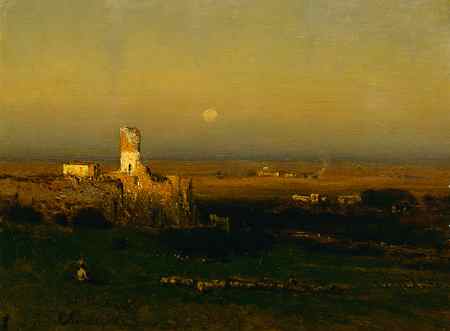 worked in Europe in the
late nineteenth and early twentieth centuries. As Europe became more accessible
to American artists after the Civil War (1861-65), many young painters desired
to experience the art and culture of the Continent. These bold artists made
the long journey across the Atlantic in hope of acquiring new techniques
and basking in the presence of masterpieces hanging on the walls of great
European museums. (right: George Inness, Campagna, Italian Landscape,
ca. 1875. Oil on wood panel. 9 5/8 x 12 7/8 inches. Frye Art Museum, 1960.005.)
worked in Europe in the
late nineteenth and early twentieth centuries. As Europe became more accessible
to American artists after the Civil War (1861-65), many young painters desired
to experience the art and culture of the Continent. These bold artists made
the long journey across the Atlantic in hope of acquiring new techniques
and basking in the presence of masterpieces hanging on the walls of great
European museums. (right: George Inness, Campagna, Italian Landscape,
ca. 1875. Oil on wood panel. 9 5/8 x 12 7/8 inches. Frye Art Museum, 1960.005.)
Many American artists returned to the United States familiar
with the latest art movements in Europe and with a renewed interest in forging
a uniquely American style. For example, armed with knowledge of French Impressionism
and its loose brushwork and light palette, artists like Childe Hassam and
John Twachtman were able to champion their vision of American Impressionism.
Exposure to German portraiture emboldened American painters like Frank Duveneck,
Robert Henri, and George Luks, who experimented with light, color, and bravura
brushwork involving thick, flowing brushstrokes. New approaches to landscape
painting were studied in academies in Düsseldorf and Munich by Albert
Bierstadt and Henry Raschen, who used German techniques to depict the undaunted
spirit of the American West. This exhibition also includes works by William
Merritt Chase, John White Alexander, Charles Sprague Pearce, and John Singer
Sargent, painters who experimented with the uncompromising Realism and Impressionism
they encountered in European art capitals, including Paris, London, and
Munich.
Some American artists found inspiration in established
academies such as the École des Beaux-Arts and Académie Julian
in Paris, the Royal Academy of Fine Arts in Munich, and the Düsseldorf
Art Academy. Others were drawn to the collective experiences of small art
colonies, like Duveneck's artist community in Polling, Bavaria, and the
famed sketching grounds in Dordrecht, Holland.
Inevitably, many of the painters in this exhibition crossed
paths: they visited each other in small villages, or sketched together in
classes at the academies. Their works would often be shown together in American
exhibitions, where critics compared their diverse interpretations of Continental
influences. They also participated in important European exhibitions, like
those of the Munich Secession and the Paris Salon, where Americans comprised
the largest national group of foreign artists. Together these artists freely
exchanged ideas, often returning to the United States with the desire to
paint their homeland with a bold reinterpretation of the techniques they
learned from their European peers.
Ties That Bind: American Artists in Europe is organized by the Frye Art Museum and curated by Jo-Anne Birnie
Danzker. The exhibition is funded by the Frye Foundation with the generous
support of Frye Art Museum members and donors. The exhibition is also supported
by a grant from the Seattle Office of Arts & Cultural Affairs. Seasonal
support of the Frye Art Museum is provided by 4Culture, Canonicus Fund,
and ArtsFund.
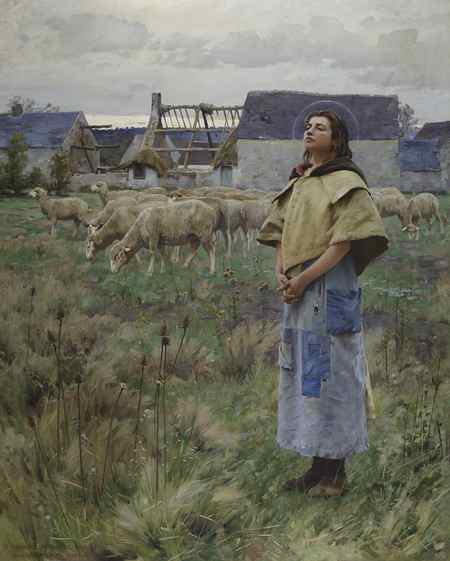
(above: Charles Sprague Pearce. Sainte Genevieve,
1887. Oil on canvas . 82 x 66 in. Courtesy of an anonymous lender. Photo:
Spike Mafford)
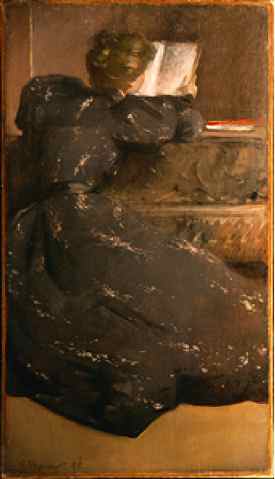
(above: John White Alexander. Woman in Black, 1896.
Oil on canvas. 40 _ x 22 _ inches. Frye Art Museum, 1998.001.)
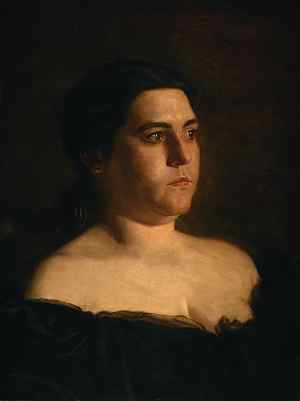
(above: Thomas Eakins, Maybelle (Mrs. Henry Walter Schlichter),
1898. Oil on canvas. 24 _ x 18 _ inches. Frye Art Museum, 1958.011.)
Checklist for the exhibition
- John White Alexander
- Woman in Black, 1896
- Oil on canvas
- 40 _ x 22 _ in.
- Frye Art Museum, 1998.001
-
- Albert Bierstadt
- Rainbow in the Sierra Nevada,
ca. 1871-73
- Oil on panel
- 18 x 24 in.
- Frye Art Museum, 1997.006
-
- Mary Stevenson Cassatt
- Little Eve, ca. 1902
- Pastel on paper
- Frye Art Museum, 1962.01
-
- William Merritt Chase
- Portrait of a Lady against Pink Ground (Miss Virginia
Gerson), ca. 1886
- Oil on canvas
- 72 x 36 in.
- Frye Art Museum,1969.007
-
- Frank Duveneck
- Henry Singlewood Bisbing,
ca. 1880-85
- Oil on canvas
- 23 x 19 in.
- Frye Art Museum, 1962.002
-
- Thomas Eakins
- Maybelle (Mrs. Henry Walter Schlichter), 1898
- Oil on canvas
- 24 _ x 18 _ in.
- Frye Art Museum, 1958.011
-
- Frederick Childe Hassam
- Parc Monceau, Paris, 1897
- Oil on canvas
- 24 1/8 x 17 _ in.
- Frye Art Museum, Charles and Emma Frye Collection, 1952.059
-
- Robert Henri
- The Stoker, 1910
- Oil on canvas
- 24 _ x 20 _ in.
- Frye Art Museum, 1958.009
-
- George Inness
- Campagna, Italian Landscape,
ca. 1875
- Oil on wood panel
- 9 5/8 x 12 7/8 in.
- Frye Art Museum, 1960.005
-
- Willard Leroy Metcalf
- Bank of the Seine, Giverny,
1888
- Oil on canvas
- 26 x 32 in.
- Frye Art Museum, 1969.006
-
- Willard L. Metcalf
- Auberge on the Road to Giverny,
1887
- Oil on canvas
- 13 x 16 in.
- Frye Art Museum Purchase, 1961.005
-
- Charles Sprague Pearce
- Sainte Genevieve, 1887
- Oil on canvas
- 82 x 66 in.
- Anonymous lender, IL 2011.011
-
- Henry Raschen
- The Deserted Camp, n.d.
- Oil on canvas
- 26 7/8 x 46 _ in.
- Frye Art Museum, Charles and Emma Frye Collection, 1952.134
-
- John Singer Sargent
- Mrs. Frederick William Roller,
1895
- Oil on canvas
- 88 _ x 44 5/8 in.
- Frye Art Museum, 1981.014
-
- John Henry Twachtman
- Dunes Back of Coney Island,
ca. 1880
- Oil on canvas
- 13 7/8 x 19 7/8 in.
- Frye Art Museum, 1956.010
-
- John Henry Twachtman
- Windmills, Dordrecht, ca.
1881
- Oil on panel
- 14 5/8 x 20 _ in.
- Frye Art Museum, 1977.014
-
- Thaddeus Welch
- Steep Ravine, Marin County, California, 1912
- Oil on canvas
- 26 x 46 _ in.
- Frye Art Museum, Charles and Emma Frye Collection, 1952.188
-
- James Abbott McNeill Whistler
- Head of Mrs. Beaumont, 1895
- Oil on canvas
- 14 _ x 12 _ in.
- Frye Art Museum, 1961.002
Editor's note: RL readers may also enjoy:
and biographical information on selected artists cited
in this article in America's Distinguished
Artists, a national registry of historic artists.
Read more articles and essays concerning this institutional
source by visiting the sub-index page for the Frye
Art Museum in Resource Library.
Search Resource
Library for thousands of articles and essays on American art.
Copyright 2012 Traditional Fine Arts Organization, Inc., an Arizona nonprofit corporation. All rights
reserved.