Editor's note: The Art Institute of Chicago provided
source material to Resource Library for the following article. If
you have questions or comments regarding the source material, please contact
the Art Institute of Chicago directly through either this phone number or
web address:
- 312-443-3600
- http://www.artic.edu/aic/index.html
They Seek a City: Chicago
and the Art of Migration, 1910-1950
March 3 - June 2, 2013
During the first half
of the 20th century, the city of Chicago was shaped and reshaped by waves
of migration and immigration as African Americans 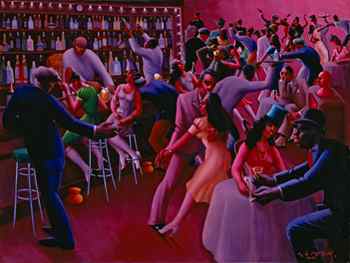 poured
in from the South and newcomers arrived from Europe and Mexico. To celebrate
these great migrations, the Art Institute of Chicago organized the first
exhibition to focus on the art produced by the diverse communities that
made Chicago their home. (right: Archibald John Motley, Jr. Nightlife,
1943. Restricted gift of Mr. and Mrs. Marshall Field, Jack and Sandra Guthman,
Ben W. Heineman, Ruth Horwich, Lewis and Susan Manilow, Beatrice C. Mayer,
Charles A. Meyer, John D. Nichols, and Mr. and Mrs. E.B. Smith, Jr.; James
W. Alsdorf Memorial Fund; Goodman Endowment. © Chicago History Museum.)
poured
in from the South and newcomers arrived from Europe and Mexico. To celebrate
these great migrations, the Art Institute of Chicago organized the first
exhibition to focus on the art produced by the diverse communities that
made Chicago their home. (right: Archibald John Motley, Jr. Nightlife,
1943. Restricted gift of Mr. and Mrs. Marshall Field, Jack and Sandra Guthman,
Ben W. Heineman, Ruth Horwich, Lewis and Susan Manilow, Beatrice C. Mayer,
Charles A. Meyer, John D. Nichols, and Mr. and Mrs. E.B. Smith, Jr.; James
W. Alsdorf Memorial Fund; Goodman Endowment. © Chicago History Museum.)
They Seek a City: Chicago and the Art of Migration,
1910-1950 features more than 80 works created primarily
by Southern- and foreign-born artists such as Margaret Burroughs, Eldzier
Cortor, Walter Ellison, Todros Geller, Stanislaw Szukalski, and Morris Topchevsky
-- many rarely seen by the museum's audiences. The exhibition draws on an
extensive core of paintings, prints, sculptures, photographs, and books
from the Art Institute's permanent collection, and is enhanced by works
borrowed from local private collectors and institutional lenders, among
them the historically significant South Side Community Art Center and the
Jane Addams Hull-House Museum. On view from March 3 through June 2, 2013,
They Seek a City is a survey of Chicago's rich art of migration and
demonstrates how the city became the polyglot, cosmopolitan place that it
remains today.
The story of Chicago has always revolved around the movement
of people. As a city made great by a network of railroads fanning out in
every direction, Chicago developed in the 19th century as the Midwestern
capital of industry and retail, eclipsing older, more established cities.
After the catastrophic fire of 1871 destroyed over three square miles of
downtown and nearby neighborhoods, civic leaders vowed to rebuild on a grander
scale. Meatpacking companies such as Armour & Company drove the growth
of the city, prompting a demand for labor that was filled by the arrival
of thousands of immigrants and migrants. This rebirth also contributed to
the cultural advancement of the city: philanthropists such as Martin Ryerson,
Henry Field, and Potter Palmer appreciated the value of a flourishing artistic
community, and through their efforts, the Art Institute of Chicago developed
its world-renowned collection and the School of the Art Institute established
itself as a preeminent art academy. 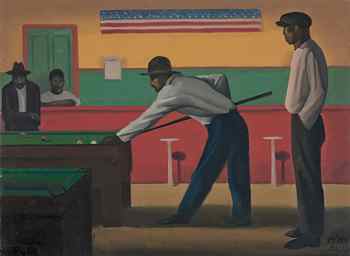
The vibrancy of Chicago's artistic scene in the period
from 1910 to 1950 depended on the complex interchange of immigration, migration,
industry, and the arts. European immigrants -- particularly Eastern European
Jews fleeing political and religious persecution -- poured into the city
between 1880 and 1920, when newly enacted Congressional immigration quotas
began closing U.S. borders to many. As European immigration slowed, the
city's industries demanded new sources of labor, particularly during World
War I. The demand was soon filled by new arrivals, particularly Southern-born
African Americans and Mexicans, who became integral to the city's growth.
(left: Herman Menzel. Mexican Pool Room, S. Chicago #2 (with Bunting),
1927. Private Collection.)
They Seek a City celebrates
the art produced by these newcomers. Immigration and migration, assimilation
and alienation were topics that resonated with artists as they sought to
establish new lives in a strange city. Although many of Chicago's artists
were social realists who worked in a figurative tradition, avant-garde art
by European immigrants also played a role in the city's changing cultural
life. Despite sometimes-divergent methods, there was an overarching sense
of artistic community, as artists crossed ethnic and racial boundaries,
linked by shared institutional affiliations, political beliefs, and aesthetic
outlooks.
By examining the art of the city through the lens of migration,
They Seek a City not only traces Chicago's rich and dynamic cultural
development, but also explores some of the most important social and artistic
questions of the early 20th century, including the intersecting issues of
racial and cultural identity.
Catalogue
They Seek a City is accompanied
by a fully illustrated, 116-page catalogue. The book, by Sarah Kelly Oehler,
the Henry and Gilda Buchbinder Associate Curator of American Art at the
Art Institute of Chicago, features 85 color and 10 black-and-white illustrations,
plus five scholarly chapters that explore Chicago and the art of migration.
The catalogue, published by the Art Institute and distributed by Yale University
Press, is available at Art Institute's Museum Shop.
Exhibition organizer
They Seek a City: Chicago and the Art of Migration,
19101950 is organized by the Art Institute
of Chicago and curated by Sarah Kelly Oehler, the Henry and Gilda Buchbinder
Associate Curator of American Art at the Art Institute of Chicago.
Selected related programs
A Seminar titled They Seek a City is being held
April 6, 2013 at the Institute. Four specialists will discuss selected works
featured in the exhibition They Seek a City: Chicago and the Art of Migration,
1910-1950:
-
- "The Great Migration and Culture Workers: The Making
of the Black Chicago Renaissance"
- Darlene Clark Hine, Northwestern University
-
- "African American Artists and the Art Institute
during the Great Migration"
- Daniel Schulman, author and curator
-
- "Repairing the World: Jewish Artists in Chicago"
- Susan Weininger, Roosevelt University
-
- "Better Selves and Better Futures: The Promise of
the Paragon"
- Amy Mooney, Columbia College Chicago
A gallery talk concerning the exhibition will be held at
the Institute April 11, 2013
Editor's note: RL readers may also enjoy:
For biographical information about artists mentioned in
this article please see America's Distinguished
Artists, a national registry of historic artists
Read more articles and essays concerning this institutional
source by visiting the sub-index page for the Art
Institute of Chicago in Resource Library.
Search Resource
Library for thousands of articles and essays on American art.
Copyright 2013 Traditional Fine Arts Organization, Inc., an Arizona nonprofit corporation. All rights
reserved.