Editor's note: The Washington County Museum of Fine Arts provided source material to Resource Library for the following article. If you have questions or comments regarding the source material, please contact the Washington County Museum of Fine Arts directly through either this phone number or web address:
Ian Hornak: Transparent Barricades
June 1 - October 13, 2013
This retrospective exhibition of the artist Ian Hornak (1944 - 2002) is made possible through the efforts of the Ian Hornak Foundation, multiple public and private collections, and the Washington County Museum of Fine Arts.
Hornak's artistic talent was visible at an early age. His earliest works show influences of the high renaissance masters, such as Leonardo and Michelangelo, whose drawings and paintings he saw in a book about the Old Masters given to him by his mother. The technical skills he learned from emulating the masters work is visible in Hornak's art throughout his career.
Hornak's realism was counter to the abstract expressionist movement popular in the 1960s, but he resisted pressure from teachers and other artists to work in a non-representational style. He continued in the realist tradition even after moving to New York City in 1968 where he became close friends with some of the leading abstract and pop artists, Willem de Kooning, Robert Indiana, Andy Warhol, and Robert Motherwell.
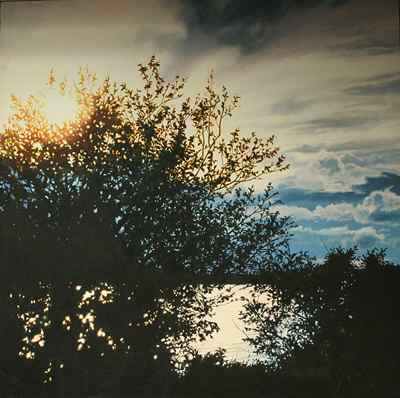
One of Hornak's signature styles was the technique of transposing multiple photographs of a landscape into one painting. Using photographs he took during his travels as inspiration, Hornak layered the images to create multiple exposure landscape paintings. The resulting paintings display both surrealism and romanticism and brought critical acclaim to the artist in the 1970s.
In the mid-1980s, Hornak began adding "painted frames" -- flat, wood borders that he would use to expand the imagery of the canvas. He used these painted frames in his landscapes and to create a different type of multiple exposure painting. Hornak, also employed "painted frames" when he began experimenting with still life painting in the late-1980s. His still lifes show a reverence for Flemish and Dutch masters and portray a keen sense of design and openness to vibrant color.
Hornak continued to paint and create new, imaginative works until his untimely death in 2002 at the age of fifty-eight. Today, he is recognized as one of the founding artists of the hyperrealist movement and his work is included in many public and private collections.
This retrospective exhibition of the artist Ian Hornak (1944 - 2002) is made possible through the efforts of the Ian Hornak Foundation, multiple public and private collections, and the Washington County Museum of Fine Arts.
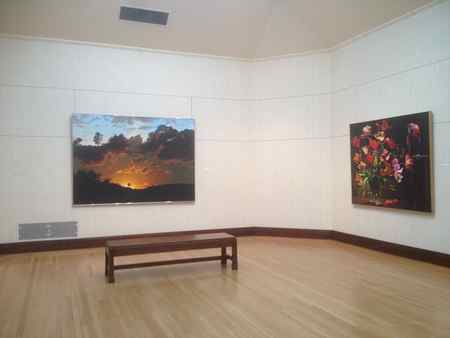
(above: View of Ian Hornak works on display in a gallery at Washington County Museum of Fine Arts. Photo courtesy Washington County Museum of Fine Arts)
Exhibition List
Resource Library editor's note
RL readers may also enjoy:
For biographical information on artists referenced in this article please see America's Distinguished Artists, a national registry of historic artists
Read more articles and essays concerning this institutional source by visiting the sub-index page for the Washington County Museum of Fine Arts in Resource Library.
Search Resource Library for thousands of articles and essays on American art.
Copyright 2013 Traditional Fine Arts Organization, Inc., an Arizona nonprofit corporation. All rights reserved.