Editor's note: The Bruce Museum provided source
material to Resource Library for the following article or essay.
If you have questions or comments regarding the source material, please
contact the Bruce Museum directly through either this phone number or web
address:
Telling American History:
Realism from the Print Collection of Dr. Dorrance T. Kelly
August 31, 2013 - December 1, 2013
Highlighting the work
of nine American artists who at the beginning of the twentieth century were
inspired by the world around them to realistically depict 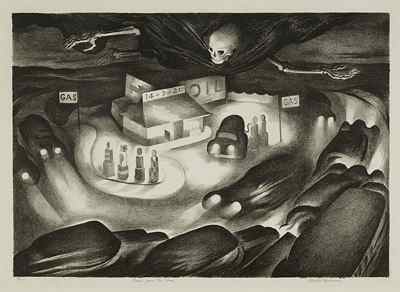 everyday scenes, the Bruce Museum presents the new exhibition
Telling American History: Realism from the Print Collection of Dr. Dorrance
T. Kelly from August 31 through December 1, 2013. (right: Benton
Murdoch Spruance (American, 1904-1967), Road from the Shore, 1936,
Lithograph. 10 x 14 1/4 inches. Collection of Dr. Dorrance T. Kelly. Courtesy
of Dolan/Maxwell)
everyday scenes, the Bruce Museum presents the new exhibition
Telling American History: Realism from the Print Collection of Dr. Dorrance
T. Kelly from August 31 through December 1, 2013. (right: Benton
Murdoch Spruance (American, 1904-1967), Road from the Shore, 1936,
Lithograph. 10 x 14 1/4 inches. Collection of Dr. Dorrance T. Kelly. Courtesy
of Dolan/Maxwell)
The show features more than 40 original fine art prints
including lithographs and etchings that chronicle daily life -- the bustle
of urban streets, boisterous moments of leisure, modern modes of transportation,
and bucolic rural images -- by leading artists who approached their subject
matter through the lens of realism: George Bellows (1882-1925), Thomas Hart
Benton (1889-1975), Edward Hopper (1882-1967), Martin Lewis (1881-1962),
Reginald Marsh (1898-1954), John Sloan (1871-1951), Benton Murdoch Spruance
(1904-1967), Stow Wengenroth (1906-1978), and Grant Wood (1891-1942).
"Each print featured in the exhibition was chosen
for its subject matter and artistic merit," notes Diane Myers, the
exhibition's curator and former Bruce Museum Manager of School & Tour
Services. "Placed together, they present windows into scenes of America's
past, creating opportunities for us to reflect on the art and history that
came before us."
The artworks present visitors with a snapshot of America
from 1905 through 1967. Set amid a backdrop of events such as World War
I, the Great Depression, New Deal programs, and World War II, the country
was experiencing changes in its cultural, geographic, and demographic nature.
The nation experienced a great upheaval as citizens and immigrants alike
flocked to urban areas in hopes of greater economic prospects. At the same
time, advances in technology and transportation were transforming rural
regions.
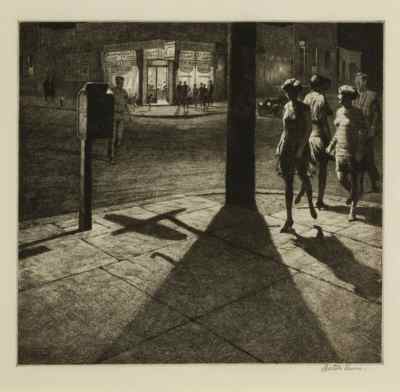 "All of these elements shaped the
work of the artists featured in this exhibition," Myers explained,
"although each chose to depict his experiences in a slightly different,
but still realistic, manner." (left: Martin Lewis (American,
1881-1962), Corner Shadows, 1930, Drypoint and sandpaper ground,
8 1/8 x 9 inches. Collection of Dr. Dorrance T. Kelly. ©Estate of Martin
Lewis)
"All of these elements shaped the
work of the artists featured in this exhibition," Myers explained,
"although each chose to depict his experiences in a slightly different,
but still realistic, manner." (left: Martin Lewis (American,
1881-1962), Corner Shadows, 1930, Drypoint and sandpaper ground,
8 1/8 x 9 inches. Collection of Dr. Dorrance T. Kelly. ©Estate of Martin
Lewis)
Drawn from different areas of the country, the artists
shared a similar goal of creating artwork that was available to all. They
embraced realism, using it to capture images of modern American society
as it quickly changed around them and distinguishing their work from the
traditional, idealized and romanticized work of European art.
"By illustrating everyday scenes, the artists featured
here created connections for the average American and invited them to become
part of the artistic dialog," Myers said."Their images not only
appealed through accessible subject matter, but also appealed to the pocketbook
of the everyday person."
Addressing the relevance of this art to 21st century viewers,
Myers observes, "The prints bring the same accessibility to today's
audiences as they did when they were first created."
Telling American History: Realism from the Print Collection
of Dr. Dorrance T. Kelly is the third show in the
past three years that the Bruce Museum has organized from the collection
Dr. Kelly, whose holdings include European prints from the 15th through
19th centuries and American prints from the 19th and 20th centuries.
A fully illustrated catalogue of the show will be available
in the Bruce Museum Store. A series of public programs will be offered to
complement the show, including Monday morning lectures, hands-on printmaking
workshops for adults and students, a program for families with toddlers
and one for seniors suffering from memory loss, as well as school tours.
The exhibition is supported by the Charles M. and Deborah
G. Royce Exhibition Fund and a grant from the Connecticut Humanities Council,
Inc. Connecticut Humanities (CTH) is a non-profit affiliate of the National
Endowment for the Humanities that funds, creates and collaborates on hundreds
of cultural programs across Connecticut each year. Connecticut Humanities
brings together people of all ages and backgrounds to express, share and
explore ideas in thoughtful and productive ways. From local discussion groups
to major exhibitions on important historical events, CTH programs engage,
enlighten and educate.
Public Programs
A series of public programs will be offered to complement
the exhibition, including lectures, print workshops for adults and students,
a program for families with toddlers, and school tours. These programs
are supported by a grant from the Connecticut Humanities Council, Inc. Please
call the museum for information about reservations and applicable fees.
- Monday Lecture Series: Telling American History
through Imagery in Prints
- Mondays, September 30, October 7, 14, 21, 2013, 10:00
am
- A series of four lectures presented in conjunction with
the exhibition. Lectures will provide the historical and biographical
context that informed the artists' work as well as the history and role
of printmaking in the overall work of each artist presented in the series.
Fee.
-
- September 30
- The Realists' World: American Life at the Turn of
the Twentieth Century
- Michael Willrich, PhD, Professor of History, Brandeis
University
- Dr. Willrich will provide an historical overview of America
in the first quarter of the 20th century.
-
- October 7
- John Sloan and the Ashcan School
- Michael Lobel, PhD, Professor of Art History, SUNY Purchase
- Dr. Lobel will discuss the work of Sloan in context
of the Ashcan School and the advent of urban realism in American art.
-
- October 14
- Prints for the Public: Thomas Hart Benton and Associated
American Artists
- Justin Wolff, PhD, Associate Professor of Art History,
University of Maine
- Dr. Wolff will speak on Thomas Hart Benton's prints and
printmaking, in particular on his relationship with Associated American
Artists, which distributed his lithographs to the public in a variety of
innovative ways.
-
- October 21
- Edward Hopper in the 1920s
- Gail Levin, PhD, Distinguished Professor of Art History,
Graduate Center CUNY.
- Dr. Levin will discuss Edward Hopper's foray into printmaking
in the context of his art and life. The talk will include a discussion
of paintings he made during the 1920s.
-
- Look and See: See America through Prints
- Wednesday, October 2, 12:30 - 1:15 pm
- A program especially designed for children ages 3-5 years
and their adult caregivers, who will explore the Museum's exhibition through
hands-on experiences, stories and more. Children will explore the exhibition
and then make their own prints. Fee.
-
- Printmaking Workshops for Adults and Students
- The Museum presents a series of hands-on art workshops
where participants will explore the exhibition, discuss themes and printmaking
techniques, and then create their own solar-plate intaglio prints.
Each workshop is a complete program. These inclusive workshops are suitable
for people of all abilities. Fee.
-
- Lifetime of Looking: Recalling American History through
Prints
- Thursday, October 17, 1:00 - 2:30 pm
- For Senior Citizens and their Caregivers
- A program especially designed for senior citizens and
their caregivers who will explore the exhibition with Museum educators
to provide meaningful cultural experiences and personal enrichment. A voluntary
craft project and refreshments are included.
-
- Diane Darst Learning to Look® Family Art Appreciation
Day
- Sunday, November 17, 1:00 - 3:00 pm
- This program is designed especially for families and
children to foster appreciation and understanding of art related to current
Museum exhibitions and based on the Learning to Look® curriculum developed
by Diane W. Darst and Sue Ann Massey Williamson. Today's program will be
presented in conjunction with the Bruce Museum exhibition Telling American
History: Realism from the Print Collection of Dr. Dorrance T. Kelly.
The lessons will be led by Learning to Look Instructor beginning at 1:15
pm, repeated at 2:15 pm, and will focus on portraiture. There
will be printmaking activities in the Education Workshop.
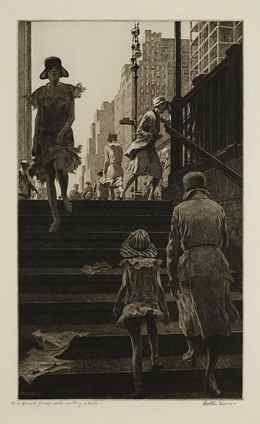
(above: Martin Lewis (American, 1881-1962), Subway Steps,
1930, Drypoint. Collection of Dr. Dorrance T. Kelly. © Estate of Martin
Lewis)
Resource Library readers may also enjoy:
and biographical information on selected artists cited
in this article in America's Distinguished
Artists, a national registry of historic artists.
Read more articles and essays concerning this institutional
source by visiting the sub-index page for the Bruce
Museum in Resource Library.
Search Resource
Library for thousands of articles and essays on American art.
Copyright 2013 Traditional Fine Arts Organization, Inc., an Arizona nonprofit corporation. All rights
reserved.