Editor's note: Casa Romantica Cultural Center and
Gardens provided source material to Resource Library for the following
article. If you have questions or comments regarding the source material,
please contact Casa Romantica directly through either this phone number
or web address:
The Color of San Clemente
October 8 - November 17, 2103
Casa Romantica Cultural
Center and Gardens has inaugurated new visual arts programming through its
presentation of a one-man show by San Clemente artist 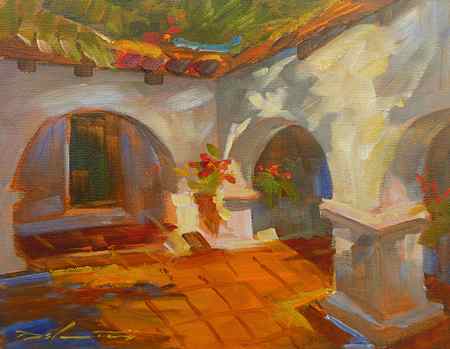 Rick
J. Delanty. The show's theme is "The Color of San Clemente," which
opened on October 8, 2013 and continues through November 17, 2013. This
will be the inaugural show for the "Open Casa" program of visual
artists that executive director Berenika Schmitz has designed to initiate
her new programming direction at the Casa. Delanty will be the first artist
in a series of three artists to be exhibiting in one-person shows at the
Casa during the upcoming year. (right: Rick J. Delanty, THE GOLDEN
CASA, 2013, 8 x 10 inches, acrylic on board, collection of the artist.)
Rick
J. Delanty. The show's theme is "The Color of San Clemente," which
opened on October 8, 2013 and continues through November 17, 2013. This
will be the inaugural show for the "Open Casa" program of visual
artists that executive director Berenika Schmitz has designed to initiate
her new programming direction at the Casa. Delanty will be the first artist
in a series of three artists to be exhibiting in one-person shows at the
Casa during the upcoming year. (right: Rick J. Delanty, THE GOLDEN
CASA, 2013, 8 x 10 inches, acrylic on board, collection of the artist.)
Ms. Schmitz says about the artist, "Rick has been
living and working as a professional artist and educator for decades in
this community. Inspired by that intimate knowledge, he has recently created
a body of original paintings of this city and region that is both varied
and spectacular." She also notes that artwork will be available for
purchase, with partial proceeds being donated by the artist to the Casa.
The artist's subtitle for the presentation is "A Collection
of Original Paintings of San Clemente and Its Surrounding." That "essence
of San Clemente" is the subject of this exhibit of thirty-five paintings.
"It is my intention to communicate in these artworks the light, freedom,
peace, and color that characterize this 'Spanish Village by-the-Sea."
Inspired by his intimate experience with this area, Delanty
has recently created a body of paintings that reflect both his observations
and feelings about this coastal community. "I've drawn and painted
in many locales throughout the United States, Mexico and Europe," says
the artist, "and it seems that every place has its own 'color character.'
For example, the California impressionists, such as William Wendt, Franz
Bischoff, and Guy Rose, came to southern California in the 30's because
they all sensed a unique, warm light that infused an entirely different
quality to their paintings of sunlight than those that were being created
elsewhere in the world. To them, the light on the landscape was more similar
to that in Italy, or the south of France. In putting together images for
this show, I have been discovering for myself the unique color palette of
San Clemente. When painting here, I am often reaching for burnt sienna,
all kinds of green, phthalo, blue, oranges and yellows."
As he selected images for his paintings, Delanty had in
mind the vision that the founder of the city of San Clemente, Ole Hanson,
described in 1925: "I envision a place where people can live together
more pleasantly than any other place in America. I have a clean canvas and
I am determined to paint a clean picture. Think of it -- a canvas five miles
long and one and a half miles wide."
"For myself," the artist concludes, "I hope
to elevate public consciousness with this show regarding the value of these
resources, and the importance of preventing them from disappearing altogether."
About the artist
Rick J. Delanty is a California native, and graduated from
UC Santa Barbara with degrees in English literature and studio art. He is
the recipient of several local, regional and national awards, and has been
selected six times to both the Laguna Festival of Arts and the Laguna Beach
Plein Air Painting Invitational. He is a Signature member of both the Laguna
Plein Air Painters Association and the International Society of Acrylic
Painters, as is active in Christians in the Visual Arts (CIVA). He is also
a writer for the Oil Painters of America, and an organizing committee member
for the Orange County Chapter of the California Art Club.
During the last forty years in San Clemente, Delanty has
combined thirty-two years of teaching painting and drawing courses at San
Clemente High School with a career as a professional fine artist.
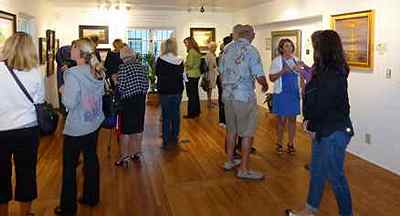
(above: Artist's reception for Rick J. Delanty's solo
exhibition "The Color of San Clemente" at Casa Romantica Cultural
Center and Gardens. Photo by Lynn Delanty)
Artwork labels from the exhibition
-
- Rick J. Delanty, HEAVEN'S CURTAIN, 2013, 36 x
36 inches, acrylic on canvas, courtesy of Bill and Joan Ray.
- If heaven had a doorway, this is how I imagine it to
be.High above the earth, at an elevation high, bright, and nearly unimaginable.
- "The Lord's throne is in heaven--the Lord is
in His holy temple."
- --Psalm 11:4
-
- This painting was inspired by the passing of Terry Martin,
a widely-renown surfboard shaper. In the surfing industry, there was not
anyone he did not know. And the Lord knew him, and he knew the Lord. When
he passed, I wanted to paint the door that I believe his spirit went through,
on the way to the perfect world, the kingdom of God.
-
-
-
- Rick J. Delanty, CASA ATRIUM, 2013, 30 x 40 inches,
acrylic on canvas, courtesy of the Casa Romantica.
-
- In 1928, the founder of San Clemente, Ole Hanson, built
this home for his family, and lived here until 1937, when he sold it as
a result of the impact of the Depression on his real estate business. Tiled
loggias, or vaulted corridors, lead away from the keyhole-shaped doorway,
once a sign of authority and importance in Spain. There once existed a
reflecting pool in the center courtyard that was home to baby Mexican alligators.
The building is now owned by the City of San Clemente, and is the setting
for the Casa Romantica Cultural Center and Gardens.
-
-
-
- Rick J. Delanty, COTTON'S KAYAKS, 2013, 24 x 30 inches,
acrylic on canvas, collection of the artist.
-
- Near Cotton's Point are the two "farthest-south"
housing communities in San Clemente, Cyprus Cove and Cyprus Shore, both
of which use the beach there extensively. On this plein air trip to Cotton's,
I had not expected to see my painting subject strewn across the sand in
front of me, as these kayaks were. Immediately I wanted to create this
image that captured some of the chief features of this seaside paradise,
including its history, light and air, and the prominence of recreation,
and the opportunities for a healthy lifestyle. This painting was begun
on location, and completed in the
- studio.
-
-
-
- Rick J. Delanty, CYPRUS SHORES POND, 2013, 16
x 20 inches, acrylic on canvas, collection of the artist.
-
- This gem of a park is located in a secluded area enjoyed
exclusively by the residents of Cyprus Shore and Cyprus Cove. In 1927,
when Hamilton Cotton owned 110 acres in this area, he built and landscaped
the park and Fish pond, where he entertained his guests at lawn parties.
Today the palms and cypress trees frame the breaking surf, and serve as
remarkable backdrops for get-togethers, weddings, and private meditation.
-
-
-
- Rick J. Delanty, ATMOSPHERE, COTTON'S POINT, 2013,
24 x 48 inches, acrylic on canvas, collection of the artist.
-
- "Cotton's" is a significant landscape and historical
feature at the southern tip of San Clemente, at the dividing line between
Orange and San Diego Counties. It is near the edge of Camp Pendleton Marine
Base and right around the corner from one of the most renown surfing beaches
in the world, Trestles. It was the site of the western White House when
former President Richard Nixon was in office, in the home built there by
Hamilton Cotton, who helped Ole Hanson financially and literally put San
Clemente on the map. Nixon purchased that home in 1969 and named it "Casa
Pacifica." It was owned until recently by Gavin Herbert, who was a
dedicated supporter of the Casa Romantica. Surfing is often good just off
the point, and views down to San Diego on clear days are spectacular.
-
-
-
- Rick J. Delanty, SUNSET COAST, 24 x 48 inches,,
2013, acrylic on canvas, collection of the artist
-
- I was intent on capturing the city from above, including
the natural and Man-made elements that, for me, define the unique character
of San Clemente. One evening I drove up Avenida Presidio, just before a
breath-taking sunset. From the hood of my car midway up the hill, I created
a drawing of the hills, trees, ocean, the I-5 artery, Dana Point, and St.
Andrews United Methodist Church overlooking it all. The painting was created
from the drawing -- it's about home and community, and the spiritual essence
of living in a place where neighbors care about each other.
-
-
-
- Rick J. Delanty, TRESTLES AND COBBLES, 2012, 24
x 72 inches, acrylic on canvas, private collection .
-
- The title of this painting reflects the science behind
the natural and aesthetic power and beauty of the right-and-left-breaking
waves at Lowers, which is a point break with a cobbled-rock-and-sedimentary
bottom. The gradual build up of the wave begins a mile out, and is a magnet
for swells. With a head-high swell, rights at Lowers can go for a hundred
yards.
- -- Courtesy Kurt Snibbe, Orange County Register
-
-
- Rick J. Delanty, WAITING FOR THE HEAT (The Hurley
Pro), 2013, 16 x 20 inches, acrylic on board, collection of the artist.
-
- I definitely wanted to show surfing as part of my "journal
of San Clemente in paint." Huntington Beach and San Clemente have
had wars in the press in the past concerning whether that city or this
one should receive the official designation "Surf City USA."
And we've had so many pros on the world circuit grow up here surfing in
these breaks (Andino, Yeomans, Gudauskas brothers), especially on those
perfect breaks at Trestles. So this past month I took my plein air kit
to the beach on my bike and set up just north of the tent-craziness that
was Hurley Pro 2013. There was a lot of waiting: waiting for the perfect
surf, waiting to park all the cars up on the bluffs, waiting for event
to start, waiting for the athletes to paddle out for the next heat. So
in the midst of all that activity, I chose a moment that, to me, is so
characteristic of part of this event: the waiting.
-
-
-
- Rick J. Delanty, THE GOLDEN CASA, 2012, 8 x 10
inches, acrylic on board, collection of the artist.
-
- The Casa is a textbook example of Spanish Colonial Revival
architecture, which was such a significant piece of city founder Ole Hanson's
vision for the aesthetic of San Clemente. The style was born as a result
of the Panama-California Exposition in San Diego in 1915-16, and became
a style movement in the U.S. through 1934, taking off first in Florida
and California. Exterior elements that define this style include: curves
and arches; roughly-textured white stucco walls; painted tiles; terra cotta
roof tiles; ornamental iron work; courtyards; arcades (arches supported
by columns); and, of course, the outdoor fireplace.
-
-
-
- Rick J. Delanty, HOME BY SUNSET, 2013, 12 x 12
inches, acrylic on canvas, collection of the artist.
-
- From the hills above Spanish Village and the local high
school, there is this wondrous view of lights coming on in homes just before
sunset, and the line of headlights coming into the city on the Interstate
and Avenida Pico. The city is San Clemente, named by its founder Ole Hanson,
in reference to "San Clemente Island," located about 50 miles
off the coast. This island of San Clemente was first named by its discoverer,
Vizcaino, who spotted it on November 23, 1602. For Vizcaino, his patron
saint for that date was Saint Clement. San Clemente, then, owes its name
to an explorer, a saint, and an island.
-
-
-
- Rick J. Delanty, AVENIDA DEL MAR, 2013, 16 x 12
inches, acrylic on board, collection of the artist.
-
- "The Avenue of the Sea" is the main shopping
street and thoroughfare to the beach. Pictured here is the Library's clock-tower,
and the historic City Hall at the far end of the street. Built in 1929,
the City Hall building at 101 S. El Camino Real was designed by Virgil
Westbrook in a Spanish Moorish style. It was also
the site of the judge's office and city jail. The building now houses commercial
offices, and contains one of the town's finest Spanish- tiled stairways.
-
-
- Rick J. Delanty, LOST WINDS LIGHT, 12 x 16 inches,
acrylic on canvas, collection of the artist.
-
- A stretch of beach south of the Trafalgar Street overcrossing
is often referred to by locals as "Lost Winds," probably a mutation
of the nearby street name, Calle Lasuen, on the bluffs. That street was
named after a Franciscan, Fray Fermin Lasuen (1736-1803) who has been called
the "forgotten friar," as he is not generally known for having
governed the California mission system 3 years longer than his more famous
predecessor, Padre Junipero Serra. In fact, Fray Lasuen helped establish
Mission San Juan Capistrano.
-
-
-
- Rick J. Delanty, HQ, 2012, 11 x 14 inches, acrylic
on board, collection of the artist.
-
- Built in 1967, this structure houses a staff of lifeguards
that over the years has included swimming, surfing, waterpolo, triathlon,
and waterman champions. The guards average 1,200-1,500 rescues annually,
over a stretch of beach extending one mile on either side of the pier.
From Tower Zero, visible in the painting on the pier, a lifeguard scans
swimmers and surfers with binoculars, and dispatches jeeps and guards to
emergency situations. Eight beach towers, two trucks, and a boat help guards
to efficiently patrol this area. Surfing conditions are consistent here,
due to the southwest
- orientation of the beach. Summer water temperatures average
68 degrees.
-
-
-
- Rick J. Delanty, FRIDAY NIGHT LIGHTS, 11 x 14
inches, acrylic on board, collection of the artist.
-
- The nocturne paintings of Frederic Remington and Charles
Rollo Peters intrigue me with their depth, atmosphere, and the magical
quality that Night lends to the landscape. This piece was begun at a picnic
table near the pier, and finished in the studio. As I painted shapes and
colors, I was thinking of the way we naturally see, straight ahead, at
the periphery of our vision, and at the area of greatest focus and visibility.
Color and size of accents was my primary concern in the final stages.
-
-
-
- Rick J. Delanty, MUNI, 13TH HOLE, 2013, 12 x 24
inches,, acrylic on canvas, collection of the artist.
-
- The San Clemente Municipal Golf Course was originally
built by renown golf course architect, William Bark Bell, on land donated
by city founder Ole Hanson. The original course consisted of nine holes
on opening day in 1927, with what is now the back nine added in 1955. The
golf course boasts magnificent ocean and city panoramas. It now hosts over
120,000 rounds of golf per year, making it one of the most popular eighteen
hole golf courses in the world.
-
-
- Rick J. Delanty, CASA MEMORIES, 2012, 8 x 10 inches,
acrylic on board, collection of the artist.
-
- The Casa was built in 1927 for Ole Hanson and his eight
children. There were 7 bedrooms and bathrooms, and 7,200 square feet of
interior space. The home was designed by Carl Lindbom, who also designed
La Casa Pacifica for Hamilton Cotton on Cotton's Point. There was
a reflecting pool in the courtyard where the lawn is today. The Hansons
lived in the home until 1933, when the bank foreclosed on the property.
It was sporadically rented until 1945, when Lambert Schuyler purchased
it and named it Casa Romantica. The Schuyler family lived here until 1952.
That year Mrs. Fred Waring purchased it, and sold it in 1956 to the Whitehouses,
who renamed it "Casa Blanca." In 1958, Tom Sanford bought the
home as an investment, then sold it to George and Louise Welsh in 1960,
who turned it into a retirement home. The Welsh family owned it until 1989.
The home was then alternately vacant, a site for a wedding business, and
proposed for use as a Mexican restaurant. In 1989, The City of San Clemente
purchased Casa Romantica for 2.4 million.
-
-
-
- Rick J. Delanty, FROM AFAR, TRESTLES, 2012, 30
x 40 inches, acrylic on board, collection of the artist.
-
- Trestles and San Onofre beaches have been nominated by
Surfrider Foundation to the National Register of Historic Places as the
"Trestles Historic District." That 2.25 mile-long beach zone
lies within the jurisdiction of Camp Pendleton, and is a State Park by
virtue of a lease from the Department of the Navy that expires in 2021.
The parkland at San Onofre includes not only Trestles, but La Cristianita
monument located along San Mateo Creek (the feeder stream to Trestles)
, site of the first Christian baptism in Alta California in 1769.
-
-
-
- Rick J. Delanty, THE BEACON, 2013, 24 x 30 in.,
acrylic on linen, private collection.
-
- The original "fishing and pleasure pier" was
a gift to the people of San Clemente from the town's founder, Ole Hanson.
It was first built in 1928 at a cost of $75,000. Jutting into the ocean
1200 feet, the pier is based on a 3,000-foot stretch of beach that was
also donated by Mr. Hanson.The structure was almost totally destroyed by
storm activity, and then re-built in 1939. In 1978, the pier was completely
renovated. Today it is the focus of surfing events, fishing contests, Independence
Day fireworks, a chowder cook-off, the annual summertime Ocean Festival,
and dining at the Fisherman's Restaurant.
-
-
-
- Rick J. Delanty, INTO THE LIGHT, 2013, 24 x 24
in., acrylic on canvas, private collection.
-
- Tower Zero is the only tower in the city that is staffed
with lifeguards year-round. The lifeguard in charge is the master lookout,
involved in any operational decision that can be observed from that vantage
point. Assignment to the tower is based on prior job performance. On the
Fourth of July the tower is opened at 6 a.m., and stays open until 10:30
at night for the fireworks display. In the summer months, from approximately
11 a.m. to 4 or 5 p.m., depending on the conditions, two lifeguards man
the tower and split the area visually. A single guard mans the tower during
the winter months.
- --Interview with lifeguard Ian Burton, courtesy Fred
Swegles in the OC Register
-
-
- Rick J. Delanty, PERIHELION, 2012, 24 x 24 inches,
acrylic on canvas, collection of the artist.
-
- The Perihelion is the point in the orbit of a planet,
asteroid, or comet where it is nearest to the sun.(Greek, "peri"
near and "helios," sun). All planets, comets and
asteroids in our solar system have elliptical orbits. Thus, they all have
a closest and a farthest point from the sun: a perihelion and an
aphelion. Earth comes closest to the sun every year around January
3 (about 146 million kilometers). It is farthest from the sun every year
around July 4 (about 150 million kilometers).
-
-
- Rick J. Delanty, TRAIL TWO, 2012, 16 x 20 inches,
acrylic on board, collection of the artist.
-
- Six trails make up the San Onofre State Beach parkland,
south of the popular San Onofre surfing beach.The park lies on the edge
of the Santa Ana Mountains, along the Pacific Ocean. Its habitats and terrains
vary from flat, sandy beaches to sheer coastal cliffs, marshes to alluvial
floodplains, and prairies to rolling foothills. Spectacular vertical terraces,
nearly 100 feet tall, form the beachside bluffs.
- -- courtesy of the website for San Onofre Foundation
-
-
-
- Rick J. Delanty, TRAIL THREE, 16 x 16 inches,
2013, acrylic on board, collection of the artist.
-
- Trail 3 is one of the six Trails located along the beach
running from San Onofre State south to the edge of Camp Pendleton. It is
part of San Onofre State Beach park. The bluffs above this beautiful and
remote beach are a popular spot for roadside campers. It was also a popular
surfing spot where a very well-liked San Clemente High School math teacher
and cross-country coach, Jeff Spear, used to take his family. It is the
perfect spot for surfing, meditation, alone-time, and painting.
-
-
-
- Rick J. Delanty, OUTPOST, 2013, 10 x 20 inches,
acrylic on board, collection of the artist.
-
- Above Old Man's Beach on the bluffs is this lifeguard
station that also overlooks Church's and Trestles Beach. From here the
State guard that mans it directs operations, emergencies, and rescue efforts.
It reminds me of the small forts that dotted the frontier in the early
days of the West.
-
-
-
- Rick J. Delanty, CLASSIC SAN CLEMENTE, 11 x 14
inches, acrylic on board, collection of the artist.
-
- (121 Avenida Esplanade) Begun on location in the grass
median in the center of Avenida Esplanade during the Paint San Clemente
competition this past summer. This classic house epitomizes "San Clemente"
for me.
-
-
-
- Rick J. Delanty, NORTH BEACH TIDE, 12 x 16 inches,
acrylic on board, collection of the artist.
-
- North Beach is a popular gathering place for walkers
as they set out on the Beach Trail, which originates here. Homes are built
right at the edge of the ocean northward, with waves breaking near the
doorsteps. Mariposa Point is in the middle ground, with Cotton's Point
in the background.
-
-
-
- Rick J. Delanty, CONSERVANCY DUSK, 2011, 11 x
14 inches, acrylic on board, collection of the artist.
-
- The Donna O'Neill Conservancy is a nature preserve adjacent
to San Clemente's Talega development. It is a non-profit corporation which
provides stewardship for the 1200 acre wilderness reserve. The Conservancy's
mission is to protect the natural resources of the San Mateo Watershed
by providing opportunities for environmental education, biological research,
and sensitive recreational access to the Conservancy
- -- from the VolunteerMatch.org website
-
-
-
- Rick J. Delanty, WHAT THE ACJACHEMEN SAW, 11 x
14 inches, acrylic on board, collection of the artist.
-
- The Juaneno Acjachemen are a native American group from
Southern California, who identify themselves as descendants of the indigenous
society living in the local San Juan and San Mateo Creek drainage areas.In
the San Mateo Valley today, south of San Clemente, there is an ancient
Acjachemen village that is over 8,000 years old, called Panhe. Currently,
it is a sacred, ceremonial, cultural, and burial site for the Acjachemen
people.
-
- The painting here was begun on location near the ancient
site of Panhe, and is a personal expression of appreciation for the same
natural resources that sustained native Americans.
- -- from the San Onofre Foundation website
-
-
-
- Rick J. Delanty, ART SUPPLY, 2013, 9 x 12 inches,
acrylic on board, collection of the artist.
-
- Houston natives Richard and Patti Herdell trekked from
Texas to San Clemente to open a new business ten years ago. They launched
an art materials business on a site once occupied by a mortuary. The property
at 1531 N. El Camino Real was falling apart, and the Herdells restored
it, added a basement, an office, and a classroom for adult and children's
classes. The store stocks over 20,000 sensibly-priced items, and serves
as a rendezvous for artists in all media.
-
-
-
- Rick J. Delanty, HEAVEN'S CURTAIN, 2012, 36 x
36 inches, acrylic on canvas, collection of the artist.
-
- If heaven had a doorway, this is how I imagine it to
be.High above the earth, at an elevation high, bright, and nearly unimaginable.
-
- "The Lord's throne is in heaven--the Lord is
in His holy temple."
- --Psalm 11:4
-
- This painting was inspired by the passing of Terry Martin,
a widely-renown surfboard shaper. In the surfing industry, there was not
anyone he did not know. And the Lord knew him, and he knew the Lord. When
he passed, I wanted to paint the door that I believe his spirit went through,
on the way to the perfect world, the kingdom of God.
-
-
-
- Rick J. Delanty, TRESTLES AND COBBLES, 2011, 24
x 72 inches, acrylic on canvas, private collection.
-
- The title of this painting reflects the science behind
the natural and aesthetic power and beauty of the right-and-left-breaking
waves at Lowers, which is a point break with a cobbled-rock-and-sedimentary
bottom. The gradual build up of the wave begins a mile out, and is a magnet
for swells. With a head-high swell, rights at Lowers can go for a hundred
yards.
- -- Courtesy Kurt Snibbe, Orange County Register
-
- Trestles is remote, pristine, and an "end-and-beginning
of the world" kind of place.
-
-
-
- Rick J. Delanty, LOST WINDS WALK, 2012, 16 x 20
inches, acrylic on board, collection of the artist.
-
- Think of this spot as the " Oz" for local bodyboarding.
If you follow the concrete trail past the parking meter trees you can consult
with the Wizard. He often gives the gift of barreled waves, though they
are usually 3-4ft.
-
- This spot is great for pre-work and lunch surf sessions
no matter the size, and only becomes a problem when school is out. Due
to the proximity to beach housing, many 8-17 year-olds walk to the beach
and it gets packed fast. Paddle battles at this spot are not fun because
you'll either miss a wave for pulling out to let someone else go, or drop-in
and get railed.
-
- More often than not you can find yourself surfing with
local and world pro surfers, especially when they are in-town for the ASP
tour. Either way, this place is usually toastin'.
- -- From an online review of T-Street Beach, by Robert
H. of Augusta, Georgia
-
-
-
- Rick J. Delanty, THE WEDDING PLANNER, 2011, 24 x 24 inches, acrylic on canvas, courtesy of the Casa
Romantica.
-
- Over the years, there have been hundreds of events and
occasions for which the Casa Romantica has been the focal point. Here the
wedding planner spends some valuable time alone picturing the event in
her head, designing the layout, predicting exactly what will make the event
be the very best and most memorable. We see her through the keyhole doorway
of the Casa, as the birds sing in the gardens, and the sun bathes her movements
in the warmth of the atrium.
-
-
-
- Rick J. Delanty, THE GOLDEN CASA, 2013, 8 x 10
inches, acrylic on board, collection of the artist.
-
- The Casa is a textbook example of Spanish Colonial Revival
architecture, which was such a significant piece of city founder Ole Hanson's
vision for the aesthetic of San Clemente. The style was born as a result
of the Panama-California Exposition in San Diego in 1915-16, and became
a style movement in the U.S. through 1934, taking off first in Florida
and California. Exterior elements that define this style include: curves
and arches;
- roughly-textured white stucco walls; painted tiles; terra
cotta roof tiles; ornamental iron work; courtyards; arcades (arches supported
by columns); and, of course, the outdoor fireplace.
-
-
-
- Rick J. Delanty, CASA MEMORIES, 2011, 8 x 10 inches,
acrylic on board, collection of the artist.
-
- The Casa was built in 1927 for Ole Hanson and his eight
children. There were 7 bedrooms and bathrooms, and 7,200 square feet of
interior space. The home was designed by Carl Lindbom, who also designed
La Casa Pacifica for Hamilton Cotton on Cotton's Point. There was
a reflecting pool in the courtyard where the lawn is today.
-
- The Hansons lived in the home until 1933, when the bank
foreclosed on the property. It was sporadically rented until 1945, when
Lambert Schuyler purchased it and named it "Casa Romantica."
The Schuyler family lived here until 1952. That year Mrs. Fred Waring purchased
it, and sold it in 1956 to the Whitehouses, who renamed it "Casa Blanca."
In 1958, Tom Sanford bought the home as an investment, then sold it to
George and Louise Welsh in 1960, who turned it into a retirement home.
The Welsh family owned it until 1989. The home was then alternately vacant,
a site for a wedding business, and proposed for use as a Mexican restaurant.
In 1989, The City of San Clemente purchased Casa Romantica for $2.4 million.
-
-
-
- Rick J. Delanty, CON TRAILS, MARIPOSA, 2013, 16
x 20 inches, acrylic on board, collection of the artist.
-
- Contrails, or vapor trails, are long thin artificial
(man-made) clouds that sometimes form behind aircraft. Their formation
is most often triggered by the water vapor in the exhaust of aircraft engines.
Like all clouds, contrails are made of water, in the form of a suspension
of billions of liquid droplets or ice crystals. Depending on the temperature
and humidity at the altitude the contrail forms, they may be visible for
only a few seconds or minutes, or may persist for hours and spread to be
several miles wide. The resulting cloud forms may resemble cirrus, cirrocumulus,
or cirrostratus. -- courtesy Wikipedia
-
-
-
- Rick J. Delanty, DOHENY ESTUARY,
2011, 12 x 12 inches, acrylic on board, collection of the artist.
-
- I climbed over a low wall at the San Juan Creek River
mouth to set up my easel to paint this scene en plein air. To the
extreme right of this composition, the viewer can catch a glimpse of the
city of Dana Point, and Pacific Coast Highway going away up the hill.
-
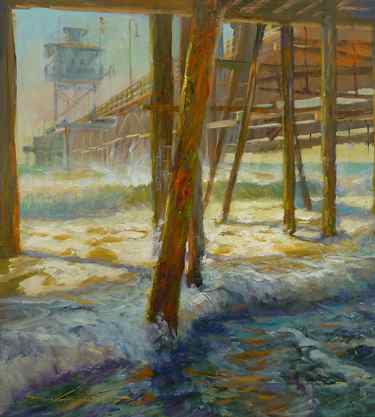
(above: Rick J. Delanty, INTO THE LIGHT, 2013, 24
x 24 in., acrylic on canvas, private collection.)
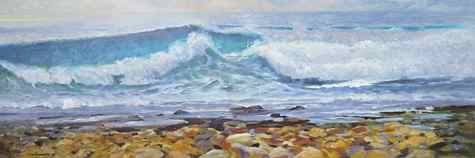
(above: Rick J. Delanty, TRESTLES AND COBBLES, 2011,
24 x 72 inches, acrylic on canvas, private collection.)
RL editor's note: readers may
also enjoy:
See America's Distinguished
Artists for more biographical information on historic artists cited
in the above article.
Editor's note
In November, 2006 the Casa inaugurated the Capistrano
Light Plein Air Art Exhibition and Sale, sponsored by Joan Irvine Smith,
at its Fourth Annual Toast to the Casa. The kick off event was
followed by a two month exhibit of 27 participating artists. An article by
Kaerie Ray, published in the San Clemente Times, Vol. 1, Issue
34, November 9-15, 2006, covered the event. Ray reported: " With $10,000
in prize money offered for first, second and third place and a $1,000 environmental
prize from Joan Irvine Smith Fine Arts Inc., select artists from across
the county assembled to submit plein air paintings of areas south of Crown
Valley Parkway, including the beaches. So far this exhibit has appeared
at The Oaks/Blenheim/Rancho Mission Viejo Riding Park in San Juan Capistrano,
Pelican Point in Crystal Cove State Park and, now, Casa Romantica-the final
stop." Mrs. Smith conceived Capistrano Light to heighten awareness
of the need for environmental preservation in southern Orange County.
Casa Romantica Cultural Center and Gardens is located at
415 Avenida Granada, San Clemente, CA 92672. Please see Casa Romantica's
website for hours and fees.
Search Resource
Library for thousands of articles and essays on American art.
Copyright 2013-21 Traditional Fine Arts Organization, Inc., an Arizona nonprofit corporation. All rights
reserved.