Editor's note: The Orange County Museum of Art
provided source material to Resource Library for the following article.
If you have questions or comments regarding the source material, please
contact the Orange County Museum of Art directly through either this phone
number or web address:
California Landscape into
Abstraction: Works from the Orange County Museum of Art
December 15, 2013 - March 9, 2014
Orange County Museum
of Art is presenting an in-depth study into the changing modes of landscape
representation in modern and contemporary art. 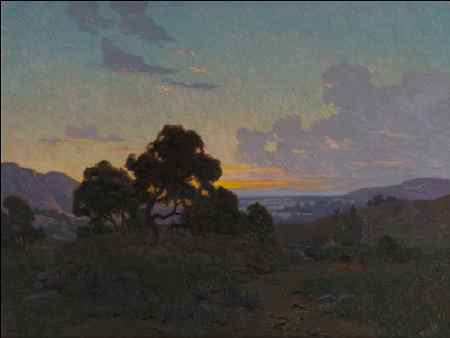 Drawn
entirely from OCMA's collection, the paintings, photography, video, and
sculpture -- among other media -- explore how artists on the West Coast
have produced work in which landscape evolves into abstraction, and in some
cases transforms back again. California Landscape into Abstraction: Works
from the Orange County Museum of Art presents more than 120 artworks
that, with a few exceptions, range in date from the 1920s through the present
day, and includes works by Ansel Adams, Peter Alexander, John Altoon, Elmer
Bischoff, Vija Celmins, Jay DeFeo, Llyn Foulkes, Joe Goode, Tim Hawkinson,
Drew Heitzler, Dorothea Lange, Helen Lundeberg, Lee Mullican, Agnes Pelton,
Ken Price, Ed Ruscha, Millard Sheets, James Turrell, Edward Weston, and
Paul Wonner, among others. (right: Elmer Wachtel, Landscape,
1922, Oil on canvas, 30 x 40 inches. Collection OCMA; Gift of Mr. and Mrs.
Julian Wilcox)
Drawn
entirely from OCMA's collection, the paintings, photography, video, and
sculpture -- among other media -- explore how artists on the West Coast
have produced work in which landscape evolves into abstraction, and in some
cases transforms back again. California Landscape into Abstraction: Works
from the Orange County Museum of Art presents more than 120 artworks
that, with a few exceptions, range in date from the 1920s through the present
day, and includes works by Ansel Adams, Peter Alexander, John Altoon, Elmer
Bischoff, Vija Celmins, Jay DeFeo, Llyn Foulkes, Joe Goode, Tim Hawkinson,
Drew Heitzler, Dorothea Lange, Helen Lundeberg, Lee Mullican, Agnes Pelton,
Ken Price, Ed Ruscha, Millard Sheets, James Turrell, Edward Weston, and
Paul Wonner, among others. (right: Elmer Wachtel, Landscape,
1922, Oil on canvas, 30 x 40 inches. Collection OCMA; Gift of Mr. and Mrs.
Julian Wilcox)
"A persistent theme in California art over the past
century is the charged relationship between abstraction and landscape,"
states OCMA Chief Curator Dan Cameron. "A schism of sorts opened in
the 1930s and 1940s between naturalist landscape painters and those of a
more modernist inclination, and that resulting breach proved to be a catalyst
for a lot of adventurous ideas over several decades. Today it's still considered
heresy to connect California Impressionism to later abstract, minimal, and
conceptual art, but as a museum that collects from both ends of the spectrum,
if seemed like there was more we could bring to the conversation."
California Landscape into Abstraction includes fine examples of 19th and early 20th century landscape
painters such as Frank Cuprien, Elmer Wachtel, and James Milford Zornes.
By the 1940s, the stylistic tension between the two schools seems to be
fully in place with the Modernists -- including Oskar Fischinger, Helen
Lundeberg, Agnes Pelton, Frederick Wight, and Stanton McDonald Wright --
approaching the landscape as a vehicle for expressionist, surrealist, or
hard-edge influences.
At the heart of this exhibition are dozens of outstanding
examples of mid-century California paintings in which the effort on the
part of their makers to 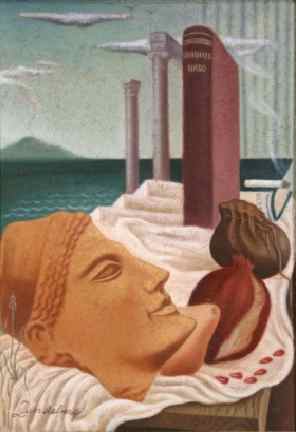 incorporate
elements of landscape without recycling art historical stereotypes is a
thread connecting several styles and genres. Artists such as Stanton Macdonald-Wright,
Hans Burkhardt, and Oskar Fischinger -- who relocated to the Los Angeles
area after years abroad -- were working concurrently with Angelenos Edward
Biberman, Nicholas P. Brigante, Helen Lundeberg and Lorsen Feitelson. Outnumbered
and lacking a cohesive style, this generation was initially unable to compete
with the plein air artists, whose vision of a life devoted to rendering
luminous waves and sunsets had yet to be surpassed. (left: Helen
Lundeberg, Persephone, 1933, Oil on celotex, 25 1/8 x 17 _ inches.
Collection OCMA; Gift of Lorser Feitelson and Helen Lundeberg Feitelson
Revocable Trust © The Feitelson/Lundeberg Art Foundation. Courtesy
Louis Stern Fine Arts)
incorporate
elements of landscape without recycling art historical stereotypes is a
thread connecting several styles and genres. Artists such as Stanton Macdonald-Wright,
Hans Burkhardt, and Oskar Fischinger -- who relocated to the Los Angeles
area after years abroad -- were working concurrently with Angelenos Edward
Biberman, Nicholas P. Brigante, Helen Lundeberg and Lorsen Feitelson. Outnumbered
and lacking a cohesive style, this generation was initially unable to compete
with the plein air artists, whose vision of a life devoted to rendering
luminous waves and sunsets had yet to be surpassed. (left: Helen
Lundeberg, Persephone, 1933, Oil on celotex, 25 1/8 x 17 _ inches.
Collection OCMA; Gift of Lorser Feitelson and Helen Lundeberg Feitelson
Revocable Trust © The Feitelson/Lundeberg Art Foundation. Courtesy
Louis Stern Fine Arts)
The steady influx of modernists into Southern California
may have signaled the beginning of the end of the hegemony of California
Impressionism, but landscape as subject never went away. Although some of
those modernists fell into relative obscurity during the 1950s and 1960s,
another avant-garde rose in its wake, centered on the artists associated
with the Ferus Gallery (1957-66), including John Altoon, Llyn Foulkes, Kenneth
Price, and Ed Ruscha. Defining the landscape by way of Northern California
bohemia were several painters based in San Francisco: Elmer Bischoff, Jay
DeFeo, Richard Diebenkorn, David Park, and Paul Wonner.
The exhibition also features many examples of OCMA's strong
holdings in photography by artists active in the 1970s and 1980s who helped
redefine the issues of representation and landscape. By taking an often
critical look at the growing industrialization of landscape, such artists
as Lewis Baltz, Laurie Brown, John Divola, Lee Friedlander, Anthony Hernandez,
Richard Misrach, John Pfahl, Stephen Shore, and Arthur Taussig helped push
the boundaries of landscape by bringing civilization into the picture in
an often unflattering way.
At the other end of the spectrum, certain artists showed
an ongoing commitment to painting, especially in cases where the practitioners
pursued an idiosyncratic or maverick approach to the history of the medium.
In the early 1960s, Laguna Beach resident Roger Kuntz achieved critical
attention for tightly cropped images of freeways and overpasses with occasional
glimpses of nature in the margins; ten years later, muralist Terry Schoonhoven
was employing trompe-l'oeil techniques at architectural scale representing
slices of local nature dramatized within unexpected formats and location.
California Landscape into Abstraction also showcases paintings by
Carlos Almaraz, Larry Cohen, and John Lees.
Throughout the installation, California Landscape into
Abstraction incorporates more recent developments in landscape interpretations,
with digital and photographic work by Walead Beshty, Katy Grannan, Shirley
Shor, Diana Thater, Mungo Thomson, and Amir Zaki. Painters working today
who are interpreting the landscape genre in even looser reading include
Brian Calvin, Brian Fahlstrom, Pearl C. Hsiung, and Mary Weatherford.
Instead of a chronological installation for the exhibition,
Cameron has organized the works in a thematic design that dissolves some
of the barriers between historical styles. Each gallery focuses on a particular
theme -- albeit with diverse approaches -- presenting key selections for
visitors to explore and better understand how the landscape interpretations
evolved over the decades. The section devoted to Color and Light, for example,
includes works by artists separated from each other by a span of many decades
-- but nonetheless exploring comparable issues. Other thematic groupings
include Mapping, Marking, and Measuring; Language of the Land; First Impressions,
The Modernist Variations; Occupied Vistas; A Backyard Eden; Paradise Endangered;
Manmade Landscapes; and Fictional Histories.
The exhibition is on view December 15, 2013, through March
9, 2014.
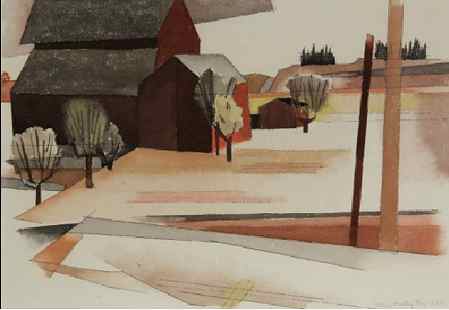
(above: Mary Finley Fry, An Orange County Barn, 1937,
Watercolor on paper, 10 3/8 x 15 1/8 inches. Collection OCMA; Gift of Nancy
Dustin Wall Moure)
List of artists
A full list of artists whose works are included in the
exhibition follows.
- Kim Abeles
- Ansel Adams
- Lita Albuquerque
- Peter Alexander
- Carlos Almaraz
- John Altoon
- Lewis Baltz
- Mark Bennett
- Walead Beshty
- Edward Biberman
- Elmer Bischoff
- Paul Brach
- George Kennedy Brandriff
- Rex Brandt
- Nicholas P. Brigante
- Laurie Brown
- Conrad Buff
- Jerry Burchfield & Mark Chamberlain
- Brian Calvin
- Vija Celmins
- William Clift
- Larry Cohen
- Miles Coolidge
- Carlotta Corpron
- Frank Cuprien
- Jay DeFeo
- Lewis deSoto
- Richard Diebenkorn
- John Divola
- Maynard Dixon
- Elliott Erwitt
- Brian Fahlstrom
- Judy Fiskin
- Llyn Foulkes
- Lee Friedlander
- Mary Finley Fry
- William Giles
- Ed Gilliam
- Joe Goode
- April Gornik
- Jane Gottlieb
- Katy Grannan
- Tim Hawkinson
- Drew Heitzler
- Maxwell Hendler
- Anthony Hernandez
- Eikoh Hosoe
- Pearl C. Hsiung
- N. Jay Jaffee
- Robert Glenn Ketchum
- Paul Kos
- Roger Kuntz
- Ben Kutcher
- Paul Landacre
- Dorothea Lange
- John Lees
- James Luna
- Helen Lundeberg
- Daniel Joseph Martinez
- Barse Miller
- Richard Misrach
- Lee Mullican
- Joan Myers
- Charles Christian Nahl
- Kori Newkirk
- Agnes Pelton
- John Pfahl
- Ken Price
- Sterling Ruby
- Ed Ruscha
- Terry Schoonhoven
- Millard Sheets
- Shirley Shor
- Stephen Shore
- Alan Sonfist
- Norman St. Clair
- Arthur Taussig
- Diana Thater
- Hank Willis Thomas & Kambui Olujimi
- Mungo Thomson
- George Tice
- James Turrell
- Penelope Umbrico
- Elmer Wachtel
- Mary Weatherford
- William Wendt
- Edward Weston
- Frederick Wight
- Jane Wilson
- Paul Wonner
- Amir Zaki
- James Milford Zornes
Wall panel texts from the exhibition
- MAPPING/MARKING/MEASURING
-
- One approach to understanding the landscape is by subjecting
- it to observation, classification, and documentation;
the
- unknowable can be broken down into identifiable parts.
Yet, even
- under rigorous scrutiny, all maps are abstractions, depicting
a real
- place from a singular point of reference. Maps represent
a broader
- concept: the tangible between the concept and the real.
-
- This situating of multiple components calls attention
to both the
- overall process and the individual artist's sensibility.
For example,
- Vija Celmins's Moon Surface (Luna 9) #2 (1969),
created the
- same year that man first landed on the moon, captures
both the
- romance of exploration and the violence of conquest,
while slowly
- revealing the labor-intensive artistic process. Celmins
intentionally
- distances her work from that of a documentary photograph.
- Instead, she uses graphite to mimic reality while calling
attention to
- the underlying structure and its questionable efficacy
as a tool to
- understanding the universe.
-
- In James Turrell's Roden Crater (1986), the topographical
model
- with accompanying text and photographs act as documentation
- and blueprint for Turrell's ongoing Earthwork in an extinct
volcanic
- cinder cone located in the Arizona desert. Begun in 1974
and
- with the final stage of this colossal art work nearing
completion,
- the Roden Crater material here provides valuable insight
into
- Turrell's unique vision about a full decade into the
undertaking.
-
-
-
- LANGUAGE OF THE LAND
-
- The subject of landscape and the efforts of artists to
capture an
- essence of place that was characteristically "Western"
have always played
- a key role in the development of California art. Artists
who arrived in
- the state in the nineteenth century devoted much of their
practice to
- their never-before-painted environs, an impulse that
eventually gave rise
- to California Impressionism, the first real movement
in West Coast art.
- Painters such as Conrad Buff working en plein air depicted
the beauty
- of the natural environment by reveling in the vastness
of the horizon
- against clear, blue skies.
-
- During the early twentieth century, advancements in and
- accessibility to photography supplanted painting within
the broader
- conversation on how landscape might be represented. Ansel
Adams
- and Edward Weston, co-founders of the San Francisco-based
- Group f/64, advocated for a more precise approach by
focusing
- their lenses on details unseen to the naked eye. Weston's
Dunes,
- Death Valley (1938) sustains
an even sharpness from foreground to
- background without enlarging and achieves an impressive
field of
- depth for the desert horizon within its eight-by-ten-inch
frame.
-
- So far in the twenty-first century, the western landscape,
due to
- population growth and urbanization among other factors,
has changed
- considerably, inspiring artists such as Mungo Thomson
to draw their
- inspiration from a mediated view of the American West.
In The American
- Desert (For Chuck Jones) (2002),
a sequence of Road Runner cartoons
- omits both main characters, allowing the viewer to experience
the
- unexpected beauty of the Southwest as the main event
instead of merely
- a fleeting backdrop. As the video progresses, Thomson
pays tribute to
- the emotional, almost spiritual, content of Jones's desert
landscapes
- by only including the essential features-blue skies,
vast mesas, and
- panoramic horizons-that make up the language of the land.
-
-
- LIGHT AND COLOR
-
- Known for its Mediterranean climate, abundant sunshine,
diverse
- landscape, and vibrant flora, California has long been
a magnet to
- artists who have flocked here to utilize these natural
resources. To
- represent their environment, artists often employ light
and color to
- capture the essence of movement, space, time, and emotion.
- Besides situating a landscape at a particular time of
day,
- warmer and brighter colors typically advance in painting
while
- cooler or darker hues generally recede into the background.
-
- Peter Alexander's Untitled (1975) exemplifies
this use of light and
- color. Primarily identified as a member of the Light
and Space
- movement with his translucent resin sculptures, Alexander's
prolific
- career as a painter equally harnesses the light from
his California
- surroundings. Here Alexander silhouettes mountains against
the
- warm hues of the cloud cover, bringing them and the haze
into the
- foreground, while the cool colors of the twilight sky
recede into
- the background. Bright, light-cadmium yellows reflecting
from the
- landscape suggest that the piece captures the moment
of sunset
- just before the scene is reduced to darkness.
-
- Although the use of color to convey time and mood in
an
- artwork is fairly universal, the similarities of the
palettes used by
- the artists here-colors plucked from the California landscape-
- convey disparate messages. Carlos Almaraz's cool colors
can be
- found in Brian Fahlstrom's Visitation (2007) and
the same warm
- hues that Elmer Wachtel employs can be seen again in
Paul
- Brach, Frank Cuprien, and Joe Goode.
-
-
- FIRST IMPRESSIONS
-
- A highly charged recurring motif in the literature of
exploration is the elusive
- goal of the virgin wilderness, a land as yet unexplored
by other humans, where
- the burden of civilization might be cast aside in the
process of developing an
- idealized balance between nature's boundlessness and
man's innermost self.
- Whether in the form of a waterfall buried deep within
a South American rain
- forest, or the fabled first gaze at the Pacific Ocean
envisioned by early settlers,
- who sometimes exhausted much of their worldly wealth
along with weeks (if not
- months) of their lives just to get here, the lure of
a place where others have not
- already carved their initials has always been irresistible
to other humans. That this
- same appeal was later used by railroad companies and
land developers to attract
- potential tourists and homeowners should not be considered
insignificant.
-
- Early landscapes of the California coastline, like George
Kennedy Brandriff's
- Trees and the Sea and Norman
St. Clair's Hills and Trees often framed the
- picturesque view in a way that emphasized its unspoiled
qualities, as if to say,
- "I was here first." By the 1960s, the practice
had taken a more creative turn,
- as in Llyn Foulkes's heroically incongruous image of
Leonard's Rock (1969), a
- formation whose scale and shape seem like a far-fetched
tale. A few years later
- the same task would fall to photographers such as William
Clift in his iconic
- image of Canyon de Chelly, or William Giles's bird's-eye
view of Black Rock,
- or even Terry Schoonhoven's mural study for The Isle
of California (1970-71),
- to erase or edit out all traces of previous visitors,
in an effort to recapture that
- untouched look.
-
- The triptych of photographs from the series Order
from Chaos (1972-84) by
- Robert Glenn Ketchum reconsiders the subject from a preservationist
standpoint
- by capturing the lush interiors of primeval old-growth
areas that were implicitly
- or explicitly endangered. Some decades later, Walead
Beshty's Terra Incognito
- series (2005-06) achieves a similar effect by seeking
out the traffic medians
- on the California freeway system and documenting the
indigenous vegetation
- growing wild; through a visually narrow framework, the
pockets of nature convey
- a lost paradise.
-
-
- MODERN TRANSLATIONS
-
- The first half of the twentieth century was a time of
birth and
- expansion for California modernism. The return of native-born
modernist
- Stanton Macdonald-Wright in 1918 can be seen to have
signaled the
- emergence of modern American versions of European movements
and
- a potent rival to the hegemony of California Impressionism.
Inspired by
- Cubist voluminous flatness and bright colors found in
the works of French
- Fauvists, Macdonald-Wright had, while still in New York,
co-founded with
- Morgan Russell the art movement Synchromism, which became
the first
- American avant-garde art movement to receive international-albeit
- short-lived-attention.
-
- Macdonald-Wright's efforts to promote high European modernism
- helped pave the way for a wider acceptance of abstraction
in the latter
- half of the twentieth century. Lee Mullican, with fellow
San Franciscan
- artists Gordon Onslow Ford and Wolfgang Ford, co-founded
the Dynaton
- surrealistic school. Mullican's concepts were particularly
influential as a
- transition between European modernism and American Abstract
- Expressionism and depicted nature in abstract, weightless,
and cosmiclike
- shapes of line and color such as in The Measurement
(1951).
-
- Agnes Pelton and Helen Lundeberg (with husband Lorser
Feitelson)
- also championed alternative applications of Surrealism
in their own
- respective way with the Lundeberg taking a more argumentative
stance
- for synthesis of classical and Surrealist traditions
resulting in a new,
- Southern California-based movement known as Post-Surrealism.
-
- John Altoon, now considered one of Southern California's
principal
- Abstract Expressionists, also applied surrealist concepts
using action
- painting techniques. Ocean Park Series (1962)
demonstrates Altoon's fluid
- style, which moved between quasi-abstraction and landscape.
Altoon
- would play a central role in leading a new wake of avant-garde
centered
- on artists associated with the Los Angeles Ferus Gallery
(1957-66).
-
-
- OCCUPIED VISTAS
-
- Once the West had been made relatively safe for new inhabitants
- during the late-nineteenth century, images of the landscape
could be
- similarly adjusted to reflect either the arriving population
or, in some
- cases, those Native Americans who in most cases had recently
been
- moved or eliminated. In Paul Landacre's engraving Campers
(ca. 1920),
- a minute figure cavorts amid crashing waves. Eighty years
later,
- Katy Grannan photographed Carla, Arnold Arboretum,
Jamaica Plains,
- MA (2002), in which the subject's
naturalist experience of nature is
- captured surreptitiously, as a fleeting act of disobedience.
-
- Occupied Vistas also refers to the fact that there was
no period over
- the past several hundred years when Southern California
was actually
- uninhabited, so that any aspirations toward being the
"first" to occupy
- or possess a particular land need to factor in the experience
of those
- inhabitants whose population preceded explorations made
by people
- of European ancestry. Native Americans are often edited
out of the
- shortened narrative of the West's settlement, or their
roles distorted,
- and the very word "settlement" suggests the
entity from whom the
- new arrivals had to be kept safe. In this light, Charles
Christian Nahl's
- The Night Watch (1870) belongs
to the genre of historical painting that
- depicts Native Americans as essentially one with the
landscape, while
- James Luna's End of the Frail (1993) parodies
one of the more enduring
- images of the "noble savage" genre in his photo-collage
of a present-day
- artist (himself) slumped over his studio props.
-
-
- WORKING THE LAND
-
- The paintings on this wall represent distinct phases
in the
- investment of capital and labor into the land, from agriculture
- and mining to the rapid post-World War II growth of Southern
- California's beach communities. Until the 1860s, the
main industry
- in the area now known as Orange County was ranching,
but a
- severe drought resulted in many of the largest parcels
being
- bought up by land barons. The 1887 discovery of silver
in the Santa
- Ana Mountains accelerated the flow of settlers into the
region,
- and by the early twentieth century, citrus, berry, and
avocado
- crops had become a mainstay of the state's prosperity.
While labor
- disputes were frequent and the role of migrant workers
was often
- the subject of periodic disagreement, the economic growth
in
- industrialized agriculture was spectacular for half a
century, until
- it was gradually displaced by real estate in the 1970s
and 1980s.
-
-
- LEWIS BALTZ
-
- One of the most devastating photographic statements about
- the transformation of landscape through industrialization
came
- from an artist who, instead of turning to the transcendent
aspects
- of the environment, lent his unflinching gaze to the
process of
- its destruction. In 1974, photographer Lewis Baltz completed
- a series titled The New Industrial Parks near
Irvine, California,
- fifty-one black-and-white photographs that surveyed the
rapid
- suburbanization of his native Orange County. Within the
same
- year, Baltz found himself at the center of a new movement
in
- photography dubbed the New Topographics after the highly
- influential, eponymous exhibition at the George Eastman
House in
- Rochester, New York. This movement epitomized a key moment
- in American landscape photography, which focused on uninspired,
- manmade environments as the quintessential American vista.
-
- The most striking aspect in these photographs is the
- conspicuously absent natural elements of landscape: sunshine,
- oceans, mountains (except from a distance), animals,
the desert,
- even people. The light has a uniformly apocalyptic whiteness
that
- is profoundly unflattering, and the photographic angle
nearly
- always reinforces the surveyor's position relative to
roads and
- property lines. Baltz moved to Europe in the mid-1980s,
and his
- working methods changed substantially, but forty years
later,
- the legacy of his New Industrial Parks series
lay in its author's
- adaptation to the apparent featurelessness of this industrial
- environment, providing groundwork for how photographers
would
- document man-altered landscapes in the years to come.
-
-
- PARADISE ENDANGERED
-
- While our knowledge of the limits of Earth's capacity
to replenish
- its resources at anything like the degree with which
we consume them
- dates back to the second half of the nineteenth century,
the urgency
- with which that information is disseminated has increased
dramatically