Editor's note: The Pasadena Museum of California
Art provided source material to Resource Library for the following
article or essay. If you have questions or comments regarding the source
material, please contact the Pasadena Museum of California Art directly
through either this phone number or web address:
Serigrafía

January 19 - April 20, 2014
Serigrafía, on exhibit at the Pasadena Museum of California Art from January
19 through April 20, 2014, surveys the powerful tradition of information
 design in California's Latino
culture, featuring thirty influential silkscreens from the 1970s to the
present. Beginning in the late 1960s, graphic art created at and distributed
by artist-led collectives, or centros, contributed significantly to the
public discourse. Emerging in concert with the civil rights movement and
demanding political and social justice for marginalized groups, these prints
confront political, economic, social, and cultural issues on both a personal
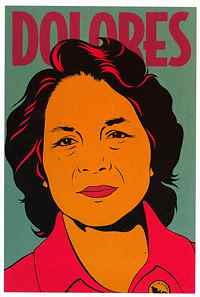
and a global level. (right: Barbara Carrasco, Dolores, 1999,
Silkscreen Print. Courtesy of Self Help Graphics & Art)
design in California's Latino
culture, featuring thirty influential silkscreens from the 1970s to the
present. Beginning in the late 1960s, graphic art created at and distributed
by artist-led collectives, or centros, contributed significantly to the
public discourse. Emerging in concert with the civil rights movement and
demanding political and social justice for marginalized groups, these prints
confront political, economic, social, and cultural issues on both a personal
and a global level. (right: Barbara Carrasco, Dolores, 1999,
Silkscreen Print. Courtesy of Self Help Graphics & Art)
Curated by seven design experts, the exhibition examines
how both aesthetics and portability are key aspects of the prints as communicative
and educational objects. Unlike work created for galleries or museums, the
poster's primary function is to clearly give voice to a complex message
in very different environments.
Challenging the traditional notion of a "poster,"
the selected prints exemplify the impact of effective and moving communication
through the printmaking process. Capturing momentous cultural and political
events and experiences, the works in the exhibition explore subjects such
as the United States embargo against Cuba and the Occupy Wall Street Movement,
and are conceived to provoke, protest, and praise.
This exhibition was organized by Exhibit Envoy and is funded
by the James Irvine Foundation. It is supported by the Board of Directors
of the Pasadena Museum of California Art, Carrie Adrian, and Susan Davis.
Wall text panels from the exhibition
-
- Serigrafía
-
- Designs from California's Silkscreen Master Printmakers
-
- Serigrafía surveys
the powerful tradition of information design in California's Latino culture,
featuring thirty influential silkscreens from the 1970s to the present.
Beginning in the 1970s, graphic art was created at and distributed by artist-led
collectives, or centros, and started to contribute significantly
to the public discourse. Emerging in concert with the civil rights movement
and activism for political and social justice for marginalized groups,
these prints confront political, economic, social, and cultural issues
on both a personal and a global level.
-
- Challenging the traditional notion of a "poster,"
the selected prints exemplify the impact of effective and moving communication
through the printmaking process. Capturing momentous cultural and political
events and experiences, the works in the exhibition explore subjects such
as the United States embargo on Cuba, and the Occupy Wall Street Movement,
and are conceived to provoke, protest, and praise.
-
- The works represent the printmaking heritage in California
and were chosen from the tens of thousands of posters held in archives,
collections, and museums statewide. Curated by seven design experts, the
exhibition also examines how both aesthetics and portability are key aspects
of the prints as communicative and educational objects. Unlike work created
for galleries or museums, the poster's primary function was to clearly
give voice to a complex message in very different environments.
-
-
Object labels from the exhibition
-
- Jesus Barraza
- Alcatraz Indigenous People's Thanksgiving, 2009
- Silkscreen Print
- Courtesy of the Artist
-
- Barraza created this print to celebrate the 40th anniversary
of the occupation of Alcatraz by Indians of all Tribes who took over the
island in 1969 as an act of resistance. After creating the prints, he attended
the annual sunrise celebration on Alcatraz and freely shared them with
the community.
- - Favianna Rodriguez
-
-
- Jesus Barraza and Melanie Cervantes
- Did we vote on your marriage?,
2011
- Silkscreen Print
- Courtesy of the Artist
-
- This print features an illustration of a couple who are
friends of the artists, who were engaged and who, under California Law,
do not have the right to marry each other. The artists wanted to develop
a poster to call attention to Proposition 8 and the unjust way in which
a person's right to marriage can be determined by a vote. The couple featured
in the piece later used the image for their wedding invitations.
- - Favianna Rodriguez
-
-
-
- Barbara Carrasco
- Dolores, 1999
- Silkscreen Print
- Courtesy of Self Help Graphics & Art
-
- "There are so many icons of men, and icons of women
painted by men, that I wanted [as a woman] to create an iconic image of
Dolores to recognize her as an equal of Cesar Chavez and, historically,
the most important negotiator for the United Farm Workers."
- - Barbara Carrasco
-
- Dolores Huerta is a labor organizer, human rights activist,
feminist, and considered to be the most important Chicana activist of our
time. Carrasco symbolically selected the colors: yellow ocher for Dolores'
face to represent sunshine, the essence of her energy; a rose-colored blouse
to symbolize her femininity and gentleness, combined with her unwavering
support of women; and, finally, to recognize Dolores' lifelong commitment
to farmworkers, Carrasco selected a background of mint green to illustrate
growing plants, agriculture and life itself.
- - Carol Wells
-
-
-
- Leonard Castellanos
- Celebración Día de los Muertos, 1976
- Digital Print of Silkscreen Print
- Reproduction Courtesy of the Collection of the Center
for the Study of Political Graphics, Los Angeles
-
- The Mexican Day of the Dead holiday is a rich mixture
of religious and cultural history, drawing from indigenous and Catholic
traditions. It is a celebration of the role that the dead play in the cycle
of life, where skulls (calaveras) and skeletons serve as powerful
graphic reminders of the departed. In this screenprinted poster, the skull
wears sunglasses and a headdress, and the stylish hand lettering coupled
with a chrome-like color treatment make it distinctly modern interpretation.
The letters "CS" in the upper corners stand for "Con
Safos," or "With Respect."
- - Lincoln Cushing
-
-
-
- Rene Castro
- CAMP Central American Mission Partners, 1992
- Silkscreen Print
- Courtesy of Mission Gráfica
-
- Castro's graphic interpretation of an arm delivering
a lighted candle appears to reach into the poster. The candle becomes a
torch of light announcing the solidarity between the peoples of the Americas.
-
- CAMP, a human rights and economic development organization
established in 1984 aimed to stop the kidnappings by security forces in
El Salvador, otherwise gruesomely known as the death squads.
- - Juan R. Fuentes
-
-
-
- Rene Castro
- National Teach-in on US Involvement in Central America, 1984
- Silkscreen Print
- Courtesy of a private collection
-
- San Francisco's Mission District was a hotbed of political
activity in the 1980s, as many groups, opposed to both direct and indirect
U.S. military intervention in Central America, organized various informational
and protest activities and events. Artists used their skills in support
of these organizations. This street poster, an image of the Huey helicopter
gunship (an icon of U.S. involvement) with a dove of peace skewered on
its landing skid, leaves no doubt where the artist stands.
-
- Castro's posters are known for their rich color and expressive
drawing combined with posterized photographic images.
- - Jos Sances
-
-
- Enrique Chagoya and Jos Sances
- U.S. Hands off Cuba, 1990
- Silkscreen Print
- Courtesy of the Artist
-
- This print is collaboration between Chagoya and
Sances. Chagoya drew the island of Cuba and the jet plane flying over it.
The state of Florida and the "spy versus spy" characters from
Mad magazine were drawn by Sances. Both artists acknowledge an affinity
with the cartoon style of Mad magazine since childhood and its influence
on their art.
-
- This poster was made for an exhibit of artworks by artists
opposed to U.S. sanctions against Cuba and the severing of diplomatic relations
with the country in 1960 after Fidel Castro came to power in 1959.
- - Jos Sances
-
-
-
- Ricardo Favela, of the Royal Chicano Air Force
- ¡Huelga! Support the UFWA International Boycott,
1976
- Silkscreen Print
- Courtesy of the Collection of the Center for the Study
of Political Graphics, Los Angeles
-
- This is one of the many posters by the Royal Chicano
Air Force (RCAF) that supported the Farm Worker Movement strike against
Gallo wines, Sun Maid raisins, and Safeway markets for selling non-union
lettuce and grapes. The RCAF merged art, humor and activism. Founded in
1970 in Sacramento, as the Rebel Chicano Art Front, the name was soon changed
when they saw humor in having the same initials as the Royal Canadian Air
Force. The artists began wearing World War II bomber jackets and flight
helmets, and drove a military jeep, as seen here. They also talked about
having "adobe airplanes"?a joke some growers believed.
- - Carol Wells
-
- Juan R. Fuentes
- World Women's Conference, NGOs Nairobi Kenya, 1985
- Silkscreen Print
- Courtesy of the Artist
-
- Fuentes has used the image of a woman carrying a collage
of photographic images depicting the reality of People's struggle, under
the burden of the repressive apartheid regime. The poster stands as a tribute
to the struggle and contribution that women have waged for peace, equality
and liberation throughout the world.
-
- Women from around the world attended the 1985 United
Nations World Women Conference, Nairobi, Kenya. The Bay Area women's organization,
The Alliance Against Women's Oppression sent representatives to the conference.
- - Juan R. Fuentes
-
-
-
- Rupert Garcia
- Fuera de Panama, 1989
- Silkscreen Print
- Courtesy of the Collection of the Center for the Study
of Political Graphics, Los Angeles
-
- Rupert Garcia was one of the first Chicano artists in
California to be involved in making political screen prints. As a Vietnam
Veteran, Garcia holds strong opinions about U.S. military intervention
around the world, and has done a number of prints dealing with this theme.
In this dark and ominous print he depicts the nighttime assault by a U.S.
helicopter. The poster expresses Garcia's outrage at the 1989 U.S. military
invasion of Panama that deposed president Manuel Noriega, capturing him
and bringing him to Miami for trial.
- - Jos Sances
-
-
-
- Xico González
- ChePata, 2006
- Silkscreen Print
- Courtesy of the Collection of the Center for the Study
of Political Graphics, Los Angeles
-
- "I morphed the iconic images of Ché Guevara
and Emiliano Zapata to not only present Zapata in a different light, but
to inspire the masses to stand up and fight for their rights." ?Xico
Gonzalez
-
- The poster was produced for the April 10, 2006, National
Day of Action for immigrant rights, when hundreds of thousands across the
country demonstrated against the national anti-immigrant bill HR4437. April
10th is also the anniversary of Mexican revolutionary Emiliano Zapata's
assassination. The words "¡Ya Basta!" (Enough is
Enough!) connects the work to the Zapatista struggle of Chiapas, México
and the words "Stop Unjust Immigration Laws!" grounds the work
in the struggle for immigrants' rights in the United States. ?Carol
Wells
-
-
- Daniel González, UCLA Labor Center
- Workers & Students Unite for Justice, 2010
- Silkscreen Print
- Courtesy of the Collection of the Center for the Study
of Political Graphics, Los Angeles
-
- Although the faces in the demonstration are brown, this
poster demands immigrants' rights for people from all over the world --
a message reinforced by the primary slogan "United for Justice"
in twelve languages. Set in front of the nation's capital, the crowd is
asking for access to safe and decent-paying jobs, access to educational
opportunities, and progressive immigration reform. The United Farm Worker
phrase "Si se puede" (Yes We Can) placard honors the long
labor tradition of civil disobedience, and the crisp, linoleum-cut print
style evokes the agitational posters of both Mexican and U.S. social justice
movements.
- - Lincoln Cushing
-
-
- Ester Hernandez
- Sun Mad, 1982
- Silkscreen Print
- Courtesy of the Collection of the Center for the Study
of Political Graphics, Los Angeles
-
- Hernandez was born and raised in the San Joaquin Valley,
the center of the California raisin industry. Her parents were agricultural
workers and during the summer Ester worked in the raisin fields where many
farms displayed the Sun Maid logo. She was inspired to produce Sun
Mad after learning that the area's agribusiness had contaminated the water
table in her hometown. By combining the familiar Sun Maid girl with Jose
Guadalupe Posada's graphic tradition of the calavera or satirically
costumed skeletons, Hernandez links raisins -- usually considered to be
a healthy, natural food?to illness and death because of the use of pesticides,
fungicides and other toxic chemicals. She is also critiquing
the many advertisements that use women to sell products.
- - Carol Wells
-
-
-
- La Raza Graphics
- Cesar Chavez, Yes on 14,
1976
- Digital Print of Silkscreen Print
- Reproduction Courtesy of Oakland Museum of California
-
- The clean, dignified face of farmworker leader Cesar
Chavez gazes from this poster promoting a speaking engagement at San Francisco
State University. The United Farm Workers Union (UFW) eagle at the top
is stylized from the traditional version, and the split fountain effect
uses the unevenly blended red and black to dramatically enhance the impact
of a single-pass poster. The topic at hand was Proposition 14, a California
initiative put before the voters to protect progressive farm labor laws
from being weakened. Even though the initiative failed, a key portion of
the law was upheld allowing the right of unions to access workers on the
job site.
- - Lincoln Cushing
-
-
- Yolanda M. López
- Women's Work is Never Done: Homage to Dolores Huerta, 1995
- Silkscreen Print
- Courtesy of the collection of Alliance Graphics
-
- López produced this work as part of her series
Women's Work is Never Done, which celebrates the 75th anniversary
of women's suffrage. López contrasts an iconic 1965 photo of Dolores
Huerta with images of laborers who risk their health and lives to produce
our food. Their bandanas provide scant protection from harmful pesticides
to which they are constantly exposed and underscore the artist's concern
for environmental safety for farm workers. This is a stunning representation
of the work of an important contemporary Chicana artist and focuses attention
on one of the many issues that confront women workers.
- - Jos Sances
-
-
-
- Malaquias Montoya
- BAKKKE, 1977
- Silkscreen Print
- Courtesy of the Artist
-
- In 1978, the United States Supreme Court ruled on a historic
case. Allan Bakke, a white male from Sunnyvale, CA, won a suit against
the University of California, Davis on the grounds that he was discriminated
against based on the principles of Affirmative Action. The racially charged
decision caused a huge uproar and a call to overturn the case. Montoya
captures community outrage by choosing "KKK" as a focal point
and exposing the case for what it was, Racist. Adding to the tension he
brings the idea of inequality with a group of students being towered by
American bigotry.
- - Tony Carranza
-
-
-
- Malaquias Montoya
- Stop Wells Fargo Bank Loans to Chile, 1979
- Silkscreen Print
- Courtesy of the Artist
-
- This poster was printed in 1979 and not only highlights
a prescient issue in light of the recent Occupy protests which have taken
root throughout the United States but also is an incredible example of
a simple yet visually arresting two color silkscreen poster. Like many
of Montoya's posters, the issue raised here ties the complicity of U.S.
corporations, banks and citizens, and how their actions supported the oppression
and anti-democratic actions occurring internationally.
- - Carlos Jackson
-
-
-
- Gilda Posada
- Libertad, 2008
- Silkscreen Print
- Courtesy of the Artist
-
- Intending to illustrate developing world liberation and
solidarity, this poster was created to show the relationship between liberation
movements for human rights in Palestine and in Mexico. Posada printed Libertad
in 2008 as a student in the Chicana/o Studies Poster Workshop at Taller
Arte del Nuevo Amanecer in Woodland, CA, which is a community based art
center managed and directed by the Chicana/o Studies Department at UC Davis.
This poster was developed using rubylith film with the artist cutting the
stencils using an X-Acto knife.
- - Carlos Jackson
-
-
-
- Celina Spring Rodriquez
- Sudan, 2006
- Silkscreen Print
- Courtesy of the Artist
-
- Rodriguez produced Sudan for the organization
STAND, which is the student led division of United to End Genocide, the
largest activist organization in America dedicated to preventing and ending
genocide and mass atrocities worldwide. She made this print as a student
in Malaquias Montoya's Chicana/o Studies Poster Workshop course at UC Davis
using traditional silkscreen materials, printing and cutting the stencils
by hand.
- - Carlos Jackson
-
-
-
- Favianna Rodriguez
- The World vs. The 1%,
2011
- Silkscreen Print
- Courtesy of the Artist
-
- I created this poster after being inspired by the collective
and powerful energy behind the Occupy Wall Street (OWS) movement. As the
messages of OWS spread across the country and the world, it created an
opening for artists like myself to talk about the detrimental costs of
capitalism, the excessive power of corporations and banks, and the economic
devastation being imposed on people around the world. For once in a long
time, I was able to critique capitalism in mainstream conversations. I
developed this poster to call out the negative effects of capitalism and
to inspire people to think globally.
- - Favianna Rodriguez
-
-
-
- Favianna Rodriguez, Jesus Barraza, and Estria Miyashiro
- Resist U.S. Imperialism,
2007
- Silkscreen Print
- Courtesy of Favianna Rodriguez
-
- The poster symbolically parallels Iraq to Aztlan. I wanted
to draw the parallels between the invasion of Iraq under the false pretense
of "liberation," and the invasion of Southwest, where Mexicanos
were promised their rights under the Treaty of Guadalupe Hidalgo, signed
in 1848 as an attempt to settle border issues between Mexico and the US,
-- yet its promises were never kept and a treaty that was never upheld.
- - Favianna Rodriguez
-
-
- Jos Sances
- Por la Paz en Nicaragua,
1984
- Silkscreen Print
- Courtesy of Mission Gráfica
-
- Sances' colorful poster of a woman sitting with folded
hands and holding a bouquet of flowers, a dove flying off the page, symbolizes
Peace in Nicaragua.
-
- The woman is very serene and appears fixed and rock solid,
alluding to the role women played in the country's struggle. They fought
as active participants and leaders, many joining the ranks of the Sandinista
People's Army. Women were key to the success of the revolution in Nicaragua.
Their voices born out of a collective suffering, assisted in the 1979 fall
of the Somoza regime.
- - Juan R. Fuentes
-
-
- La Raza Graphics
- Viva La Raza National Chicano Moratorium, 1970
- Digital Print of Silkscreen Print
- Reproduction Courtesy of Oakland Museum of California
-
- This is the earliest poster in this exhibition, reflecting
the imagery of the emerging Chicano movement. Massed hands form the shape
of an Aztec pyramid, topped with a warning palm holding the poster's title's
first word. The Chicano Moratorium consisted of several demonstrations
by the Mexican American community against the war in Vietnam and racism
at home. This event in East Los Angeles on August 29, 1970 was the largest
antiwar demonstration ever mounted by people of color. The ensuing police
riot left four dead, one of them journalist Rubén Salazar for whom
Belvedere Park is now named.
- - Lincoln Cushing
-
-
-
- Mark Vallen, Art for a Change, Shock Battalion
- Nuclear War?! There Goes My Career!, 1982
- Silkscreen Print
- Courtesy of the Collection of the Center for the Study
of Political Graphics, Los Angeles
-
- Vallen combines public fears of a nuclear war with a
critique of those too self-centered to recognize their responsibility for
the state of the world. It was produced the same year that one million
people demonstrated in New York City's Central Park against nuclear weapons
and the cold war arms race -- at the time, the largest anti-nuclear protest
and the largest political demonstration in U.S. history. The image is based
on Roy Lichtenstein's 1960s Pop Art style, combining the triviality of
pulp romance with the dot pattern and dialogue bubble characteristic of
the cheap color reproduction technology of comic books.
- - Carol Wells
-
-
-
- Xavier Viramontes
- Boycott Grapes, 1973
- Digital Print of Silkscreen Print
- Reproduction Courtesy of Oakland Museum of California
-