Editor's note: The Frederick R. Weisman Museum
of Art provided source material to Resource Library for the following
article or essay. If you have questions or comments regarding the source
material, please contact the Frederick R. Weisman Museum of Art directly
through either this phone number or web address:
Environmental Impact: Selections
from the Frederick R. Weisman Art Foundation
August 26 - November 30,
2014
Environmental Impact:
Selections from the Frederick R. Weisman Art Foundation, an exhibition showcasing original art in various mediums inspired
 about our natural world, is on
view at the Frederick R. Weisman Museum of Art at Pepperdine University
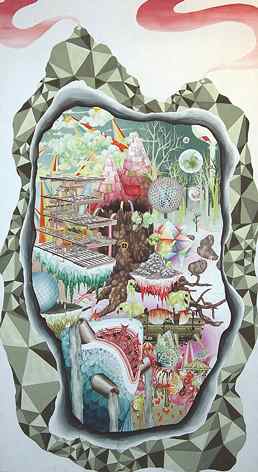
through November 30, 2014. (right: Jen Liu, Brethren
of the Stone: Paul's Vision (Three Worlds Under a Mushroom Cloud Sky), 2006,
watercolor on paper, 95-1/4 x 52-3/8 inches. Frederick R. Weisman Art Foundation)
about our natural world, is on
view at the Frederick R. Weisman Museum of Art at Pepperdine University
through November 30, 2014. (right: Jen Liu, Brethren
of the Stone: Paul's Vision (Three Worlds Under a Mushroom Cloud Sky), 2006,
watercolor on paper, 95-1/4 x 52-3/8 inches. Frederick R. Weisman Art Foundation)
Since the dawn of time, artists have been inspired by nature.
This thought-provoking exhibition features work by a diverse group of contemporary
artists who comment on our relationship to the natural world. Their
art reveals the complex ways nature functions in society. While some
see it as a source of delicate beauty, others view it as an overwhelmingly
powerful force. Regardless of their perspective, artists today understand
that our relationship to nature is delicate, complex, and interconnected.
Over 35 large-scale works fill two floors of the Weisman Museum with various
meditations on one of the most pressing issues of our time.
A key work in this exhibition is Ed Ruscha's LAX - Sunset
- Malibu (1981). Three place names, rendered with the artist's
signature use of typography, allude to the drive up Pacific Coast Highway
from the airport to Malibu. But instead of showing scenic views, the
landscape is shrouded in thick gray smog. Ruscha's witty and poignant
image reminds us that through much of the 20th century, Los Angeles held
the unfortunate distinction of being the smoggiest city in the nation.
Another work on the theme of air pollution is Joe Goode's Torn Sky
(1979). A canvas painted a smoggy gray is literally ripped to shreds
revealing another canvas painted with a bright blue sky underneath.
This humorous but poignant work reminds us of the extent to which we can
destroy our environment-and possibly repair it.
Another side of nature is seen in Wave (2009) by
New Orleans artist Srdjan Loncar. A massive eight-foot tall sculpture
of a cresting wave towers over the viewer. This monolithic mass is
covered with hundreds of photographs of water, depicting various oceans,
lakes, rivers and streams. This work reminds us that bodies of water
do not exist as isolated entities but are all part of an active, interrelated,
worldwide network.
New York painter Andrew Piedilato views the ocean as a
source of floating mystery and potential chaos. Two large-scale, 10-foot
paintings depict the seas as a setting for cataclysmic events. In
Submarine Surfacing (2010) a submarine violently emerges from the
depths, shattering the peace. In Whirlpool (2011) a logjam
of ocean debris alludes to a shipwreck but also to the fields of man-made
garbage that float upon our oceans.
In Brethren of the Stone: Paul's Vision (Three Worlds
Under a Mushroom Cloud Sky) (2006) New York based artist Jen Liu creates
a futuristic fantasy world where nature and industry collide and intermingle.
Adopting a format from traditional Chinese landscape painting, she creates
a world within a world where elephants wear gas masks and smokestacks dance
alongside smoking volcanoes. The title, which contains both religious
and apocalyptic references, reveals the artist's belief that the fate of
our environment involves both a religious and a material battle.
Our environment has historically been impacted by natural
change on and within the Earth -- by relentlessly evolving weather conditions,
such as tornadoes, hurricanes, volcanic eruptions, tidal waves, severe winds,
torrential rains, etc. Man has also added to the list of stimuli that has
significantly affected the quality of the environment, with industrial pollution,
manufacturing, automobile and airplane exhaust, plastics, paints, etc. Environmental
Impact: Selections from the Frederick R. Weisman Art Foundation has
gathered various examples of how artists have reproduced, commented and
critiqued our ever-changing environment, whether the result of nature's
forces or man's interventions. The exhibition brings together different
approaches to the subject -- both formal and conceptual -- including commentary
on pollution and natural disasters, and observing and altering the environment.
This exhibition was curated by Billie Milam Weisman and
is generously funded by the Frederick R. Weisman Art Foundation.
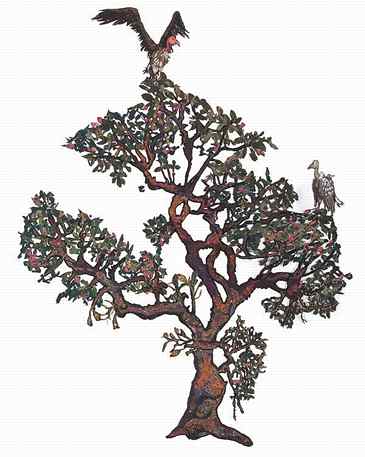
(above: Gina Phillips, Tree No. 2, 2010, fabric
thread, ink and paint, 116 x 99 inches. Frederick R. Weisman Art Foundation)
Related events:
Reception: Saturday, September 13, 5-7 p.m.
Family Art Days: Sunday, September 28, 12-2 p.m.; Saturday,
October 18, 10-1 p.m
Checklist from the exhibition:
ALBUQUERQUE, Lita - Untitled - 1989 - oil on curved panel
ALEXANDER, Peter - Punta Pilar - 1985 - oil and wax
on canvas
ARNOLDI, Charles - Impound - 1985 - acrylic and branches
on plywood
BACHMAN, James - The Portage - 1985 - Alaskan birch
BAILEY, Radcliffe - Uncured Labor - 2003 - mixed media
on wood
BEN-HAIM, Zigi - Nighttouch - 1984 - branches &
acrylic on wood
BROVALL, Veronica - Wurzel-Füllung II - 2007
- wood and mixed media
CARLOS, Ernie - Growing Plate - 2003 - glazed ceramic
CELMINS, Vija - Untitled - 1975 - lithographs (set of 4)
CHASE, Louisa - All Fire All Flame - 1983 - oil on
canvas
DEDEAUX, Dawn - Burnt Palm Hatch - 2009 - enhanced
digital print
DEDEAUX, Dawn - Mold in Greens - 2006-07 - enhanced
digital image
DEDEAUX, Dawn - Over Six Feet of Water - 2008 - transparency
on Plexiglas
DEDEAUX, Dawn - Texas Tree (For William Blake) - 2006-07
- enhanced digital image
DOVE, Daniel - Eye of Providence - 2007 - oil on canvas
DOVE, Daniel - Sequel - 2008 - oil on canvas
GOLDSWORTHY, Andy - Earth and Snow, from Silverlake to Jackson -
1993 - pigmented snowball melted to paper
GOODE, Joe - Commissioned Work (3 PANELS) [Tan] -
1979 - oil on canvas
GOODE, Joe - Forest Fire No. 77 - 1983 - oil on canvas
JIA - The Road Series No. 5 - 2009 - Inkjet print
on Hahnemühle rag Baryta paper
KACHERIAN, Gegam - No. 9 - 2007 - acrylic on canvas
LIM, Won Ju - Untitled (Hawaii No.2) - 2006 - mixed
media sculpture in plexiglass
LIU, Jen - Brethren of the Stone: Paul's Vision (Three Worlds
Under a Mushroom Cloud Sky) - 2006 - watercolor on paper
LONCAR, Srdjan - Mountain - 2006 - inkjet prints on
aluminum
LONCAR, Srdjan - Wave - 2009 - styrofoam, glue, photographic
prints and photographic paper
Mi Ju - Full Moon - 2009 - acrylic on canvas with
cut out paper
MOSES, Andy - Permian Basin - 2010 - acrylic on hyperparabolic
concave canvas
PHILLIPS, Gina - Tree No. 2 - 2010 - fabric thread,
ink and paint
PIEDILATO, Andrew - Submarine Surfacing - 2010 - oil,
alkyd, and latex on canvas
PIEDILATO, Andrew - Whirlpool - 2011 - alkyd and acrylic
on canvas
RIDGWAY, Linda - Without Ceremony - 2001 - bronze
ROSE, Thomas - Out of the Garden - 1989 - oil on wood
with photograph & mixed media
RUSCHA, Edward - Atmospheric Trash - 1985 - dry pigment
on paper
RUSCHA, Edward - Laurel Canyon / Ventura - 2001 -
Mixografia print on handmade paper
RUSCHA, Edward - LAX - Sunset - Malibu - 1981 - oil
on canvas
SIMONDS, Charles - Gates - 1982 - clay and wood sculpture
TSUMAKI, Ryozo - Kyohgen No Kabe [Wall of Appearing Border] -
2007 - acrylic and pencil on paper
WEDEL, Matt - flower tree - 2009 - fired clay and
glaze
WELLIVER, Neil - Abandoned Beaver House - 1983 - oil
on canvas
WIGHT, Frederick S. - Palm Between Two Suns - 1979
- oil on canvas
YELLIN, Dustin - Tobelas - 2007 - resin and acrylic
Resource Library editor's
note
RL readers may also enjoy:
Read more information, articles and essays concerning this
institutional source by visiting the sub-index page for the Frederick
R. Weisman Museum of Art, Pepperdine University in Resource
Library.
Search Resource
Library for thousands of articles and essays on American art.
Copyright 2014 Traditional Fine Arts Organization, Inc., an Arizona nonprofit corporation. All rights
reserved.