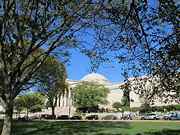
 museum.
 Traditional Fine Arts Organization
Institution Outreach Project procedure for museums
2015
1. Searching for a list of staff email addresses an a museum's website:
TFAO assigns blocks of museum names from a master list - each block containing twenty names - to a volunteer for analysis and letter processing. After each block is completed, subsequent blocks may be assigned.
For phase two, the volunteer will use the master progress
list located here to access each museum's website.
museum.
The volunteer clicks on the URL for a museum to begin the search for staff email addressees on its website.
When studying museum websites in order to locate email addresses of appropriate staff members, there are two main approaches to find email addresses. A "staff" or "people" or "personnel" or "directory" or some similar page, may have names and email addresses of staff members or departments.
The first approach is to look for an "About" or "About us" pull down menu on the home page.
If there is no "About" or About us" pull down menu on the home page, or if the "About" pull down menu does not lead to a staff directory, an alternate approach is to look for a "Contact" or Contact us" pull down menu or page.
A "Contact" pull down menu may lead to a page containing email addresses. At http://www.andover.edu/museums/addison/Pages/default.aspx, the "About Us" pull down menu is not useful, but the "Contact Us" pull down menu leads to the page "Directory" containing staff email addresses.
Sometimes email addressed are in unexpected places. For http://www.centralmethodist.edu/ashbyhodge/, the home page has a link to "contacting the curator" with an email address for the curator, yet no other routes to other staff member email addresses. TFAO found email addresses for the director and curators at http://willamette.edu/arts/hfma/ with some digging around the website's pages.
Pages that ask viewers to fill in forms to reach individuals or departments are ignored. Copy and pasting template text into a form field destroys the hyperlinks in the template.
 Hints:
2. Choosing names or departments
Only certain staff member and department names are included as addressees in outreach letters. Appropriate addressees and their identification codes are:
Staff members reporting to heads of Curatorial, Education and Library departments may have titles such as Coordinator, Assistant, Associate, etc.
 Staff members who never
receive emails include employees devoted to Development, Finance, Marketing,
Public Relations, Communications, Personnel, Human Resources and Building
Services. Also, positions of Preparator, Art Handler and Registrar in the
curatorial department do not receive emails.
Staff members who never
receive emails include employees devoted to Development, Finance, Marketing,
Public Relations, Communications, Personnel, Human Resources and Building
Services. Also, positions of Preparator, Art Handler and Registrar in the
curatorial department do not receive emails.
See Tallying addressees by code and reporting below for use of identification codes.
3. Preparing the template
TFAO first forwards a copy of the proposed template design to the volunteer, or the volunteer creates a template letter sent to TFAO. In either case, the volunteer sends a copy of the template that will be used for creating letters to museums for TFAO's review and approval prior to sending emails to museums.
Each copy produced from the template that will be sent to a museum will have the blue and white TFAO logo and live links to Traditional Fine Arts Organization, Resource Library, authors, Topics in American Art, America's Distinguished Artists, Videos Online, Videos, Online Exhibition Brochures, Catalogues, Gallery Guides and Related Materials, Geographic Tour of American Representational Art History, Audio Online, projects, reports, studies.
4. Protocol for preparing and sending emails
To begin the process of preparing an email to be sent to a museum, the template text with links and TFAO logo embedded in it, is pasted onto a blank new message.
Hint:
There is only one email letter sent to each museum, even though there may be many addressees for it.
In each email letter, appropriate email addresses are entered in the fields for the primary addressee (To:) and copy (Cc:) names There is only one primary addressee for each museum.
For the salutation, a staff member's last name will always be used for the primary addressee -- if a person's name is available -- combined with the appropriate prefix, e.g., Dr. Mr. Ms., followed by the last name of the addressee. Dr. is used when the last name's suffix is Ph.D. An example is: "Dear Dr. Jones" followed by a comma. Please double check to make sure the last name is spelled correctly.
Hint:
"Greetings from TFAO," will be the salutation if there is no personal name tied to the email addresses of the primary addressee.
If there is an email address for the Executive Director,
that person is always the primary addressee. If there is no address for
the Executive Director but there is an address for an assistant to the  Executive Director, and there are addresses to listed
departments or their staff members, the assistant to the Executive Director
is never the primary addressee.
Executive Director, and there are addresses to listed
departments or their staff members, the assistant to the Executive Director
is never the primary addressee.
If there is an email address for the head of the education department, but there is no email address for the Executive Director, the head of the education department is the primary addressee. Addresses for all other persons and departments are entered as Cc names.
In education departments, no email addresses are used for specialists that cover only primary education grades.
Hint:
If there is no email address for the head of the education department, but there is an address for the head of the curatorial department (and there is no email address for the Executive Director), the email address of the head of the curatorial department is used as primary addressee. Addresses for all other persons and departments are entered as Cc names.
In curatorial departments, no email addresses are used for specialists that cover topics other than American art. For instance, no email addresses would be used for associate curators that cover Asia, Europe or other geographic areas other than the United States. Also, no email addresses would be selected for associate curators that specialize in art prior to the 18th century. Volunteers aim to select curatorial staff that are involved in American representational art.
Email addresses of individual persons are superior to email addresses of departments. If at least one email addresses for a person is available within a department -- e.g curatorial department, education department -- the department general email address is not used.
There is always a bcc sent to  for tallying,
analysis and use in future follow up mailings.
for tallying,
analysis and use in future follow up mailings.
5. Tallying addressees by code and reporting
Staff identification codes, and the date each email is sent (mm/yy), are recorded by the volunteer for each contacted museum next to the name of the museum on each progress list segment containing 20 museum names. (The master progress list for all blocks of 20 museum names in phase two is here.) A copy of the progress list containing recorded codes are emailed to TFAO after each block of twenty museums are processed. The progress list for phase one is here, which provides an illustration of what codes on a progress list look like. The phase one list has a different way of grouping museum names because all phase one letters are being sent personally by the Director of TFAO.
Please remember that there may be several addressees connected to one staff identification code shown on the progress list.
As noted above, a bcc for each letter sent out goes to TFAO for tallying and analysis.
Factoids
Special note for artists who have exhibited their work at museums:
Artists who have exhibited their work at museums are welcome to volunteer for outreach to staff members of museums. There are several benefits to artists beyond the satisfaction of bringing further awareness of TFAO's resources to museums. Artists will:
-- become further aware of museum directors and curators aligned with their artistic focus throughout the entire United States,
-- have the opportunity to share their website URL address underneath their name, bringing addressees further awareness of their work. For instance the signature block may read:

 Return to Museum
Outreach Project
Return to Museum
Outreach Project
Clip art courtesy of clipartlord.com, cliparts.co. image of National Gallery of Art courtesy of John Hazeltine
 Search
Resource Library
Search
Resource Library
Copyright 2015 Traditional Fine Arts Organization, Inc., an Arizona nonprofit corporation. All rights reserved.