Editor's note: The Saint Mary's College Museum of Art provided permission for Resource Library to publish the following essay for the exhibition Luis Gutierrez: Another Kind of Truth, held October 4 through December 6, 2015 at the Saint Mary's College Museum of Art. If you have questions or comments regarding the essay and associated materials, please contact the Museum directly through either this phone number or web address:
Luis Gutierrez: Another Kind of Truth
by John Zarobell
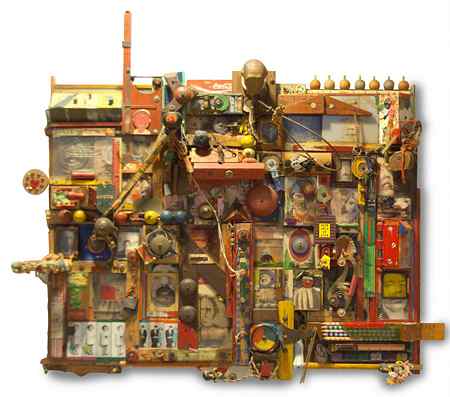
Artists have long sought to portray the world as they see it, and Luis Gutierrez is no exception. His truth clings to the surface of his canvases, but sometimes it tears right through (fig. 212). In his assemblage works, such as Panic Button and Help Us Stay Alive, historical images and objects resurface, creating juxtapositions that are beautiful but, more importantly, meaningful. It is not the kind of meaning you can read however. It must be taken in. The truth in Gutierrez's art is that very process of taking meaning in. It is not a puzzle to solve or a mystery to unfurl, but a play of light, color and perception. The images can be abstract, or landscapes, or figures but they are never just that; the art is animated by the curiosity of the viewer and requires an active reception. Gutierrez's works are not self-important and they do not disclose their significance to the incurious.
In this sense, Gutierrez's approach is historical. Coming of age as an artist in the 1960's in the Bay Area, he would have seen and understood the importance of Abstract Expressionism. In these works, the paint itself is palpably, ineluctably real and imagery is secondary. Paint, and the flatness of the canvas: these were the truths in painting. The implication is that the artist had the power to create his own world, and to appreciate the impact of that required the viewer's thoughtful interpretation. At the same time, artists were experimenting with a new kind of collage, bringing together found objects from the dustbin of history to create unprecedented juxtapositions of everyday life and artistic technique. This method was first charted in a 1961 exhibition at the Museum of Modern Art called 'The Art of Assemblage". These pioneers were working anew to break down the barrier between art and life by making work that combined commercial objects with original vision and they formed a new hybrid that expanded art's possibilities. Once again, it was up to the viewer to decode these assemblages, contemplating anew some object seen a million times now revealed through art. The question here was how these objects might function to create a new kind of meaning in art; such an inquiry was central to art's development and this spun out in many directions, from Pop to Conceptual art.
Over the course of his career, Gutierrez has been both an abstract painter and an assemblage artist, drawing upon multiple artistic methods, but the underlying question he has investigated is how to make meaning in a work of art. Whether there is political subtext, a dark truth he is aiming to confront, or simply a collection of elements that generate a satisfying composition, the question of how to interpret the work is up for grabs. Gutierrez is not trying to tell the viewer something, he is trying to tell the viewer everything. This is because the meaning you find will not be the same as mine and we have to accommodate our notion of truth to bear the vicissitudes of different experiences, different lives, different approaches to the work of art. History wants to put art works in boxes, to find the best and to arrange them neatly and reassuringly. It is the artist's job to do the opposite: to demonstrate the lack of order because only that way can one start to appreciate the beauty of the artistic encounter which emerges from discovery, expression and reception.
The selection of works for this exhibition demonstrates Gutierrez's strength as an abstract artist, which is the direction of his current work. While there are references to landscapes (such as fig. 54) and interiors (such as fig. 45), this blush of recent pictures demonstrates an active exploration of all the components of painterly expression. In all of these works, one can see line, color, traces of the brush, carefully elaborated surfaces, compositional conceptions, even the visceral flatness of the canvas. It is another question to ask what one might find there. If I tell you that I see a window in fig. 75, or a winter landscape in fig. 60, I am really telling you about me, not the paintings. The more challenging gambit is to say how such images are conjured because the evocations themselves are not neutral, but passionate and intentional.
One sees a lot of black in these paintings and, beyond that, a healthy dose of gray. It is in this dark realm where viewers must try to pick up the thread of meaning. If art is generally thought to be enlightening, here one confronts a darker vision. If one looks carefully though, it is clear that this is no apocalypse. There is light streaming in, and vibrant color, and yet it is dark. On another level, linear traces are consistently reasserting the presence of the artist's voice by tracing the movements of his hand. The resulting forms are not vague -- even the more abstract works are highly animated, deeply felt. There is a kind of vividness that opens up here, not from the color or the clarity of form, but from the intensity of the experience of making these works. This intensity does not clarify our view, but rather complicates it, forcing viewers to gaze at the pictures more intently. The more one perceives details in these works the more the tenor seems to shift. For example, the green line at the top of #007 seems like a horizon line at first, with all of the action of the painting happening beneath the surface of the earth, then the animated shapes below seem to be pushing the line up. This tension cannot be easily resolved and that is the dynamic quality of the work.
There is no sense in trying to reverse the spell of indeterminacy that fills these works, but it must be said that their inquiry is a contemporary one. If this art recuperates artistic issues of the 1960s, these recent paintings demonstrate that the challenge of addressing contemporary experience never recedes and the commitment of the artist to making sense of the world must keep pace.
About the author
John Zarobell is Assistant Professor and Undergraduate Director of International Studies at the University of San Francisco. Formerly, he held the positions of assistant curator at the San Francisco Museum of Modern Art and associate curator at the Philadelphia Museum of Art. (biographical information courtesy of University of San Francisco)
(above: Luis Gutierrez, Help Us Stay Alive, 1986, Assemblage, 37 x 30 inches. Collection of Victoria France)
Introduction from the exhibition catalogue
It has long been a tradition at the Saint Mary's College Museum of Art to exhibit artists who have made significant contributions both as artists and as teachers. Luis Gutierrez certainly deserves his place among them. From a childhood devoid of art, through perseverance he overcame many obstacles before becoming an esteemed art professor at San Jose City College, where he inspired students with uncommon classroom exercises until he retired in 1995.
In addition to teaching, Gutierrez has been prolific in his own practice, focusing on abstraction, figuration and assemblage, informed by Abstract Expressionism, the Bay Area Figurative movement, Beat, Funk and Pop. To visit his home is to be surrounded by that which inspires him. It has been a great pleasure working with Gutierrez on this exhibition, which is drawn from the artist's collection, with the exception of one of the assemblages graciously on loan from Victoria France. Thank you to everyone involved, including Janet and Luis Gutierrez, Julina Togonon and John Zarobell.
Julie Armistead, Collections Manager and Curator of the Exhibition
About the exhibition
Mexican-American artist Luis Gutierrez was born in the small town of Pittsburg, California in 1933. After his father died when Gutierrez was only 5, he helped out the family by shining shoes and selling newspapers. As he grew older, he worked in the local steel mills. Despite receiving no encouragement and never being taken to museums, Gutierrez was drawn to the visual arts and in high school won a Bank of America merit award. Gutierrez enrolled at Diablo Valley College, and through the guidance of his first mentor, transferred to San Jose State, where he received his BA. After completing his graduate studies in Mexico at the Instituto Allende in San Miguel de Allende, upon his return to San Jose he began teaching art at San Jose City College, where he remained until retiring in 1995. Abstract Expressionism, the Bay Area Figurative movement, Beat, Funk and Pop all influenced him. Gutierrez garnered national recognition through the inclusion of his work in prominent exhibitions at the De Young, San Francisco Museum of Modern Art, Palace of the Legion of Honor, Triton Museum, San Jose Museum of Art, Oakland Museum, Mexican Museum, Instituto Allende in Mexico and university galleries in the U.S. national survey shows. In 1962, Gutierrez received the prestigious James D. Phelan Award.
On view are Gutierrez's newest body of work, anchored by
a small group of assemblages, for which he became well known in the 1980s
and '90s. In this work he draws upon multiple artistic methods, but the
underlying question he investigates is how to make meaning in a work of
art.
Catalogue conversation on becoming an artist
Artist biography
Checklist
Resource Library editor's notes:
The above essay was published in Resource Library on October 12, 2015 with permission of the Saint Mary's College Museum of Art, which was granted to TFAO on October 7, 2015. Resource Library wishes to extend appreciation to Kyla Tynes of the Saint Mary's College Museum of Art for her help concerning permission for publishing the above essay.
For a checklist definition, please see Definitions in Museums Explained.
Readers may also enjoy additional articles and essays within this topic:
Read more information, articles and essays concerning this institutional source by visiting the sub-index page for the Saint Mary's College Museum of Art in Resource Library.
Search Resource Library for thousands of articles and essays on American art.
Copyright 2015 Traditional Fine Arts Organization, Inc., an Arizona nonprofit corporation. All rights reserved.