Editor's note: The Tucson Museum of Art provided
source material to Resource Library for the following article or
essay. If you have questions or comments regarding the source material,
please contact the Tucson Museum of Art directly through either this phone
number or web address:
Big Skies/Hidden Stories:
Ellen Wagener Pastels
January 16 - June 26, 2016
If a landscape could
tell stories about the human history of its place, what would these stories
look like? Ellen Wagener, a pastel artist who works in the 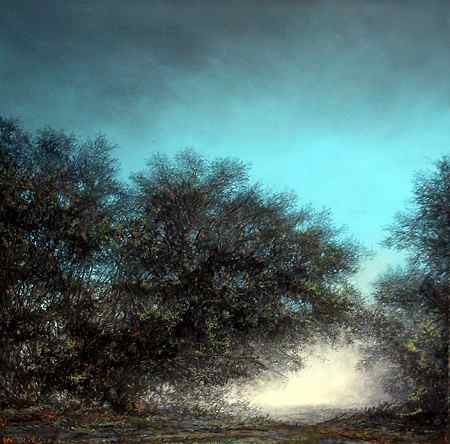 luminous landscape tradition, uses weather, dust storms,
clouds, trees, and geographic processes to focus attention on hidden histories
embedded in locations in Arizona, California, and New Mexico that relate
to the human land use. Big Skies / Hidden Stories, Ellen Wagener Pastels,
opened Saturday, January 16, 2016, at the Tucson Museum Museum of Art (TMA)
in historic downtown Tucson. (right: Ellen Wagener, Santa Cruz,
2012, pastel on paper. Image courtesy the artist.)
luminous landscape tradition, uses weather, dust storms,
clouds, trees, and geographic processes to focus attention on hidden histories
embedded in locations in Arizona, California, and New Mexico that relate
to the human land use. Big Skies / Hidden Stories, Ellen Wagener Pastels,
opened Saturday, January 16, 2016, at the Tucson Museum Museum of Art (TMA)
in historic downtown Tucson. (right: Ellen Wagener, Santa Cruz,
2012, pastel on paper. Image courtesy the artist.)
"Ellen Wagener creates pastels that are sweeping and
nuanced interpretations of the landscape in ways that reveal the majesty
of the convergence of land and sky," said Dr. Julie Sasse, TMA Chief
Curator and Curator of Modern and Contemporary Art. "Wagener is able
to simultaneously render broad tracts of land while articulating even the
smallest of details in both large- and small-scale works. But just as important,
she shares with the viewer the inspiration behind the scenes -- the histories
and stories that make the land come alive."
Though known for its cacti and dramatic mesas, the Southwest
landscape is also a place of multiple uses. Wagener finds it paradoxical
that a state that so proud of its ability to generate high amounts of solar
energy is still attached to nuclear energy and hydroelectric power from
Hoover Dam.
One piece in the exhibition resulted from visiting the
Cochise Stronghold, located in the Coronado National Forest, where Chiricahua
Apache Chiefs Cochise and Geronimo led battles against the U.S. Army before
Arizona became a state. The "Apache 8" -- a group of women firefighters
from the White Mountain Apache Tribe who fought the Rodeo-Chediski Fire
in 2002, the largest forest fire in Arizona history -- inspired another
work in the exhibition.
Also included in this exhibition are two works from the
series "D. H. Lawrence Tree," one of which is in the Museum's
permanent collection. These works are fresh interpretations of a Georgia
O'Keeffe painting of the tree in Taos, New Mexico, beneath which the author
D. H. Lawrence wrote during a highly productive time in his career.
A native of DeWitt, Iowa, Wagener received her B.F.A. from
the Corcoran School of Art in Washington, D.C., and now resides in Arizona.
Her work has been shown nationwide and is in the collections of the Cedar
Rapids Museum of Art, Iowa State University, the University of Iowa Museum
of Art, the Tucson Museum of Art, and the Figge Art Museum.
Big Skies / Hidden Stories, Ellen Wagener Pastels will remain on view at TMA until June 26, 2016.
Wall panel text
This exhibition of meticulously rendered luminous pastels
by Ellen Wagener celebrates the epic skies and dramatic terrain of the Southwest
while alluding to the "hidden stories" that inspired the artist.
For example, the Imperial Valley in California is considered the "secret
garden of the Southwest," where farmers grow crops of lettuce and small
vegetables to feed the entire country. The desert landscape is also home
to the Palo Verde Nuclear Generating Station, the largest power plant in
the country that provides energy to four million people in Arizona, Texas,
and California. As part of this discussion, Wagener's Koyanniscazi; Life
Out of Balance, Mushroom Cloud is included here, a work that references
the fragile balance of our shared landscape. Wagener finds it paradoxical
that a state so proud of its ability to generate high amounts of solar power
is still attached to its nuclear generators, as well as to hydroelectric
power at Hoover Dam. To Wagener, the shift from Arizona's economic focus
on cotton, copper, citrus, and cattle to high technology and tourism can
be addressed by the sublime rendering of these majestic landscapes.
Wagener first discovers the histories of various locales
in the Southwest through popular media such as Public Broadcasting (PBS),
Netflix, the Internet, and Arizona Highways magazine. Intrigued by
these revelations, she then visits the sites to connect the history to the
beauty of land firsthand, often including her family on an educational road
trip. For instance, she learned about the story of Cochise, Geronimo, and
the Apache resistance of the late 1800s by watching the PBS, "We Shall
Remain: Geronimo" series. This television program resulted in her visiting
and drawing the rugged terrain of Cochise Stronghold located in the Coronado
National Forest, where Chiricahua Apache Chiefs Cochise and Geronimo led
battles against the U. S. Army before Arizona became a state. Another such
discovery came when she learned about the "Apache 8," a group
of women firefighters from the White Mountain Apache Tribe who fought the
Rodeo-Chediski Fire in 2002, then considered the largest forest fire in
Arizona history. According to Wagener, "These works are not about dirty
sexy politics or environmental discord -- not the bad stuff. They are about
finding stories you didn't know existed -- they are a part of our landscape."
Also included in this exhibition are two pastels from the
"D. H. Lawrence Tree" series, fresh interpretations of a famous
Georgia O'Keeffe painting of tree in Taos, New Mexico, beneath which the
author D. H. Lawrence wrote during a highly productive time in his career.
In Wagener's version, hypnotic and frenzied marks cover the surface, which
meld into nearly photographic drawings. To celebrate the 2012 Arizona Centennial
Wagener created "Arizona 15," a series of 15 plein air pastels,
one for each county in Arizona, accompanied by text which explains each
landscape's historic narrative. Overwhelming monsoons, pecan groves in Pinal
County, historic wildfires in Navajo and Gila counties, and the "Oatman
Family Massacre" in Maricopa County are among Color is a key element
to Wagener's work. Black and white vintage photography by Edward Curtis
inspired the monumental diptych, "Cloud Bank," a sweeping cloudscape
of the Southwest, while a blast of color enlivens "Twisted Sisters,"
24 pastels depicting the high drama of summer monsoon storms.
Checklist
- All works by Ellen Wagener
-
- Alluvial Watershed, Arizona,
2007
- Pastel , 60" x 40"
- Collection of the University of Arizona Museum of Art
-
- Apache, 2012
- Pastel, 15" x 15"
- Collection of the Artist
-
- Cloud Bank, 2007
- Pastel, 60" x 40" each
- Collection of the Artist
-
- Cochise, 2012
- Pastel, 15" x 15"
- Collection of the Artist
-
- Coconino, 2012
- Pastel, 15" x 15"
- Collection of the Artist
-
- Cotton Lane, 2011
- Pastel, 15" x 15"
- Collection of the Artist
-
- D. H. Lawrence Tree, Kiowa, NM, 2007
- Pastel, 60" x 40"
- Gift of Sheryl and Bob Greenberg, 2014.14.1
-
- D. H. Lawrence Tree, 2008
- Pastel, 40" x 60"
- Collection of the University of Arizona Museum of Art
-
- 50 Shades of Gray Water,
2013
- Pastel, 15" x 15"
- Collection of Dr. Eric Jungermann, Phoenix, AZ
-
- Four Elements: Drip, Blow, Burn, Re-Birth, 2015
- Pastel, 15" x 15" each
- Collection of the Artist
-
- Four Elements: Four Nights of Darkness; Exodus, Pillar
of Cloud; Plague of Dust; Passover, Forest Fires,
2015
- Pastel, 20" x 20"
- Collection of the Artist
-
- Gila, 2012
- Pastel, 15" x 15"
- Collection of the Artist
-
- Graham, 2012
- Pastel, 15" x 15"
- Collection of the Artist
-
- Greenlee, 2012
- Pastel, 15" x 15"
- Collection of Jim Belin and Jan Krulick-Belin, Phoenix,
AZ
-
- Haboob , 2005
- Pastel , 17" x 26"
- Collection of the Artist
-
- Imperial Valley, Arizona,
2009
- Pastel, 13" x 81"
- Collection of the Artist
-
- Koyaanisqatsi (Life Out of Balance), 2008
- Pastel, 40" x 60"
- Museum Purchase, Funds Provided by Robert Greenberg.
2008.9.1
-
- La Paz, 2012
- Pastel, 15" x 15"
- Collection of the Artist
-
- Maricopa (Pah-Ute), 2012
- Pastel, 15" x 15"
- Collection of the Artist
-
- Mohave, 2012
- Pastel, 15" x 15"
- Collection of the Artist
-
- Monsoon, 5:12 PM, 2008
- Pastel, 22" x 22"
- Collection of the Artist
-
- Monsoon, Dust Cloud, 2007
- Pastel, 20" x 20" (framed)
- Collection of the Artist
-
- Navajo, 2012
- Pastel, 15" x 15"
- Collection of Jim Belin and Jan Krulick-Belin, Phoenix,
AZ
-
- Pima, 2012
- Pastel, 15" x 15"
- Collection of the Artist
-
- Pinal, 2012
- Pastel, 15" x 15"
- Collection of the Artist
-
- Roden Crater, 2007
- Pastel, 8.25" x 8.25"
- 20" x 20" (framed)
- Collection of Lisa Sette, Phoenix, AZ
-
- Santa Cruz, 2012
- Pastel, 15" x 15"
- Collection of the Artist
-
- Sunland Gin Road, 2011
- Pastel, 15" x 15"
- Collection of the Artist
-
- Sycamore, Oak, and Sedona Canyons, 2007
- Pastel, 9" x 91"
- Collection of the Artist
-
- Twisted Sisters, 2015
- pastel (24), 15" x 15" each
- Collection of the Artist
-
- Yavapai, 2012
- Pastel, 15" x 15"
- Collection of Phillip Wrigley, Carefree, AZ
-
- Yuma, 2016
- Pastel, 15" x 15"
- Collection of the Artist
Resource Library editor's
notes
For definitions of checklists and wall panels, please see
Definitions in Museums
Explained.
Readers may also enjoy:
Read more information, articles and essays concerning this
institutional source by visiting the sub-index page for the Tucson
Museum of Art in Resource Library.
Search Resource
Library for thousands of articles and essays on American art.
Copyright 2016 Traditional Fine Arts Organization, Inc., an Arizona nonprofit corporation. All rights
reserved.