Editor's note: The Gibbes Museum of Art provided
source material to Resource Library for the following article. If
you have questions or comments regarding the source material, please contact
the Gibbes Museum of Art directly through either this phone number or web
address:
Beyond Catfish Row: The
Art of Porgy and Bess
May 28 - October 9, 2016
George Gershwin's
famed opera, Porgy and Bess, left an indelible impression on our
country with its portrayal of life and race relations in Charleston in the
 1920s. The story of Porgy, Bess,
Crown, Maria, Sportin' Life, and the other residents of Catfish Row has
been communicated primarily through the arts of literature, music, and performance.
However, the visual arts have also played a crucial role in disseminating
the story of Porgy, and of African American life in Charleston, to a wide
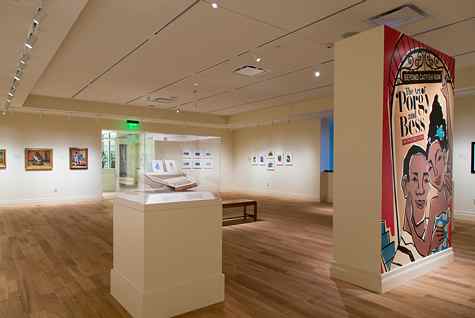
audience. Beyond Catfish Row: The Art of Porgy and Bess examines
interpretations of the opera created by visual artists through the years,
along with the important role this artwork has played in shaping public
perception. (right: Beyond Catfish Row: The Art of Porgy and Bess,
installation at the Gibbes Museum of Art, Charleston, SC, photo ©MCG
Photography)
1920s. The story of Porgy, Bess,
Crown, Maria, Sportin' Life, and the other residents of Catfish Row has
been communicated primarily through the arts of literature, music, and performance.
However, the visual arts have also played a crucial role in disseminating
the story of Porgy, and of African American life in Charleston, to a wide
audience. Beyond Catfish Row: The Art of Porgy and Bess examines
interpretations of the opera created by visual artists through the years,
along with the important role this artwork has played in shaping public
perception. (right: Beyond Catfish Row: The Art of Porgy and Bess,
installation at the Gibbes Museum of Art, Charleston, SC, photo ©MCG
Photography)
The exhibition includes works from the 1930s by George
Biddle, Henry Botkin, and George Gershwin, all of whom created significant
paintings of life in Charleston and the surrounding area. The 1930s works
are paired with more recent interpretations by contemporary artists Kara
Walker and Jonathan Green. Walker created a suite of twenty lithographs
to illustrate the Porgy and Bess libretto published in 2013, and
Green served as the visual designer for the 2016 Spoleto Festival USA production
of Porgy and Bess. Together, these works of art capture the eighty-year
history of Porgy and Bess, an enduring masterpiece of American art.
George Gershwin's opera Porgy and Bess is based
on the 1925 novel Porgy by Charleston author DuBose Heyward. The
novel caught the attention of Gershwin, who reportedly read the entire book
in one sitting and immediately wrote Heyward about a possible collaboration.
Heyward and his wife Dorothy developed Porgy into a stage production
that ran on Broadway in 1927. After several years of discussion, work began
on the opera. Heyward wrote the libretto and Gershwin composed and orchestrated
the music, with his brother Ira Gershwin contributing to the lyrics. Porgy
and Bess debuted on Broadway on October 10, 1935 at the Alvin Theatre.
Porgy and Bess is set in Charleston
in a fictional African American tenement called Catfish Row. It tells the
story of Porgy, a disabled beggar, who falls in love with Bess, a former
prostitute and drug addict trying to escape the power of an abusive man
named Crown and of a drug dealer named Sportin' Life. Crown murders a resident
of Catfish Row and escapes, but later returns in search of Bess while a
hurricane ravages the city. As the drama unfolds, the characters draw strength
from their faith, their cultural traditions, and the close-knit community
of Catfish Row.
The Gibbes Museum of Art in Charleston, South Carolina,
organized Beyond Catfish Row: The Art of Porgy and Bess, which is
on view from May 28 through October 9, 2016.
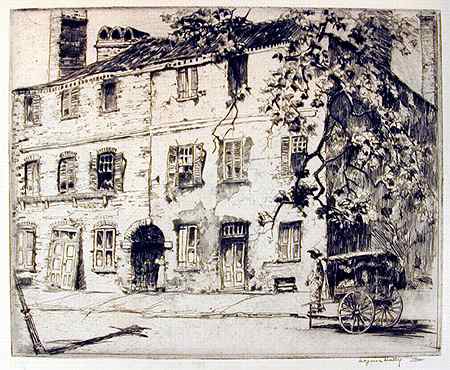
(above: Alfred Hutty (American, 1877-1954), Cabbage Row, 1928,
Etching on paper. Gibbes Museum of Art, Gift of Mrs. Alfred Hutty 1955.007.0046)
This print depicts 89-91 Church Street in Charleston, a
complex of connected buildings called Cabbage Row. The name derives from
vegetable vendors who sold goods in front of the complex. The buildings
are also the basis for DuBose Heyward's Catfish Row in the novel Porgy.
Heyward lived across the street from Cabbage Row and changed several details
for the novel, such as moving Catfish Row to the waterfront, but many remained
unchanged. In Porgy he wrote, "Catfish Row, in which Porgy lived,
was not a row at all, but a great brick structure that lifted its three
stories about the three sides of a court. Over the entrance there still
remained a massive grill of Italian wrought iron."
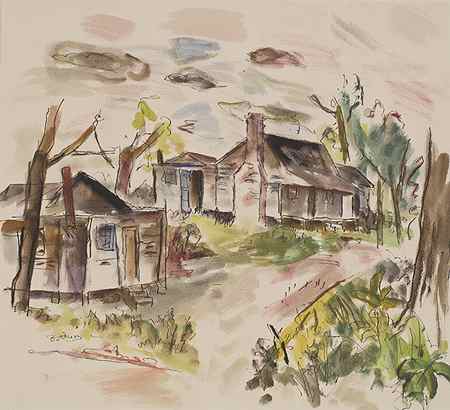
(above: Henry Botkin (American, 1896-1983), Porgy and Bess with George,
Near Folly Island, 1934, Watercolor and ink on paper. Gibbes Museum
of Art, Museum purchase 1988.011.0002)
In the summer of 1934, George Gershwin invited his cousin
Henry Botkin to accompany him to Charleston while he composed Porgy and
Bess. The pair rented a cottage on Folly Beach, across the street from
the home of DuBose and Dorothy Heyward. To fuel their creative endeavors,
Gershwin and Botkin traveled throughout the area and visited African American
churches, absorbing the atmosphere and culture of the Gullah people. Botkin
sketched his surroundings, including this charming watercolor and ink drawing
inscribed, "Porgy and Bess with George/ Near Folly Island."
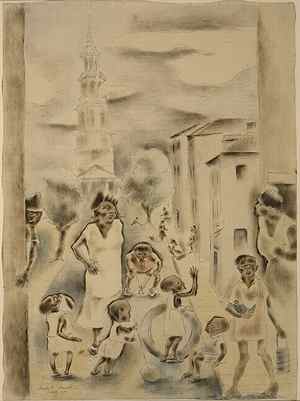
(above: George Biddle (American, 1885-1973), Church Street Amusements,
1930, Watercolor and ink on paper. Gibbes Museum of Art, Museum purchase
with funds provided by the Winnie Edwards Murray Fund 1985.027.0001)
In 1930, George Biddle traveled to Charleston where he
met DuBose Heyward, the author of the novel Porgy. Biddle spent the
months of May and June 1930 sketching genre scenes in the city and on nearby
Folly Beach. Biddle's time in Charleston resulted in a large folio of drawings,
mostly pen and ink with subtle watercolor washes, including Church Street
Amusements. This drawing was reproduced as the frontispiece for the
original Porgy and Bess libretto published in 1935.
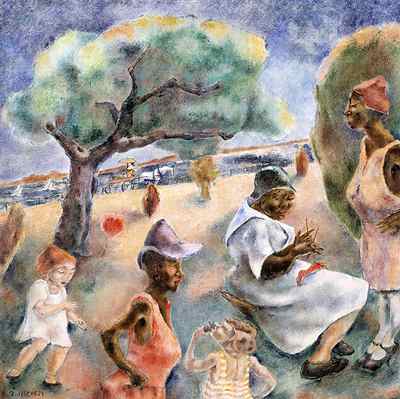
(above: George Biddle (American, 1885-1973), The Battery, Evening,
1931, Oil on canvas. Gibbes Museum of Art, Museum purchase 1999.002)
A number of sketches from George Biddle's Charleston sojourn
were later developed into oil paintings, including The Battery, Evening.
The artist's choice of subject matter demonstrates his interest in race
relations: three black women care for two white children in White Point
Gardens, located in Charleston's wealthiest neighborhood. The figures' exaggerated
features are rendered in caricature, but also reflect the style of American
Regionalism, a painting movement with which Biddle was deeply involved.
Whether Biddle intended this painting as social critique is unknown; however,
his lifelong interest in the social power of art suggests this is the case.
* * *
The above texts, including text panels and descriptive
text of selected paintings in the exhibition, were written by Pamela S.
Wall, Curator of Exhibitions at the Gibbes Museum of Art in Charleston,
South Carolina, where she manages the special exhibitions program and directs
the museum's contemporary art initiatives. Prior to her tenure at the Gibbes,
she worked at the Smithsonian Institution's National Portrait Gallery in
Washington, D.C. She holds a B.A. in Art History from Washington and Lee
University and an M.A. in Art History from the University of South Carolina.
* * *
Checklist for the exhibition
- Cabbage Row, 1928
- By Alfred Hutty (American, 1877-1954)
- Etching on paper
- Gibbes Museum of Art, Gift of Mrs. Alfred Hutty
- 1955.007.0046
-
- Porgy and Bess with George, Near Folly Island, 1934
- By Henry Botkin (American, 1896-1983)
- Watercolor and ink on paper
- Gibbes Museum of Art, Museum purchase
- 1988.011.0002
-
- George Gershwin Self Portrait,
1934
- By George Gershwin (American, 1898-1937)
- Oil on canvasboard
- Courtesy of the National Portrait Gallery, Smithsonian
Institution; gift of Ira Gershwin
-
- DuBose Heyward, 1935
- By George Gershwin (American, 1898-1937)
- Oil on canvas
- Courtesy of the National Portrait Gallery, Smithsonian
Institution; gift of Ira Gershwin
-
- Porgy and Bess: An Opera in Three Acts
- Libretto by DuBose Heyward with bookplates by George
Biddle
- Published in 1935
- Courtesy of Catherine Murray Smith
-
- Church Street Amusements,
1930
- By George Biddle (American, 1885-1973)
- Watercolor and ink on paper
- Gibbes Museum of Art, Museum purchase with funds provided
by the Winnie Edwards Murray Fund
- 1985.027.0001
-
- In the Breakers, 1932
- By George Biddle (American, 1885-1973)
- Oil on canvas
- Courtesy of The Johnson Collection, Spartanburg, South
Carolina
-
- The Crowd, Folly Beach, 1930
- By George Biddle (American, 1885-1973)
- Watercolor and ink on paper
- Gibbes Museum of Art, Museum purchase with funds provided
by the Winnie Edwards Murray Fund
- 1985.027.0004
-
- The Battery, Evening, 1931
- By George Biddle (American, 1885-1973)
- Oil on canvas
- Gibbes Museum of Art, Museum purchase
- 1999.002
-
- Folly Beach Pavilion, 1930
- By George Biddle (American, 1885-1973)
- Ink on paper
- Gibbes Museum of Art, Museum purchase with funds provided
by the Winnie Edwards Murray Fund
- 1985.027.0002
-
- Fruit Market, Charleston,
ca. 1930
- By George Biddle (American, 1885-1973)
- Oil on canvas
- Courtesy of the Greenville County Museum of Art, Museum
purchase with funds donated by the John F. Bannon Trust, Mr. and Mrs. Alester
G. Furman, III and the Museum Association
-
- At Folly Beach, 1930
- By George Biddle (American, 1885-1973)
- Watercolor and ink on paper
- Gibbes Museum of Art, Museum purchase with funds provided
by the Winnie Edwards Murray Fund
- 1985.027.0003
-
- Woman with Wheelbarrow, ca.
1934-1935
- By Henry Botkin (American, 18961983)
- Oil on canvas
- Courtesy of The Johnson Collection, Spartanburg, South
Carolina
-
- Street Shoppers, Charleston, South Carolina, 1931
- By George Biddle (American, 1885-1973)
- Oil on canvas
- Courtesy of The Johnson Collection, Spartanburg, South
Carolina
-
- Porgy, ca. 1935
- By Henry Botkin (American, 1896-1983)
- Oil on canvas
- From the collection of Janet Hopkins and the late Ted
A. Phillips, Jr.
-
- The Hurricane Scene, From Porgy and Bess, ca. 1935
- By Sergei Soudeikine (American, 1883-1940)
- Oil on paper mounted to canvas
- Gibbes Museum of Art, Museum purchase
- 1990.006
-
- Porgy & Bess
- Libretto by DuBose Heyward with lithographs by Kara Walker
- Published by Arion Press, 2013
- Gibbes Museum of Art, Museum purchase
- 2015.005.0001
-
- Porgy and Crown, Superimposed,
2013
- By Kara Walker (American, b. 1969)
- Lithograph on paper
- Gibbes Museum of Art, Museum purchase
- 2015.005.0002
-
- Strawberry Woman, 2013
- By Kara Walker (American, b. 1969)
- Lithograph on paper
- Gibbes Museum of Art, Museum purchase
- 2015.005.0003
-
- Porgy and Bess, Embracing,
2013
- By Kara Walker (American, b. 1969)
- Lithograph on paper
- Gibbes Museum of Art, Museum purchase
- 2015.005.0005
-
- Sailboat in Storm, 2013
- By Kara Walker (American, b. 1969)
- Lithograph on paper
- Gibbes Museum of Art, Museum purchase
- 2015.005.0004
-
- Costume sketches for Porgy and Bess, 2016
- By Jonathan Green (American, b. 1955)
- Acrylic on paper
- Courtesy of Jonathan Green Studios
-
- Gershwin's Cottage on the Beach,
2014
- By Jonathan Green (American, b. 1955)
- Acrylic on paper
- Courtesy of Jonathan Green Studios
-
- The Indigo Room, 2014
- By Jonathan Green (American, b. 1955)
- Acrylic on paper
- Courtesy of Jonathan Green Studios
-
- Folly Beach Dance Pavilion,
2014
- By Jonathan Green (American, b. 1955)
- Acrylic on paper
- Courtesy of Jonathan Green Studios
-
- Moonlight on the Beach, 2014
- By Jonathan Green (American, b. 1955)
- Acrylic on paper
- Courtesy of Jonathan Green Studios
-
- The Crabbing Dock, 2014
- By Jonathan Green (American, b. 1955)
- Acrylic on paper
- Courtesy of Jonathan Green Studios
-
- The Church, 2014
- By Jonathan Green (American, b. 1955)
- Acrylic on paper
- Courtesy of Jonathan Green Studios
-
- Costume sketches for Porgy and Bess, 2014
- By Jonathan Green (American, b. 1955)
- Acrylic on paper
- Courtesy of Jonathan Green Studios
Resource Library editor's notes:
Readers may also enjoy:
Read more information, articles and essays concerning this
institutional source by visiting the sub-index page for the Gibbes
Museum of Art in Resource Library
For further biographical information on certain artists
cited in this article please see America's
Distinguished Artists, a national registry of historic artists.
For a definitions of checklists and wall text panels, please
see Definitions in Museums
Explained.
Search Resource
Library for thousands of articles and essays on American art.
Copyright 2016 Traditional Fine Arts Organization, Inc., an Arizona nonprofit corporation. All rights
reserved.