Birds of a Feather: John
Costin and John James Audubon
March 24 - June 24, 2012
Wall panel text from the exhibition
- A CHARISMATIC YOUNG FRENCHMAN sailed to America in 1803
and became so taken with the North American frontier, he endeavored to
observe and draw every species of bird native to this continent. He dedicated
his life to traversing the plains, mountains, wetlands, and woodlands of
his adopted country. Through drawings and writing, he introduced over half
the continent's bird species to a 19th-century public thirsty for knowledge
of the natural world.
-
- John James Audubon is still America's most famous ornithologist,
nearly 200 years after publishing his monumental Birds of America (1827-1838).
His drawings present 497 species (1,065 individual birds) in animated,
life-like poses. Working with an engraver in England to print his images
for distribution, Audubon insisted upon an oversized print format to properly
convey the dramatic splendor of the birds he had drawn in the field.
-
- Audubon's compulsion to share the thrill of seeing these
beautiful creatures in the wild is understood by Florida printmaker John
Costin. When complete, his Large Florida Birds project will present 20
of the state's most remarkable birds in similarly natural poses and large-scale
format. These vibrant specimens confront the viewer unblinkingly. Costin
aims to replicate the sensation of suddenly encountering a one bird at
home in the lush wetlands of Florida.
-
- The North American frontier has been transformed and
largely tamed in the two centuries that separate Audubon and Costin. While
some species are now endangered or extinct, most of the birds Audubon recorded
can still be found, if in reduced natural habitats and numbers. This exhibition
pairs species observed by both Audubon and Costin, and demonstrates two
artists' shared appreciation of and concern for this land's natural living
wonders.
-
- The Audubon prints are from the historic 1971 reprint
of Birds in America, on loan from Kalamazoo College's A. M. Todd
Rare Book Collection, gift of Mrs. Merrill Taylor. The Costin portfolio
is a recent gift to the KIA from Brent Garback and Linda Tremblay.
-
-
-
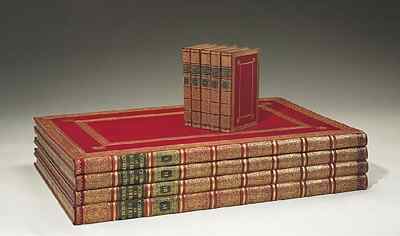
- The 1971 "Amsterdam Edition" of Birds of
America
-
- The Audubon lithographs in this exhibition play a distinguished
role in the long tradition of reproducing Audubon's work. As early as 1840
Audubon and his sons published a "miniature" version of Birds
of America in Philadelphia. However, not until 1971 was the first full-sized,
complete facsimile reproduction undertaken. The "Amsterdam Edition"
lithographs were made from an original, complete, engraved edition belonging
to the Teyler Museum of Holland.
-
- These selections are on loan from Kalamazoo College's
A.M. Todd Rare Book Room Collection, which owns one of only 250 copies
of the complete, historic reprint of Birds in America published
by the Johnson Reprint Company (New York) and Theatrum Orbis Terrarum (Amsterdam)
in 1971.
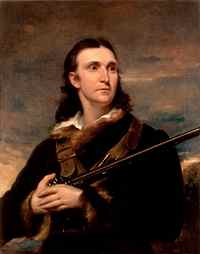
- John James Audubon (1785-1851)
-
- At age 18, Audubon was sent to America from France by
his father to escape conscription into the Napoleonic wars. Already a budding
naturalist, the young man determined to study American birds and illustrate
them in a more realistic manner than most artists of the time. He took
extensive field notes on bird behavior, conducted the first bird-banding
on this continent, and learned taxidermy. Audubon regularly burned early
drawings to force continuous improvement of his drawing skills.
(left: John Syme (Scottish, 1795-1861), John James Audubon, 1826,
oil on canvas. The White House Historical Association)
-
- Despite his obvious dedication, the American ornithological
establishment in Philadelphia did not appreciate the self-taught artist's
adopted "Daniel Boone" demeanor or his interpretation of birds
in life-like poses. So Audubon sailed to England in 1826 to seek a publisher
for his drawings. The English embraced this handsome, charming "American
woodsman" and Audubon raised sufficient funds to begin printing Birds
of America.
-
-
-
- Birds of America (1827-1838)
-
- This publication represented years of field observations
by Audubon. Completion of his most complex images could take up to 60 hours.
Audubon
 shot, stuffed, wired, and
posed the specimen as if caught in motion while feeding or hunting, then
drew and colored each bird. He used a compass to ensure accurate proportions
of the bill, feet, claws, and feathers. At times, Audubon contorted the
largest birds' poses to fit their life-size dimensions onto the page. Finally,
various assistants added environmental elements in the background.
shot, stuffed, wired, and
posed the specimen as if caught in motion while feeding or hunting, then
drew and colored each bird. He used a compass to ensure accurate proportions
of the bill, feet, claws, and feathers. At times, Audubon contorted the
largest birds' poses to fit their life-size dimensions onto the page. Finally,
various assistants added environmental elements in the background.
-
- Audubon engaged notable animal engraver Robert Havell,
Jr. of London to precisely transform the drawings to exquisite etchings.
After twelve years, this monumental work would eventually include 435 hand-colored
prints of 1,065 individual birds. Audubon selected a larger sheet than
any previous ornithology prints in order to present the birds life-sized.
The cost of printing was financed in part by 308 advance subscribers in
Europe and North America-including King George IV. (right: Audubon's
writings about each species, Ornithological Biographies, were published
separately in five volumes, 1831-1839)
-
-
-
- John Costin (b. 1955)
-
- Like Audubon, John Costin is both an artist and a bird
enthusiast. Moving from Detroit in his youth, Costin was struck by the
fantastic size and color
 of Florida's
birds. At the University of South Florida, Costin became fascinated by
the printmaking process, and in his Large Florida Bird series, he brings
together these two passions. Aware of Audubon's formidable print series
documenting North American birds, Costin decided to embark upon a smaller
suite of 20 large format etchings focusing on Florida's large birds.
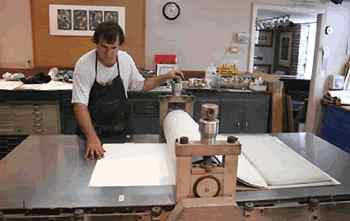
(left: John Costin and printing press. Photo source: www.costingrahics.com)
of Florida's
birds. At the University of South Florida, Costin became fascinated by
the printmaking process, and in his Large Florida Bird series, he brings
together these two passions. Aware of Audubon's formidable print series
documenting North American birds, Costin decided to embark upon a smaller
suite of 20 large format etchings focusing on Florida's large birds.
(left: John Costin and printing press. Photo source: www.costingrahics.com)
-
- Like Audubon, Costin must first shoot his subjects --
but using a camera rather than a gun. Though Costin takes thousands of
photographs, he composes his images from memory, focusing on each species'
unique character. The backgrounds give a sense of the natural habitat,
though they are somewhat abstracted to maintain focus on the bird.
-
- To achieve the richness of color in each image, Costin
inks from two to five plates with numerous colors. He wipes each plate
by hand to blend colors before printing on paper. Finally, Costin hand
paints in oil or watercolor (or both) to achieve subtle shadows and additional
chromatic intensity. It is a labor-intensive and time-consuming process
to produce 250 of each image, but he expects to complete the Large Florida
Birds series this year. Costin speaks in support of environmental conservation
in Florida and sells his work at art fairs around the country.
 Return to Birds
of a Feather: John Costin and John James Audubon
Return to Birds
of a Feather: John Costin and John James Audubon
Visit the Table
of Contents for Resource Library for thousands
of articles and essays on American art.
Copyright 2012 Traditional Fine Arts Organization, Inc., an Arizona nonprofit corporation. All rights
reserved.