Editor's note: The Columbus Museum provided source
material to Resource Library for the following article. If you have
questions or comments regarding the source material, please contact The
Columbus Museum directly through either this phone number or web address:
Annotations: George Cooke
& Thomas Hope and the Influence of Antiquity
February 5 - July 22, 2012
The Annotations:
George Cooke & Thomas Hope and the Influence of Antiquity exhibition
will be on display through Sunday, July 22, 2012 in the 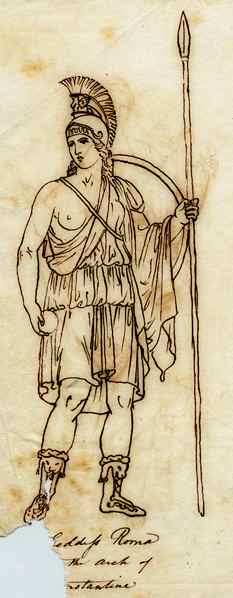 Galleria Cases at the Columbus Museum. George Cooke (1793-1849),
who began his career as a self-taught painter, sought to increase his skill
and knowledge by following the custom of many American artists in traveling
to Europe. Born in Maryland in 1793, Cooke exhibited a talent for art from
the age of three. At sixteen, he learned that his lawyer father had insufficient
funds to send him to study with noted artist Rembrandt Peale, who had just
returned to Philadelphia from Europe. Cooke went into the china and grocery
business, and then into land speculation in Missouri. When both efforts
failed, he took up art again, teaching himself to paint portraits by "copying
his Presidents." His success in achieving good likenesses led to many
early portrait commissions. (right: George Cooke after Thomas Hope,
Goddess Roma [from] the arch of [Co]nstantine, 1828, pen and ink
on wove paper. Courtesy of Hargrett Rare Book and Manuscript Library, University
of Georgia)
Galleria Cases at the Columbus Museum. George Cooke (1793-1849),
who began his career as a self-taught painter, sought to increase his skill
and knowledge by following the custom of many American artists in traveling
to Europe. Born in Maryland in 1793, Cooke exhibited a talent for art from
the age of three. At sixteen, he learned that his lawyer father had insufficient
funds to send him to study with noted artist Rembrandt Peale, who had just
returned to Philadelphia from Europe. Cooke went into the china and grocery
business, and then into land speculation in Missouri. When both efforts
failed, he took up art again, teaching himself to paint portraits by "copying
his Presidents." His success in achieving good likenesses led to many
early portrait commissions. (right: George Cooke after Thomas Hope,
Goddess Roma [from] the arch of [Co]nstantine, 1828, pen and ink
on wove paper. Courtesy of Hargrett Rare Book and Manuscript Library, University
of Georgia)
In the absence of a native school of art during the eighteenth
century, American artists based their work on European models, and the scarcity
of art academies in the United States sent artists to Europe to train their
eyes and to learn the artist's craft. This practice was also followed throughout
the nineteenth century and into the twentieth. Artists such as Benjamin
West, Sanford Robinson Gifford and Hiram Powers made Europe their temporary
or permanent home to study and emulate art of the classical world.
Not long before his departure for France in 1826, Cooke described himself
in a letter to his brother as "a student in a profession, having yet
to obtain my diploma and which can only be obtained in Europe."
In the minds of many 18th- and 19th-century Americans,
Greece and Rome rivaled each other as the summit of western cultural achievement.
The United 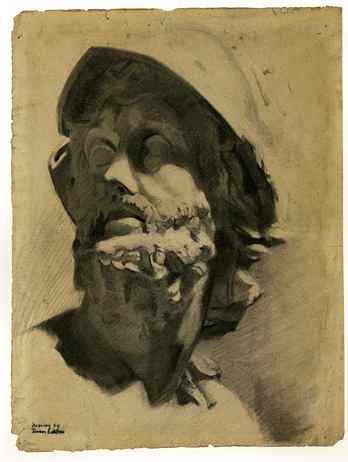 States was believed
to be the heir to the democratic ideals of the Greeks, and the sober virtue
of the Romans. As inheritors of the classical legacy, American artists like
George Cooke and Sanford Robinson Gifford traveled to Europe to study the
sculptures and buildings of antiquity. Sculptors such as Hiram Powers spent
extended periods of time in Italy; there they would thoroughly examine the
work of their Greek and Roman forerunners, obtain Italian Carrara and Seravezza
marbles (as deposits of high-quality marble had not yet been discovered
in North America), and they were able to collaborate with the skilled Italian
workmen who carved the marbles for them. Beginning in the mid-19th century,
art academies in America were commonly equipped with plaster casts of revered
ancient statues. Thereafter, art students who could not travel to Europe
could make drawings of casts of recognized ancient masterpieces. (left:
Thomas Eakins, born Philadelphia, Pa. 1844, died Philadelphia, Pa.
1916, Head of a Warrior, ca. 1862-1866, pencil and charcoal on paper.
Gift of Mrs. Richard Jennings by exchange 2008.57)
States was believed
to be the heir to the democratic ideals of the Greeks, and the sober virtue
of the Romans. As inheritors of the classical legacy, American artists like
George Cooke and Sanford Robinson Gifford traveled to Europe to study the
sculptures and buildings of antiquity. Sculptors such as Hiram Powers spent
extended periods of time in Italy; there they would thoroughly examine the
work of their Greek and Roman forerunners, obtain Italian Carrara and Seravezza
marbles (as deposits of high-quality marble had not yet been discovered
in North America), and they were able to collaborate with the skilled Italian
workmen who carved the marbles for them. Beginning in the mid-19th century,
art academies in America were commonly equipped with plaster casts of revered
ancient statues. Thereafter, art students who could not travel to Europe
could make drawings of casts of recognized ancient masterpieces. (left:
Thomas Eakins, born Philadelphia, Pa. 1844, died Philadelphia, Pa.
1916, Head of a Warrior, ca. 1862-1866, pencil and charcoal on paper.
Gift of Mrs. Richard Jennings by exchange 2008.57)
During the period in 1828, Cooke copied passages from the
introduction and figures from the engravings of noted antiquarian Thomas
Hope's Costume of the Ancients. His compendium was accepted as a
reliable visual guide to ancient costume and antiquities, and artists turned
to it not only as a source for elements of ancient costume and ancient figure
style but also for elegant poses of noble figures. Cooke apparently wanted
to master ancient costume because of his ambition, which was unfortunately
never achieved, to become a successful history painter. However, he was
successful as a portrait painter, and this exhibition explores how he might
have used the costumes and poses from Hope's publication as inspiration
for his portraits of Native Americans and of Henry Clay. The flow of inspiration
from antiquity to the 19th century artwork of Hope and other American artists
in the Museum's collection is investigated by placing them side by side
in this installation.
Cooke did finally achieve a degree of success beyond his
itinerant portrait painting at the end of his life. Daniel Pratt, the wealthy
founder of the industrial town of Prattville, Alabama, became Cooke's patron,
purchasing much of his work. He also set up a gallery of Cooke's work in
Prattville. The list of paintings in this gallery includes landscapes and
Classical and Biblical subjects, as well as portraits of American statesmen.
As he was about to settle and retire in Athens, Georgia, Cooke died suddenly
of cholera in New Orleans in 1849. His widow Maria remarried a lawyer in
Athens, and helped facilitate the transfer of Cooke's huge Interior of St.
Peter's, Rome from the Prattville gallery to the University of Georgia Chapel,
where it can still be seen today.
RL readers may also enjoy:
For biographical information on artists cited above please
see America's Distinguished Artists,
a national registry of historic artists.
rev. 4/15/14
Read more articles and essays concerning this institutional
source by visiting the sub-index page for the Columbus
Museum in Resource Library.
Search Resource
Library for thousands of articles and essays on American art.
Copyright 2012-2104 Traditional Fine Arts Organization, Inc., an Arizona nonprofit corporation. All rights
reserved.