Editor's note: The Ogunquit Museum of American
Art provided text and images to Resource Library for the following
article. The text is by Ruth Greene-McNally, Collections Manager, Ogunquit
Museum of American Art. If you have questions or comments regarding the
source material, please contact the Ogunquit Museum of American Art directly
through either this phone number or web address:
Ernest Hemingway and Henry
Strater
Ogunquit Museum of American Art,
Strater Gallery
May 1 - October 31, 2017
Following the First World War, a "Lost
Generation" of American artists came of age as expatriates in Europe.
Prompted by favorable currency exchange rates and a growing disbelief in
the American dream, the "Americans in Paris" moment had arrived
and a rising Modernist movement influenced generations of artists and writers.
Amid the historical milieu that included James Joyce, Ezra Pound, Gertrude
Stein, Pablo Picasso, and others, Ernest Hemingway and Henry Strater developed
a friendship that revolved around a fervor for beauty, bold sport, and social
activism. Together they embarked upon an artistic collaborative that signifies
the lasting impact of an era. The materials presented in the installation
trace a tumultuous relationship between two creative figures and identifies
the possibilities and of paintings and limits of art and humanity in our
time.
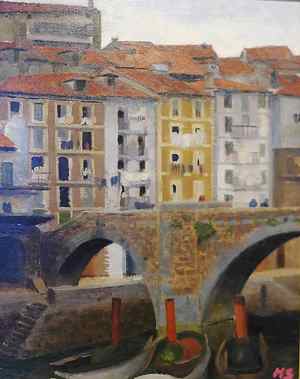
- Henry Strater (1896-1987)
- The Bridge at Andorra, Spain
- 1920
- Oil on canvas
- OMAA Permanent Collection #1960.5
- Gift of the Artist, 1960
-
-
- Though critics suggested that early in Hemingway's literary
career he was a reporter only capable of writing directly from experience,
five chapters from "in our time" depict bull fight scenes he
never actually witnessed.
-
- Strater, who studied at the Academia Real de San Fernando
in Madrid had relayed his first-hand accounts of bull fights that later
became the basis for Hemingway's graphic vignettes. Hemingway did not witness
his first bull fight until 1925, the year after "in our time"
was published.
-
- Strater toured Spain between his first summer in Ogunquit
in 1919 and his first encounter with Hemingway in Paris in 1922.
-
- Andorra is a small, independent principality situated
between Spain and France in the Pyrenees Mountains.
-
-
-
-
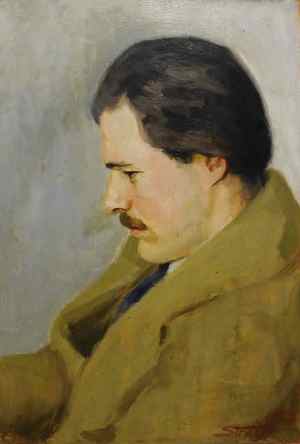
- Henry Strater (1896-1987)
- Profile of Hemingway
- Oil on wood panel
- 1922
- OMAA Permanent Collection #1988.1.326
- Gift of the Estate of Henry Strater, 1988
When Strater painted the so-called "literary portrait" of Hemingway
in Rapallo, Italy, the first of two companion oil portraits, Strater had
recently shown "Nude with Fox Terrier" at the Salon d'Automne
in Paris and Hemingway had just published his first work, "Three Stories
and Ten Poems" in Chicago. Meanwhile, Hemingway was working on "in
our time" for Three Mountains Press, Paris, published in 1924.
- Hemingway thought the profile portrait made him "look
too literary, like H. G. Wells." Strater obliged Hemingway
by completing a second portrait enhancing his tough guy image. "I'll
paint you the way you look boxing."
- When Strater posed Hemingway by a window in morning light,
the artistic collaborative proved fruitful to the author who consequently
experimented with modernist nuance on the "color" of reality
to enrich his own literary objectives.
- Strater completed a third oil portrait of Hemingway in
1930 in Key West, which was used as the cover illustration for Carlos Baker's
1969 biography of Hemingway.
-
-
-
-
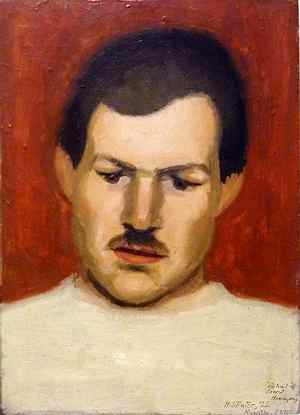
Henry Strater (1896-1987)
- Portrait of Ernest Hemingway (The Boxer Portrait)
- Oil on wood panel
- 1922
- OMAA Permanent Collection #1958.15
- Gift of the Artist
-
-
- The second of two portrayals of Hemingway completed in
Italy, "The Boxer Portrait" distinguishes their friendship bolstered
by an affinity for bold sport that coursed through their artistic ambitions
and associations with American and European literati and Avant-Garde artists.
- A boxer in high school and college, Strater challenged
Hemingway to a match on their second meeting when they put on "12-ounce
[boxing] gloves in my studio for a protracted bout." Sparring partners
for over ten years, Strater wrote that the black eye he gave Hemingway
in the late 1920s increased the author's book sales by the thousands. The
friendship faltered after Hemingway allowed an erroneous claim to Strater's
marlin catch in Bimini to stand uncorrected.
-
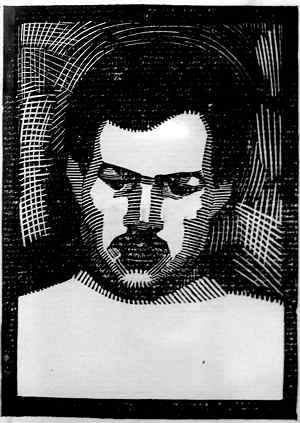
- Henry Strater
- The Boxer Portrait
- Woodcut frontispiece illustration
-
- Ernest Hemingway (1899-1961)
- in our time
- Book with illustration by Henry Strater
- 1924
- Three Mountain Press, Paris
- First Edition, 32pp.
- Courtesy of Bromer Booksellers
Since its publication of 170 copies, Hemingway's 1924 collection of eighteen
vignettes is a rarity in style with few extant copies. The volume is recognized
as a major development in American literature and Modernism. As the title,
in our time (lower case) approaches its centennial anniversary,
Hemingway's themes of social, political, and economic upheaval bear relevance
in our own time. Hemingway and American expatriates of the Lost Generation
sought to express human suffering through art.
-
- Strater met Hemingway in Paris in 1922 where he painted
Portrait of Ernest Hemingway known as "The Boxer Portrait,"
the second of three portraits. The frontispiece illustration is based on
Strater's "The Boxer Portrait."
-
- A breakthrough in its time, the 1924 Paris edition -
the author's second publication in his literary career - introduced Hemingway's
"theory of omission" or "iceberg theory," in which
crucial plot material, around which emotions or themes pivot, is superseded
by scenes of stark brutality. The author's nuanced style, based on the
premise to "show, not tell," influenced generations of writers
and artists.
-
- Hemingway's expanded, revised trade edition, In Our
Time (capital letters) was published in 1925 in New York by Boni &
Liveright Publishers.
-
-
-
-
-
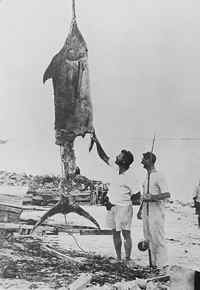
Unidentified Photographer
- Ernest Hemingway and Henry Strater
- with Black Marlin in Bimini
- 1935
- Silver gelatin print on paper
- OMAA Permanent Collection
- Gift of the Strater Family, 2013
Strater's friendship with Hemingway faltered following the fishing excursion
captured in this image by an unidentified bystander. An error of omission,
Hemingway allowed the photographer and onlookers to believe he had landed
the 14 foot 4-inch black marlin in the Bahamas, when in reality Strater
had caught the giant fish. Hemingway, who "liked to win at everything,"
according to Strater, never corrected the error and compounded the rift
by portraying his lust for sport and contest in what is commonly understood
as Hemingway's semi-autobiographical novella, The Old Man and the Sea.
-
-
-
- (no image)
- Henry Strater (1896-1987)
- First Art School Drawing
- 1919
- Charcoal on laid paper
- OMAA Permanent Collection #1967.5
- Gift of the Artist, 1967
-
- In their early 20s, Strater and Hemingway shared common
ambitions, which found expression in the arts, travel, and sports. As a
student at Princeton University, Strater excelled in boxing, became active
in social reform, and won a competition for editorship. In the same year
that Hemingway first worked as a reporter for the Kansas City Star, Strater
worked as a reporter for the Louisville Evening Post.
-
- Strater left for France in 1917 to serve with the Red
Cross and, like Hemingway, a Red Cross ambulance driver, he was wounded
shortly after his deployment. Ordered home on leave, Strater sought further
service in the Red Cross with the Belgian Army through the final weeks
of the Great War.
-
- Following the war, Strater attended the Academie Julian
in Paris. The summer of 1919 brought Strater to Ogunquit for the first
time to attend the Hamilton Easter Field School of Painting. Later that
year he studied in New York under George Bridgman at the Art Students League.
A legendary drawing instructor, Bridgman taught "constructive anatomy,"
a revolutionary approach to figure drawing in which the human form was
composed of interlocking wedge shapes. While Strater's "First Art
School Drawing" reveals a studied search for line and form, a less
structured painterly style is evident in his portraits of Hemingway completed
in 1922.
- (no image)
- Henry Strater (1896-1987)
- Mount Z Above Rapallo
- 1922
- Watercolor sketch
- OMAA Permanent Collection #1988.1.281
- Gift of Estate of the Artist, 1988
- After WWI European Avant-Garde artists and American expatriates
traveled to Italy, Spain, France, and Belgium.
-
- "We were both in a fledgling state in our respective
arts," Strater commented about his association with Hemingway in Rapallo,
Italy. While Strater painted Hemmingway's portraits, "Ernest [was]
working away on trimming his stories, eliminating trite adjectives, everlastingly
condensing."
-
- This watercolor sketch represents Strater's view of the
cascading mountainside just outside the city limits of Rapallo. Despite
his own interpretive presentation of reality, Hemingway criticized Strater's
distorted mountains for "not looking like mountains" but he may
have overlooked the artist's intention to portray the commanding presence
of the Alps. The contours of Strater's mountains appear to zig-zag, enveloping
residences along the mountainside, engulfing the village below. The title
may reflect Strater's use of descriptive imagination as "Mount Z"
is not identified on geographical or topographical maps of Rapallo. Strater
depicted the steeple of Santuario di Montallegro, a basilica built in 1559,
at the apex of the mountain.
(no image)
- Ezra Pound (1885-1972)
- XVI Cantos
- Initials by Henry Strater
(1896-1987)
- 1925
- Bound volumes (2)
- Inscribed on endpaper: To Father - April, 1925/Henry
- Three Mountain Press, Paris
OMAA Permanent Collection
-
- Like many Avant-Garde artists of the period, Ezra Pound,
Henry Strater, and Ernest Hemingway toured several European countries after
WWI. At one of his afternoon salons in Paris in 1922, Pound introduced
Strater to Hemingway. Disillusioned by Parisian social circles, Pound traveled
to Rapallo, Italy in 1924 where he reunited with Strater and continued
writing his epic poem, The Cantos, two volumes of which were illustrated
by Strater.
-
- "Italy is my place for starting things," he
said. In that year, Hemingway published in our time (lower case
letters) by Three Mountain Press with a frontispiece illustration of Strater.
In 1925, also the publication date for XVI Cantos, Hemingway re-published
an expanded In Our Time (capital letters) with Boni & Liveright
in New York.
-
-
(no image
- Gaston Lachaise (1881-1935)
- Portrait Head (Henry Strater)
- 1927
- Cast bronze on black marble base
- OMAA Permanent Collection #1953.21
- Gift of David Strater, 1953
- Born in Paris, Lachaise first apprenticed as a cabinetmaker
with his father and at age thirteen entered the Bernard Palissy School,
where he trained in the decorative arts. Between 1898 and 1904, he studied
sculpture at the Ecole des Beaux-Arts under Gabriel-Jules Thomas (1824-1905).
-
- Lachaise began his artistic career as a designer of Art
Nouveau decorative objects for the French jeweler Rene Lalique (1860-1945).
He emigrated to the United States in 1906 and worked in Boston and New
York. He shared studio space with Henry Strater at 55 West 8th Street.
Known for his bronze nudes, busts, and portraits of artists and literary
celebrities, this bronze was commissioned by Strater's wife Maggie at the
height of Lachaise's career.
-
-
-
- (no image)
- Henry Strater (1896-1987)
- "Hemingway" Art in America, vol. 49, no.
4
- Dist. by Simon & Schuster
- 1961
- Essay with illustrations by Henry Strater,
- Portrait of Hemingway,
- Profile of Ernest Hemingway,
- The 1930 Portrait, pp. 84-85
- OMAA Permanent Collection
- Museum Purchase 2017
RL Editor's note:
Ms. Greene-McNally is curator of Ernest Hemingway and
Henry Strater.
Also see Expatriate Artists
in TFAO's Topics in American Art, covering
over 200 topics in American representational art.
Also see a July 16, 2017 article
concerning Ernest Hemingway and Henry Strater in the Press Herald.
Read more articles and essays concerning this institutional
source by visiting the sub-index page for the Ogunquit
Museum of American Art in Resource Library
Visit the Table
of Contents for Resource Library for thousands
of articles and essays on American art.
Copyright 2017 Traditional Fine Arts Organization, Inc., an Arizona nonprofit corporation. All rights
reserved.