Hunter Museum of American Art
Chattanooga, TN
(423) 267-0968
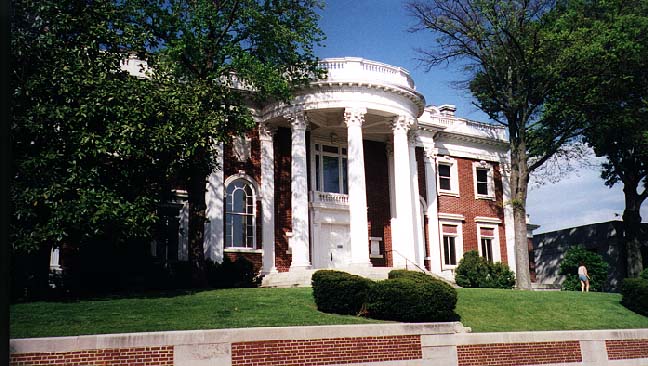
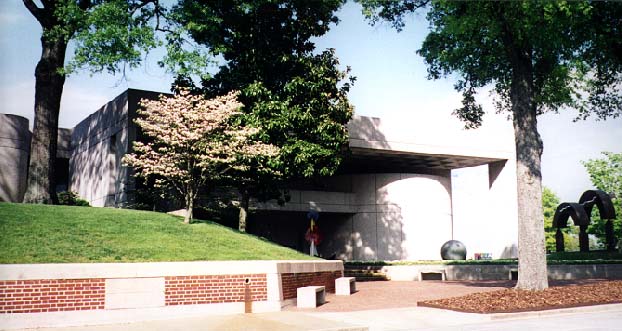
Left: original museum building containing historic collection, Right: extension wing housing contemporary collection and temporary exhibitions. Photos by John Hazeltine.
Large Drawings from the Arkansas Art Center Foundation Collection
 The 40 works in Large Drawings from the Arkansas Art Center Foundation
Collection have one thing in common: they are all works on paper in excess
of 40 inches in width or height. The exhibit spans a wide variety of media,
style and expression and includes drawings in pencil, charcoal, ink, pastel,
watercolor, silverpoint, acrylic, and oil. Most of the works date from the
1980s with a few from the 1970s. All are drawn from the collection of the
Arkansas Arts Center which focuses, in part, on collecting works on drawings
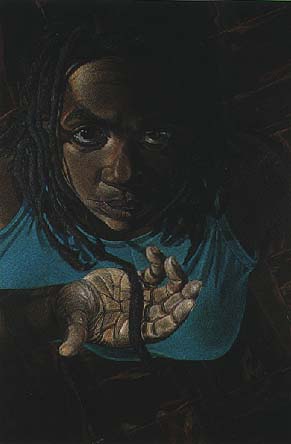
from 1600 to the present. (left: Diane Edison, Self-Portrait Standing,
1991, colored pencils on black paper, 40 x 30 inches)
The 40 works in Large Drawings from the Arkansas Art Center Foundation
Collection have one thing in common: they are all works on paper in excess
of 40 inches in width or height. The exhibit spans a wide variety of media,
style and expression and includes drawings in pencil, charcoal, ink, pastel,
watercolor, silverpoint, acrylic, and oil. Most of the works date from the
1980s with a few from the 1970s. All are drawn from the collection of the
Arkansas Arts Center which focuses, in part, on collecting works on drawings
from 1600 to the present. (left: Diane Edison, Self-Portrait Standing,
1991, colored pencils on black paper, 40 x 30 inches)
As Ruth Pasquine, who wrote an essay for the catalog of this exhibit, points out, "Small drawings, like small paintings, are windows into another world that one peeks into or through; large drawings, like large paintings, gain in reality and presence as they approach or exceed human proportions. The large drawings included here are particularly challenging, not only because of the various ways that the artists have used and manipulated materials, scale and style, but also because of the aggressive, highly charged content. When an illusionistic approach is taken for portraiture or treatment of the figure, for example, the artist goes far beyond bland photographic illusionism toward an incisive psychological penetration; when abstraction is an issue, it is explosive."
Pasquine notes that the phenomenon of monumental drawing
in the eighties can be seen as the 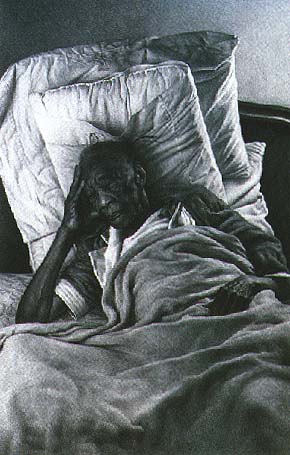 culmination of a variety of forces and influences.
In the fifties, the line, the essential formal element of drawing, had been
absorbed and mainstreamed into American Abstract Expressionist painting.
In the sixties, artists such as Robert Rauschenberg continued to assimilate
drawing forms into painting developing more idiosyncratic painting styles.
Experiments with printmaking, which was undergoing a revival at this time,
were particularly important for the development of large drawings. For example,
because artists drew with crayon on lithography stones and plates, printmaking
also brought renewed attention to the autographic qualities of drawing.
(right: Ira Korman, Sweet Virginia, 1994, charcoal on paper,
47 1/2 x 28 1/2 inches)
culmination of a variety of forces and influences.
In the fifties, the line, the essential formal element of drawing, had been
absorbed and mainstreamed into American Abstract Expressionist painting.
In the sixties, artists such as Robert Rauschenberg continued to assimilate
drawing forms into painting developing more idiosyncratic painting styles.
Experiments with printmaking, which was undergoing a revival at this time,
were particularly important for the development of large drawings. For example,
because artists drew with crayon on lithography stones and plates, printmaking
also brought renewed attention to the autographic qualities of drawing.
(right: Ira Korman, Sweet Virginia, 1994, charcoal on paper,
47 1/2 x 28 1/2 inches)
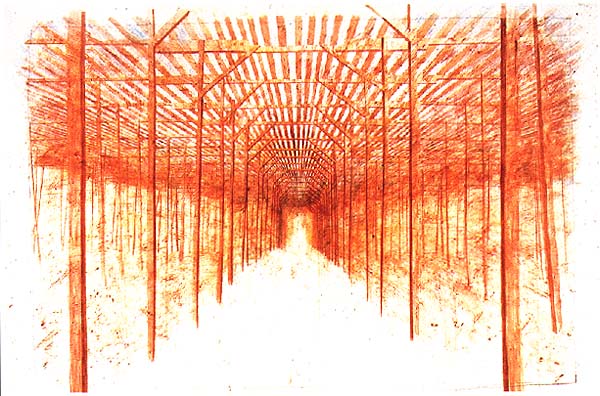 In
the seventies, led by Minimal and Conceptual artists, drawing expanded in
another direction with the use of drawings to document site specific and
installation projects. Monumentality in drawing also became important in
this period with Sol LeWitt's wall drawings and the contributions of performance
artists who created large drawings as backdrops to enliven their productions.
In the eighties, a renewed interest in painting and subject matter generated
a stylistic pluralism, while pressures from the art market led artists to
seek easier and cheaper means of reproduction. (left: Robert Stackhouse,
Inside a Passage Structure, 1986, watercolor, charcoal and graphite
on paper, 89 1/2 x 120 inches)
In
the seventies, led by Minimal and Conceptual artists, drawing expanded in
another direction with the use of drawings to document site specific and
installation projects. Monumentality in drawing also became important in
this period with Sol LeWitt's wall drawings and the contributions of performance
artists who created large drawings as backdrops to enliven their productions.
In the eighties, a renewed interest in painting and subject matter generated
a stylistic pluralism, while pressures from the art market led artists to
seek easier and cheaper means of reproduction. (left: Robert Stackhouse,
Inside a Passage Structure, 1986, watercolor, charcoal and graphite
on paper, 89 1/2 x 120 inches)
Artists in the exhibition include: Gregory Amenoff, Will Barnet, Joan Brown, Warrington Colescott, Lesley Dill, Tony Hepburn, Elizabeth Murray, Robert Stackhouse, Donald Sultan, Tom Wesselmann and Charles White. This exhibition is circulated by Smith-Kramer Fine Art Services.
Read more in Resource Library Magazine about the Hunter Museum of American Art.
rev. 11/26/10
Search Resource Library for thousands of articles and essays on American art.
Copyright 2010 Traditional Fine Arts Organization, Inc., an Arizona nonprofit corporation. All rights reserved.