National Museum of Wildlife Art
Jackson Hole, WY
307-733-5771
http://www.wildlifeart.org
Unbroken Spirit: The Wild Horse in the
American Landscape
November 19, 1999 Sunday, April 9, 2000
 Perhaps more than any other single icon, the wild horse has come
to symbolize the spirit of the American West. To explore the continuing
saga of the wild horse in America, with special emphasis on the animal's
natural history and its impact on American culture, the National Museum
of Wildlife Art presents a blockbuster exhibition titled Unbroken Spirit:
The Wild Horse in the American Landscape. This exhibition is an excerpt
of the original, multi-media Unbroken Spirit (July 23 -- October
31, 1999) curated by Dr. Charles Preston, Curator of Natural History at
the Buffalo Bill Historical Society in Cody, Wyoming. (see our illustrated
article on the exhibit at the Buffalo
Bill Historical Center) (left: W. R. Leigh, Female of
the Species, National Museum of Wildlife Art)
Perhaps more than any other single icon, the wild horse has come
to symbolize the spirit of the American West. To explore the continuing
saga of the wild horse in America, with special emphasis on the animal's
natural history and its impact on American culture, the National Museum
of Wildlife Art presents a blockbuster exhibition titled Unbroken Spirit:
The Wild Horse in the American Landscape. This exhibition is an excerpt
of the original, multi-media Unbroken Spirit (July 23 -- October
31, 1999) curated by Dr. Charles Preston, Curator of Natural History at
the Buffalo Bill Historical Society in Cody, Wyoming. (see our illustrated
article on the exhibit at the Buffalo
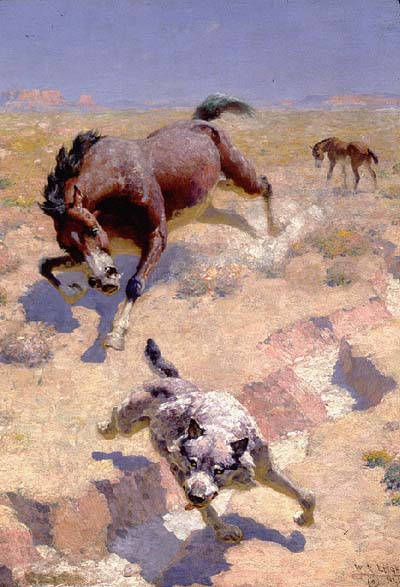
Bill Historical Center) (left: W. R. Leigh, Female of
the Species, National Museum of Wildlife Art)
Featuring original artwork, cultural and biological artifacts,
and interactive media, this exhibition paints a compelling and insightful
picture of an animal that has captured the imagination of Americans for
the past four centuries. The featured artwork includes images from the NMWA's
own collections such as William R. Leigh's oil on canvas, Female of the
Species, 1946, and Jeff Rudolph's alabaster sculpture, Painted Renegade,
circa 1990's.
Despite the fact that the modern horse is arguably not
even native to North America, and that its status as a wild  animal is
challenged by some, the wild horse is admired by millions who identify with
its indomitable spirit. The modern horse was introduced to North America
as a domestic animal by Spanish explorers in the sixteenth-century, some
10,000 years after closely related horse ancestors had become extinct on
this continent. Use of horses spread widely among settlers and Native Americans,
heralding a profound cultural revolution, especially on the western plains.
Horses that escaped or were released from captivity banded together to form
large, genetically mixed herds. These were the first "wild" horses.
It was not until 1971 that federal legislation was passed to protect wild
horses on public lands, which led to the establishment of wild horse refuges.
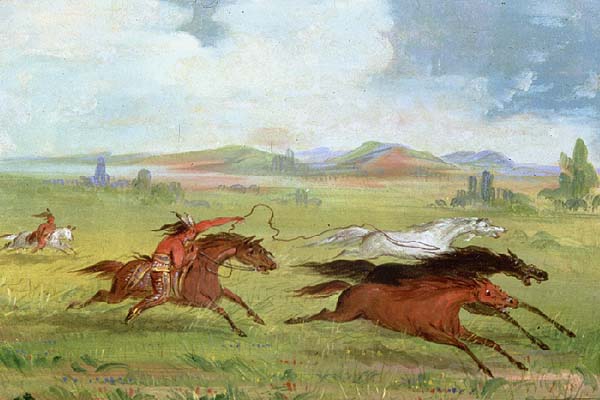
(right: Comanchee Indians Throwing the Lasso, National Museum
of Wildlife Art)
animal is
challenged by some, the wild horse is admired by millions who identify with
its indomitable spirit. The modern horse was introduced to North America
as a domestic animal by Spanish explorers in the sixteenth-century, some
10,000 years after closely related horse ancestors had become extinct on
this continent. Use of horses spread widely among settlers and Native Americans,
heralding a profound cultural revolution, especially on the western plains.
Horses that escaped or were released from captivity banded together to form
large, genetically mixed herds. These were the first "wild" horses.
It was not until 1971 that federal legislation was passed to protect wild
horses on public lands, which led to the establishment of wild horse refuges.
(right: Comanchee Indians Throwing the Lasso, National Museum
of Wildlife Art)
This exhibition has been generously sponsored by The Holt
Family, Teton Club, Williams Companies, Inc., Wyoming Arts Council, and
the Community Foundation of Jackson Hole -- Old Bill's Fun Run for Charities
III.
Read more in Resource
Library Magazine about National
Museum of Wildlife Art.
rev. 11/26/10
Search Resource
Library for thousands of articles and essays on American art.
Copyright 2010 Traditional Fine Arts Organization, Inc., an Arizona nonprofit corporation. All rights
reserved.
 Perhaps more than any other single icon, the wild horse has come
to symbolize the spirit of the American West. To explore the continuing
saga of the wild horse in America, with special emphasis on the animal's
natural history and its impact on American culture, the National Museum
of Wildlife Art presents a blockbuster exhibition titled Unbroken Spirit:
The Wild Horse in the American Landscape. This exhibition is an excerpt
of the original, multi-media Unbroken Spirit (July 23 -- October
31, 1999) curated by Dr. Charles Preston, Curator of Natural History at
the Buffalo Bill Historical Society in Cody, Wyoming. (see our illustrated
article on the exhibit at the Buffalo
Bill Historical Center) (left: W. R. Leigh, Female of
the Species, National Museum of Wildlife Art)
Perhaps more than any other single icon, the wild horse has come
to symbolize the spirit of the American West. To explore the continuing
saga of the wild horse in America, with special emphasis on the animal's
natural history and its impact on American culture, the National Museum
of Wildlife Art presents a blockbuster exhibition titled Unbroken Spirit:
The Wild Horse in the American Landscape. This exhibition is an excerpt
of the original, multi-media Unbroken Spirit (July 23 -- October
31, 1999) curated by Dr. Charles Preston, Curator of Natural History at
the Buffalo Bill Historical Society in Cody, Wyoming. (see our illustrated
article on the exhibit at the Buffalo
Bill Historical Center) (left: W. R. Leigh, Female of
the Species, National Museum of Wildlife Art)