Everson Museum of Art
Syracuse, NY
315-474-6064
http://www.everson.org
Two Hundred Years of American Art: 1746-1946
A curatorial team, composed of the
Everson's Senior Curator Thomas Piché Jr., Curator of Education Marion
Wilson, and Syracuse University art historian Dr. Judith Meighan, recently
unveiled a new display of the Everson's permanent collection. Featuring
about 40 artworks from the period spanning 1746 to 1946, the artworks illustrate
leading themes of American art history. The installation is broken down
into three broad categories: portraiture, landscape, and the culture of
industry and entertainment. Within each grouping, paintings may range from
the eighteenth to twentieth centuries, allowing unexpected comparisons to
be made, and drawing out thematic strands common to works from disparate
times. A fourth component of the reinstallation is a section devoted to
the work of Syracuse artist Beatrice Wose-Smith, whose paintings of central
New York scenes of the 1930s and 1940s have long been audience favorites.
Works on view include landscapes such as Sanford Robinson
Gifford's Sunset New York Bay (1878),  Albert
Bierstadt 's Nevada Falls (ca. 1865), Roswell Hill's Sunny Day
(1903), and Robert Henri's West Coast of Ireland (l913); portrayals
of the industrial and entertainment culture such as Glenn O. Coleman's Ferry
(1930), Gifford Beal's Freight Yards (1915), and Reginald Marsh's
Jack Curley's Dance Marathon (1932); portraits such as Gilbert Charles
Stuart's George Washington (I810), Charles Webster Hawthorne's Mother
and Child (ca. 1908), and John Sloan's Helen Taylor Sketching
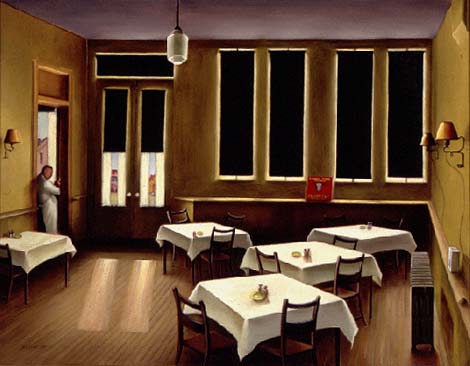
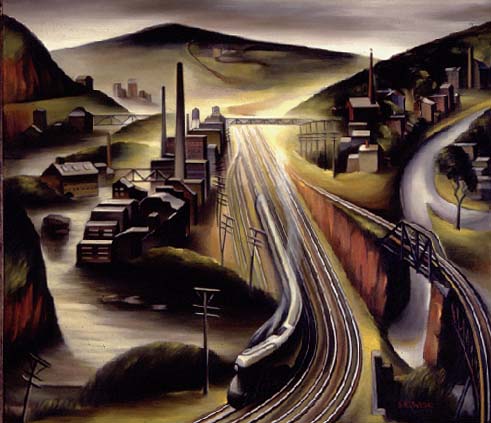
(1916); and Beatrice Wose-Smith's Open for Business, Cobblestone
Inn, Liverpool (1938) and Little Falls (1940).
(left: Gilbert Stuart, 1810, George Washington, oil on canvas, Everson
Museum of Art)
Albert
Bierstadt 's Nevada Falls (ca. 1865), Roswell Hill's Sunny Day
(1903), and Robert Henri's West Coast of Ireland (l913); portrayals
of the industrial and entertainment culture such as Glenn O. Coleman's Ferry
(1930), Gifford Beal's Freight Yards (1915), and Reginald Marsh's
Jack Curley's Dance Marathon (1932); portraits such as Gilbert Charles
Stuart's George Washington (I810), Charles Webster Hawthorne's Mother
and Child (ca. 1908), and John Sloan's Helen Taylor Sketching
(1916); and Beatrice Wose-Smith's Open for Business, Cobblestone
Inn, Liverpool (1938) and Little Falls (1940).
(left: Gilbert Stuart, 1810, George Washington, oil on canvas, Everson
Museum of Art)
In order to provide the maximum potential for educational
programming, Dr. Meighan, a former museum educator at the Museum of Modern
Art, has completed extensive research and written interpretive wall labels
for each work (excerpts below) along with overviews of the different groupings.
 "Beatrice
Wose-Smith was born in Syracuse in 1908. She studied painting at Syracuse
University, where, upon graduating, she was awarded the prestigious Hiram
Gee Award to support post-graduate study. She subsequently spent two years
with the painter George Luks in New York City. Luks was a member of The
Eight, a group of American artists also referred to as the Ashcan School
because of their interest in the vitality of the ordinary
"Beatrice
Wose-Smith was born in Syracuse in 1908. She studied painting at Syracuse
University, where, upon graduating, she was awarded the prestigious Hiram
Gee Award to support post-graduate study. She subsequently spent two years
with the painter George Luks in New York City. Luks was a member of The
Eight, a group of American artists also referred to as the Ashcan School
because of their interest in the vitality of the ordinary  aspects
of the urban scene, from portraits of street urchins, to depictions of tenement
life and sporting events. The lessons of Luks stayed with Wose-Smith throughout
her life -- her best work was inspired by the world around her, often central
New York settings and its citizenry. By 1932, the artist had returned to
Syracuse becoming a familiar presence on the local exhibition circuit. She
developed a painting style that combined direct observation of her subject
with the simplification, even stylization, of form; the use of warm, saturated
colors; linear outlines, and a highly developed facility for the depiction
of complicated compositional space. (upper left: Beatrice Wose-Smith
(1908-1971), Open for Business, Cobblestone Inn, Liverpool, 1938,
oil on canvas, 40 x 31 inches, Everson Museum of Art, Wose-Smith Collection;
upper right: Beatrice Wose-Smith (1908-1971), Little Falls, 1940,
oil on canvas, 46 x 39 inches, Everson Museum of Art, Wose-Smith Collection)
aspects
of the urban scene, from portraits of street urchins, to depictions of tenement
life and sporting events. The lessons of Luks stayed with Wose-Smith throughout
her life -- her best work was inspired by the world around her, often central
New York settings and its citizenry. By 1932, the artist had returned to
Syracuse becoming a familiar presence on the local exhibition circuit. She
developed a painting style that combined direct observation of her subject
with the simplification, even stylization, of form; the use of warm, saturated
colors; linear outlines, and a highly developed facility for the depiction
of complicated compositional space. (upper left: Beatrice Wose-Smith
(1908-1971), Open for Business, Cobblestone Inn, Liverpool, 1938,
oil on canvas, 40 x 31 inches, Everson Museum of Art, Wose-Smith Collection;
upper right: Beatrice Wose-Smith (1908-1971), Little Falls, 1940,
oil on canvas, 46 x 39 inches, Everson Museum of Art, Wose-Smith Collection)
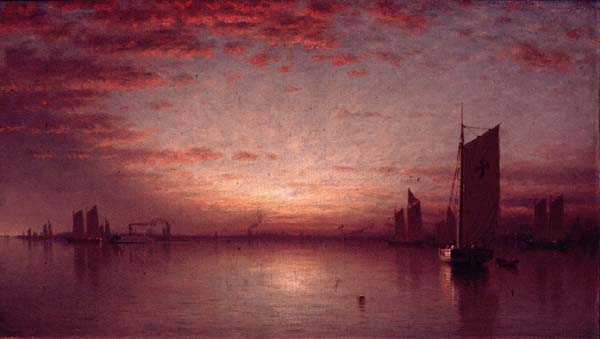
 "Sanford
Gifford, known for working at "fever heat," channeled his energy
into a neatly organized image of the New York bay. Gifford filled two-thirds
of the canvas with sky. His clouds fan out in tidy tiers to frame the sunset
that radiates from the center. The rosy glow warms both the sky and the
smooth, mirror-like surface of the water. In the midst of this theater of
nature, ships and boats, dwarfed by the sky and the sea, proceed in an orderly
arrangement that suggests a serene, carefully measured world. (left:
Sanford Gifford, Sunset New York Bay, 1878, oil on canvas, Everson
Museum of Art, P.C. 72.26)
"Sanford
Gifford, known for working at "fever heat," channeled his energy
into a neatly organized image of the New York bay. Gifford filled two-thirds
of the canvas with sky. His clouds fan out in tidy tiers to frame the sunset
that radiates from the center. The rosy glow warms both the sky and the
smooth, mirror-like surface of the water. In the midst of this theater of
nature, ships and boats, dwarfed by the sky and the sea, proceed in an orderly
arrangement that suggests a serene, carefully measured world. (left:
Sanford Gifford, Sunset New York Bay, 1878, oil on canvas, Everson
Museum of Art, P.C. 72.26)
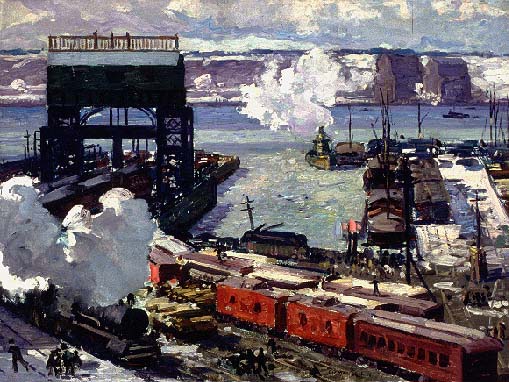
 "Though
railroad lines started in the late 1820s and crossed continental America
in 1869, the locomotive and the workings of the railroad do not take center
stage in American art until the twentieth century. Fascinated by the working
waterfront, [Gifford] Beal chose as a subject the active Sixtieth Street
Yards of the New York Central Railroad that followed along the Hudson River
on the west side of Manhattan. Trains, tracks, and machines fill two-thirds
of the canvas with a web of activity. Painted as cool lavender silhouettes,
the cliffs of the New Jersey palisades rise in the background. (left:
Gifford Beal (1879-1956), American Freight Yards, 1915, oil on canvas,
36 x 48 inches, Everson Museum of Art, P. C.19.80)
"Though
railroad lines started in the late 1820s and crossed continental America
in 1869, the locomotive and the workings of the railroad do not take center
stage in American art until the twentieth century. Fascinated by the working
waterfront, [Gifford] Beal chose as a subject the active Sixtieth Street
Yards of the New York Central Railroad that followed along the Hudson River
on the west side of Manhattan. Trains, tracks, and machines fill two-thirds
of the canvas with a web of activity. Painted as cool lavender silhouettes,
the cliffs of the New Jersey palisades rise in the background. (left:
Gifford Beal (1879-1956), American Freight Yards, 1915, oil on canvas,
36 x 48 inches, Everson Museum of Art, P. C.19.80)
"Gifford Beal was born the year after Sanford Gifford
painted the work... Sunset New York Bay in 1878. In the thirty-seven
years that separate these two paintings of the active New York harbor, the
view of industry had changed dramatically. Notice, for example, the way
each artist portrayed clouds of smoke and steam generated by machines. With
his broad, choppy strokes of paint, Beal makes his clouds exuberant and
nearly as forceful as the machines that produce them.
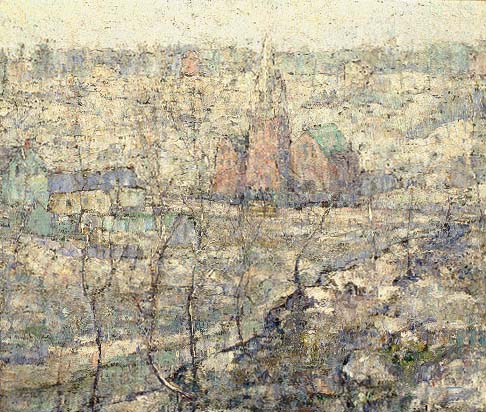
 "Landscape,
particularly in winter, always inspired [Ernest]Lawson . In Early Spring,
he took on the difficult painting problem of creating a nearly all-white
scene. To depict this snow fall just at the start of spring, he translated
the muting effects of the weather into very subtle, almost fragile tints
of color. Along the edge of the hill, the trees, depicted by the thinnest
of lines, nearly vanish. These lines and the faded hues contrast with the
hearty texture he produced by thickly applying paint to the canvas surface...
(left: Ernest Lawson (1873-1949), Early Spring, c. 1936, oil
on canvas, 20 14 x 24 1/4 inches, Everson Museum of Art, P. C.58.1)
"Landscape,
particularly in winter, always inspired [Ernest]Lawson . In Early Spring,
he took on the difficult painting problem of creating a nearly all-white
scene. To depict this snow fall just at the start of spring, he translated
the muting effects of the weather into very subtle, almost fragile tints
of color. Along the edge of the hill, the trees, depicted by the thinnest
of lines, nearly vanish. These lines and the faded hues contrast with the
hearty texture he produced by thickly applying paint to the canvas surface...
(left: Ernest Lawson (1873-1949), Early Spring, c. 1936, oil
on canvas, 20 14 x 24 1/4 inches, Everson Museum of Art, P. C.58.1)
"From the start, Lawson pursued his interest in landscape
choosing to study with American Impressionist John H. Twachtman. American
Impressionist artists favored landscape, worked outdoors, and painted in
light, bright colors. Lawson, however, distinguished his work by the use
of robustly applied thick paint and stronger contrasts of light and dark.
"Lawson also had a talent for interesting associates.
While studying in Paris (1893), Lawson shared a studio with the writer Somerset
Maugham who based his character Frederick Lawson in Of Human Bondage
(1915) on the artist.
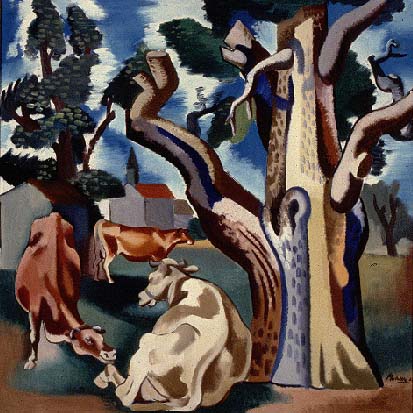
 "[Jan]
Matulka drew and painted this (left) tree and its accompanying cows
many times; it is a symbol of the dairy cow farm in Bohemia (now in the
Czech Republic) where he lived as child before coming to America in 1907.
When he was seventeen, his parents sold this farm property in Vlachovo Brezi
and brought Matulka and five younger sisters to the Bronx, New York. Visiting
his hometown as a grown man in his early thirties, Matulka took away a lasting
impression of this tree rooted in his family's former farmland. (left:
Jan Matulka, Pastoral, 1927, oil on canvas, Everson Museum of Art,
P. C.60.5)
"[Jan]
Matulka drew and painted this (left) tree and its accompanying cows
many times; it is a symbol of the dairy cow farm in Bohemia (now in the
Czech Republic) where he lived as child before coming to America in 1907.
When he was seventeen, his parents sold this farm property in Vlachovo Brezi
and brought Matulka and five younger sisters to the Bronx, New York. Visiting
his hometown as a grown man in his early thirties, Matulka took away a lasting
impression of this tree rooted in his family's former farmland. (left:
Jan Matulka, Pastoral, 1927, oil on canvas, Everson Museum of Art,
P. C.60.5)
"The tree, filling more than half the space, dominates
the painting. Using strong, sharp colors and a piebald pattern, Matulka
gave it a vigor that contrasts with its dead, barren branches. Docile cows
rest and graze serenely under the branches. This bucolic passage underscores
the title, Pastoral, which refers to a work of art that celebrates
the simplicity and peace of rural life.
"The use of vigorous patches of color throughout the
painting owes to Matulka's knowledge of European modern art, especially
the fragmented forms of Cubism. Making annual trips to Europe from 1920
to 1933, the artist brought back first hand of his knowledge of Cubism,
Dadaism, and Surrealism to his students at the Art Students League in New
York City.
"A man of few words and an introspective temperament,
Matulka always maintained a strong attachment to his European heritage.
His close ties to the Czech community in New York City included marrying
the librarian for Czechoslovakian literature at the New York Public Library,
Ludmila Jirouskova, who had emigrated from the same region as he did.
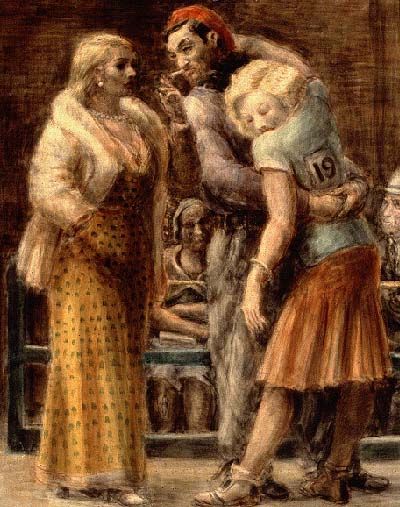
 "The
dance marathon started out as a popular, cheap entertainment in the 1920s.
Anyone could enter to test their stamina in the twenty-four hour, seven
day a week amusement. By 1932, when [Reginald] Marsh recorded Jack Curley's
Marathon, the event had become a professional performance with emcees and
variety acts. Veteran contenders would walk the floor for forty-five minutes
with a fifteen minute break each hour. Success depended on endurance and
coordinated teamwork. As depicted here, one partner would sleep while standing;
the other would provide the physical support to keep the team upright to
stay in the contest. (left: Reginald Marsh (1898-1954), Jack Curley
's Dance Marathon, 1932, tempera on canvas mounted on board, Everson
Museum of Art, Wose-Smith Collection, P.C. 64.25)
"The
dance marathon started out as a popular, cheap entertainment in the 1920s.
Anyone could enter to test their stamina in the twenty-four hour, seven
day a week amusement. By 1932, when [Reginald] Marsh recorded Jack Curley's
Marathon, the event had become a professional performance with emcees and
variety acts. Veteran contenders would walk the floor for forty-five minutes
with a fifteen minute break each hour. Success depended on endurance and
coordinated teamwork. As depicted here, one partner would sleep while standing;
the other would provide the physical support to keep the team upright to
stay in the contest. (left: Reginald Marsh (1898-1954), Jack Curley
's Dance Marathon, 1932, tempera on canvas mounted on board, Everson
Museum of Art, Wose-Smith Collection, P.C. 64.25)
"Through the postures and gestures of his three main
figures, Marsh captures the exhaustion and exploitation of the Depression
era marathon. This painting features two views of his favorite urban character,
the voluptuous blonde, a familiar figure in movies of the period. Here Marsh
contrasts the bold and flaunting style of one who has made it to Easy Street
with the exhausted but gritty determination of the other.
The reinstallation of the Falcone Gallery has been made
possible with public funds from the New York State Council on the Arts,
a state agency.
Read more in Resource
Library Magazine about the Everson
Museum of Art.
For further biographical information on selected artists
cited above please see America's Distinguished
Artists, a national registry of historic artists.
rev. 11/26/10
Search Resource
Library for thousands of articles and essays on American art.
Copyright 2010 Traditional Fine Arts Organization, Inc., an Arizona nonprofit corporation. All rights
reserved.