San Jose Museum of Art
San Jose, CA
408-271-6840
www.sjmusart.org
The Suburban Seventies: Photographs by
Bill Owens
 On January 23, 2000 the exhibition The Suburban Seventies: Photographs
by Bill Owens will open at the San Jose Museum of Art. Capturing the
essence of suburban culture -- tract houses, block parties, mini-skirts,
bell-bottoms, rolled-out "instant" lawns, swimming pools, garage
sales, and shag carpeting -- Bill Owens' classic photographs are considered
to be the definitive treatise on the suburban sprawl that occurred across
America in the 1970s. The exhibition includes approximately 80 black-and-white
and color photographs, and will run through April 2, 2000. (left:
Bill Owens, from the series Suburbia © 1973, photographs 1968-1972,
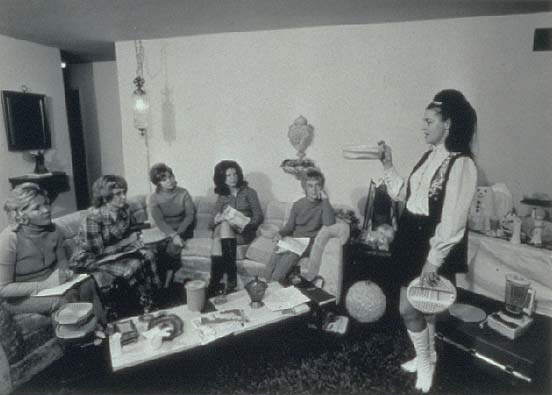
"I enjoy giving a Tupperware party in my home. It gives me a chance
to talk to my friends. But really, Tupperware is a homemaker's dream, you
save time and money because your food keeps longer.")
On January 23, 2000 the exhibition The Suburban Seventies: Photographs
by Bill Owens will open at the San Jose Museum of Art. Capturing the
essence of suburban culture -- tract houses, block parties, mini-skirts,
bell-bottoms, rolled-out "instant" lawns, swimming pools, garage
sales, and shag carpeting -- Bill Owens' classic photographs are considered
to be the definitive treatise on the suburban sprawl that occurred across
America in the 1970s. The exhibition includes approximately 80 black-and-white
and color photographs, and will run through April 2, 2000. (left:
Bill Owens, from the series Suburbia © 1973, photographs 1968-1972,
"I enjoy giving a Tupperware party in my home. It gives me a chance
to talk to my friends. But really, Tupperware is a homemaker's dream, you
save time and money because your food keeps longer.")
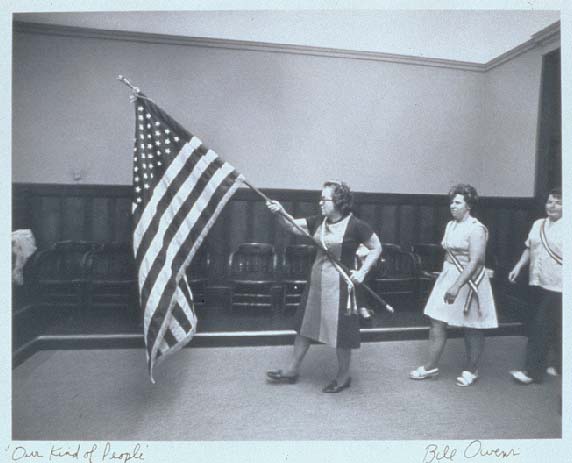
The photographs in The Suburban Seventies focus
on four separate aspects of the suburban  phenomenon -- life, ritual, work, and leisure. The
first three series resulted in separate publications: Suburbia, 1973;
Our Kind of People, 1975; and Working (I Do It For The Money),
1977. (right: Bill Owens, from the series Our Kind of People ©
1975, photographs 1969-74, "The Companions of the Forest of America
teaches devotion to the home, respect for other people's religious beliefs,
loyalty to the American flag and obedience to God's commandments. Our motto
is 'Sociability, Sincerity, and Constancy.' Many good and lasting friendships
are formed through membership in the Companions of the Forest of America."
)
phenomenon -- life, ritual, work, and leisure. The
first three series resulted in separate publications: Suburbia, 1973;
Our Kind of People, 1975; and Working (I Do It For The Money),
1977. (right: Bill Owens, from the series Our Kind of People ©
1975, photographs 1969-74, "The Companions of the Forest of America
teaches devotion to the home, respect for other people's religious beliefs,
loyalty to the American flag and obedience to God's commandments. Our motto
is 'Sociability, Sincerity, and Constancy.' Many good and lasting friendships
are formed through membership in the Companions of the Forest of America."
)
Owens' interest in his subject matter grew out of his work
as a photographer in the 1970s for the Livermore Independent, a Bay
Area suburban newspaper. On his beat, he covered such "newsworthy"
civic events as ribbon cuttings, beauty pageants, and talent shows. While
working for the newspaper, he developed a keen eye for the quirkier side
of the mainstream, and took his own "off-the-wall" pictures in
addition to more predictable photographs for the Independent. Unlike
his predecessors in the documentary tradition -- Diane Arbus, Walker Evans,
and Weegee (Arthur Fellig) -- who focused on marginalized groups, Owens
was fascinated with showing "ordinary" people and places as equally
engaging subjects.
 Far
from ordinary, Owens' photographs - primarily of his friends and neighbors
-- are paired with arch quotations made by the subjects themselves. The
combination of quotes and photographs inspire the viewer to alternately
laugh with recollection, wince in pity, and nod with understanding. For
example, one photograph shows a woman with a bouffant hair-do, dressed in
white leather go-go boots and mini-skirt, as she pitches kitchenware to
her friends. The caption reads: "I enjoy giving a Tupperware party
in my home. It gives me a chance to talk to my friends. But really, Tupperware
is a homemaker's dream, you save time and money because your food keeps
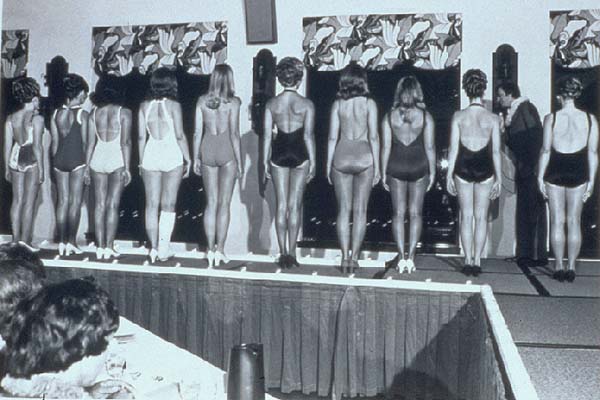
longer." (left: Bill Owens, from the series Our Kind of People
© 1975, photographs 1969-74, "A lot of people say we're chunks
of meat, like cattle, but we're not. We're all individuals with dreams and
aspirations like everybody else. Being a beauty contestant has taught me
about myself, other people, poise, and public speaking. If I had to do it
over again, I would. " )
Far
from ordinary, Owens' photographs - primarily of his friends and neighbors
-- are paired with arch quotations made by the subjects themselves. The
combination of quotes and photographs inspire the viewer to alternately
laugh with recollection, wince in pity, and nod with understanding. For
example, one photograph shows a woman with a bouffant hair-do, dressed in
white leather go-go boots and mini-skirt, as she pitches kitchenware to
her friends. The caption reads: "I enjoy giving a Tupperware party
in my home. It gives me a chance to talk to my friends. But really, Tupperware
is a homemaker's dream, you save time and money because your food keeps
longer." (left: Bill Owens, from the series Our Kind of People
© 1975, photographs 1969-74, "A lot of people say we're chunks
of meat, like cattle, but we're not. We're all individuals with dreams and
aspirations like everybody else. Being a beauty contestant has taught me
about myself, other people, poise, and public speaking. If I had to do it
over again, I would. " )
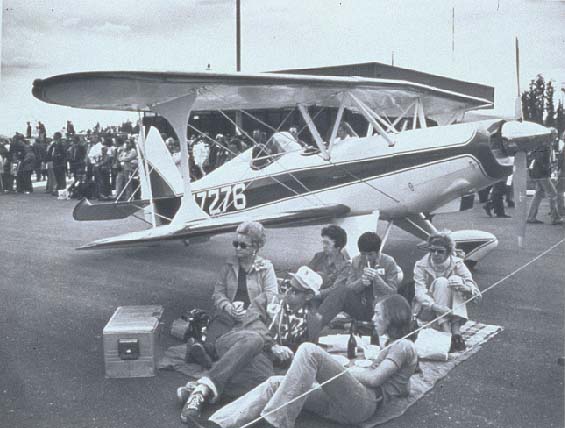
More disquieting is a quote from the parent of a boy who
somberly patrols the neighborhood on  a Big Wheel with a toy rifle in hand: " I don't
feel that Richie playing with guns will have a negative effect on his personality.
(He already wants to be a policeman). His childhood gun-playing won't make
him into a cop shooter. By playing with guns he learns to socialize with
other children. I find the neighbors who are offended by Richie's gun, either
the father hunts or their kids are the first to take Richie's gun and go
off and play with it." (left: Bill Owens, from the series Leisure
(1976-77), Air Show, 1977)
a Big Wheel with a toy rifle in hand: " I don't
feel that Richie playing with guns will have a negative effect on his personality.
(He already wants to be a policeman). His childhood gun-playing won't make
him into a cop shooter. By playing with guns he learns to socialize with
other children. I find the neighbors who are offended by Richie's gun, either
the father hunts or their kids are the first to take Richie's gun and go
off and play with it." (left: Bill Owens, from the series Leisure
(1976-77), Air Show, 1977)
Born in San Jose, Owens first picked up photography in
the mid-1960s to document his  experiences in Jamaica and the West Indies. By 1968,
after returning to the Bay Area, he had landed a staff position at the Livermore
Independent, where he worked for 10 years, entrenching himself in the
suburban community. Fascinated by his neighbors and their surroundings,
he found them to be willing co-conspirators in his idea for a photographic
survey of suburbia. The resulting book projects, funded in part by the National
Endowment for the Arts and the Guggenheim Foundation, were instant national
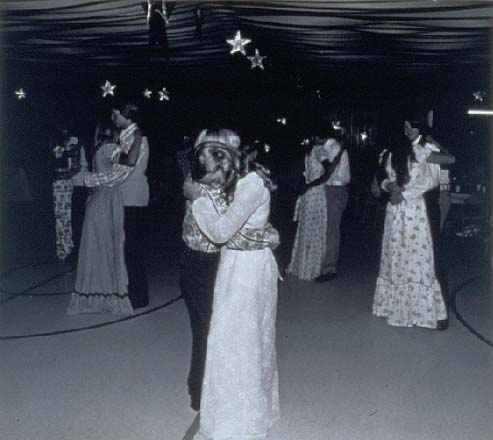
hits which eventually rose to cult status. (right: Bill Owens, from
the series Our Kind of People © 1975, photographs 1969-74, "Our
eighth-grade graduation dance was really far out. We spent over $160 on
crepe paper, stars and decorations. There was an arched entrance with flowers,
a white picket fence, a fountain with real water and a black light. We had
live music and a buffet with chicken, turkey, ham, salad, dessert and punch.
We had a ball. You only graduate from eighth grade once.")
experiences in Jamaica and the West Indies. By 1968,
after returning to the Bay Area, he had landed a staff position at the Livermore
Independent, where he worked for 10 years, entrenching himself in the
suburban community. Fascinated by his neighbors and their surroundings,
he found them to be willing co-conspirators in his idea for a photographic
survey of suburbia. The resulting book projects, funded in part by the National
Endowment for the Arts and the Guggenheim Foundation, were instant national
hits which eventually rose to cult status. (right: Bill Owens, from
the series Our Kind of People © 1975, photographs 1969-74, "Our
eighth-grade graduation dance was really far out. We spent over $160 on
crepe paper, stars and decorations. There was an arched entrance with flowers,
a white picket fence, a fountain with real water and a black light. We had
live music and a buffet with chicken, turkey, ham, salad, dessert and punch.
We had a ball. You only graduate from eighth grade once.")
The Suburban Seventies is curated
by Patricia Hickson, SJMA assistant curator. Unavailable for years, a "new
& improved" version of Bill Owens' Suburbia has just been
released by Fotofolio, with an introduction by David Halberstam. The new
version includes color images to complement the original black-and-white
photographs, and is available at The Museum Store at SJMA.
Read more about San Jose
Museum of Art in Resource Library Magazine.
Text and images courtesy of San Jose Museum of Art
For further biographical information on selected artists
cited above please see America's Distinguished
Artists, a national registry of historic artists.
rev. 12/23/10
Search Resource
Library for thousands of articles and essays on American art.
Copyright 2010 Traditional Fine Arts Organization, Inc., an Arizona nonprofit corporation. All rights
reserved.
 On January 23, 2000 the exhibition The Suburban Seventies: Photographs
by Bill Owens will open at the San Jose Museum of Art. Capturing the
essence of suburban culture -- tract houses, block parties, mini-skirts,
bell-bottoms, rolled-out "instant" lawns, swimming pools, garage
sales, and shag carpeting -- Bill Owens' classic photographs are considered
to be the definitive treatise on the suburban sprawl that occurred across
America in the 1970s. The exhibition includes approximately 80 black-and-white
and color photographs, and will run through April 2, 2000. (left:
Bill Owens, from the series Suburbia © 1973, photographs 1968-1972,
"I enjoy giving a Tupperware party in my home. It gives me a chance
to talk to my friends. But really, Tupperware is a homemaker's dream, you
save time and money because your food keeps longer.")
On January 23, 2000 the exhibition The Suburban Seventies: Photographs
by Bill Owens will open at the San Jose Museum of Art. Capturing the
essence of suburban culture -- tract houses, block parties, mini-skirts,
bell-bottoms, rolled-out "instant" lawns, swimming pools, garage
sales, and shag carpeting -- Bill Owens' classic photographs are considered
to be the definitive treatise on the suburban sprawl that occurred across
America in the 1970s. The exhibition includes approximately 80 black-and-white
and color photographs, and will run through April 2, 2000. (left:
Bill Owens, from the series Suburbia © 1973, photographs 1968-1972,
"I enjoy giving a Tupperware party in my home. It gives me a chance
to talk to my friends. But really, Tupperware is a homemaker's dream, you
save time and money because your food keeps longer.")