Everson Museum of Art
Syracuse, NY
315-474-6064
http://www.everson.org
Public Works of Art Project of 1934: Works
on Paper
 The Everson Museum of Art will present Public Works of Art Project
of 1934: Works on Paper beginning March 3, 2000 and running through
May 14, 2000. The exhibition, culled from the Everson Museum' s permanent
collection, will explore the depth of work created under this early federal
work relief program. Works in the exhibition by approximately twenty artists
- including Mortimer Borne, Paul Busch, Don Freeman, Mabel Dwight, Victoria
Hutson Huntley, Agnes Tait, Prentiss Taylor, Georges Schreiber and Emil
Holzhaver - will portray scenes of the urban landscape and traditional views
of rural life, as well as social problems of the early 1930s - racism, class
inequalities, and unemployment exacerbated by the Great Depression. (left:
Victoria Hutson (1900-1971), Lackawanna Bridge, 1934, lithograph,
9 x 13 1/4 inches, Gift of the PWAP of NYC)
The Everson Museum of Art will present Public Works of Art Project
of 1934: Works on Paper beginning March 3, 2000 and running through
May 14, 2000. The exhibition, culled from the Everson Museum' s permanent
collection, will explore the depth of work created under this early federal
work relief program. Works in the exhibition by approximately twenty artists
- including Mortimer Borne, Paul Busch, Don Freeman, Mabel Dwight, Victoria
Hutson Huntley, Agnes Tait, Prentiss Taylor, Georges Schreiber and Emil
Holzhaver - will portray scenes of the urban landscape and traditional views
of rural life, as well as social problems of the early 1930s - racism, class
inequalities, and unemployment exacerbated by the Great Depression. (left:
Victoria Hutson (1900-1971), Lackawanna Bridge, 1934, lithograph,
9 x 13 1/4 inches, Gift of the PWAP of NYC)
 In
the wake of the Great Depression, a concern for professional artists' employment
led the Roosevelt administration to allocate funds to the Public Works of
Art Project (PWAP). The PWAP ran from December 1933 to June 1934 and was
the first federal attempt to sponsor the fine arts. It employed 3,749 artists,
working in a wide variety of media. Under the guidance of Edward Bruce,
artist and lawyer, it concentrated on hiring established artists, designating
the theme the "American Scene" as appropriate subject matter.
The artists were given the task of creating works to embellish public buildings
- including one artwork for each member of Congress as well as for public
schools, orphanages, libraries, museums and practically every other type
of public building. Don Adams and Arlene Goldbard state in their New Deal Cultural Programs:
Experiments in Cultural Democracy that "PWAP exhibitions in
many cities were well-attended: 33,000 people showed up in a single day
for an opening in Los Angeles. PWAP ended in April, 1934, along with the
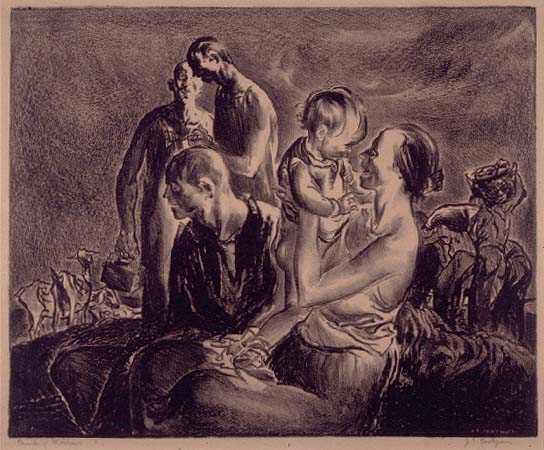
rest of the CWA." (left: John Edward Costigan (1888-1972), Group
of Workers #1, 1934, lithograph, 12 x 14 1/4 inches, Gift of the PWAP
of NYC)
In
the wake of the Great Depression, a concern for professional artists' employment
led the Roosevelt administration to allocate funds to the Public Works of
Art Project (PWAP). The PWAP ran from December 1933 to June 1934 and was
the first federal attempt to sponsor the fine arts. It employed 3,749 artists,
working in a wide variety of media. Under the guidance of Edward Bruce,
artist and lawyer, it concentrated on hiring established artists, designating
the theme the "American Scene" as appropriate subject matter.
The artists were given the task of creating works to embellish public buildings
- including one artwork for each member of Congress as well as for public
schools, orphanages, libraries, museums and practically every other type
of public building. Don Adams and Arlene Goldbard state in their New Deal Cultural Programs:
Experiments in Cultural Democracy that "PWAP exhibitions in
many cities were well-attended: 33,000 people showed up in a single day
for an opening in Los Angeles. PWAP ended in April, 1934, along with the
rest of the CWA." (left: John Edward Costigan (1888-1972), Group
of Workers #1, 1934, lithograph, 12 x 14 1/4 inches, Gift of the PWAP
of NYC)
 PWAP
was part of the Civil Works Administration (CWA), an experimental program
in federal work relief, providing the unemployed with public service jobs
during the bitter winter of 1933-34 when the number of unemployed ranged
from 8 to 17 million workers , this, at a time when the total U.S. population
was just 125 million. Not only did federal funding help artists flourish,
it changed America's relation to art by bringing it into federal and public
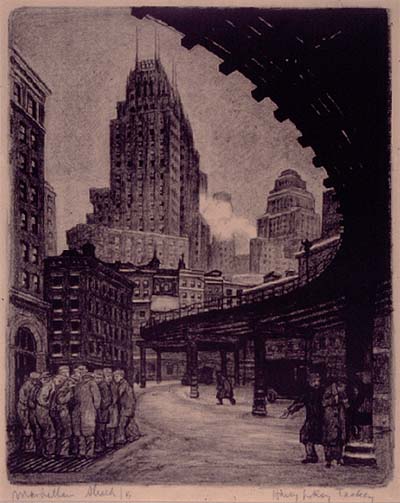
spaces where many could see and interact with the work. (left: Harry
Leroy Taskey (b. 1892), Manhatten Sheep, 1934, lithograph, 14 1/2
x 11 5/8 inches, Gift of the PWAP of NYC)
PWAP
was part of the Civil Works Administration (CWA), an experimental program
in federal work relief, providing the unemployed with public service jobs
during the bitter winter of 1933-34 when the number of unemployed ranged
from 8 to 17 million workers , this, at a time when the total U.S. population
was just 125 million. Not only did federal funding help artists flourish,
it changed America's relation to art by bringing it into federal and public
spaces where many could see and interact with the work. (left: Harry
Leroy Taskey (b. 1892), Manhatten Sheep, 1934, lithograph, 14 1/2
x 11 5/8 inches, Gift of the PWAP of NYC)
Ed: If you are interested in "American Scene"
art of the 1930s and 40s you may enjoy the WPA Period Print Collection Directory
from the University of Montana.
Please Note: RLM does not endorse
sites behind external links. We offer them for your additional research;
external links were chosen on the basis of being the most informative online
source at the time of our search.
Read more in Resource Library
Magazine about the Everson Museum of Art.
For further biographical information on selected artists
cited above please see America's Distinguished
Artists, a national registry of historic artists.
rev. 12/23/10
Search Resource
Library for thousands of articles and essays on American art.
Copyright 2010 Traditional Fine Arts Organization, Inc., an Arizona nonprofit corporation. All rights
reserved.
 The Everson Museum of Art will present Public Works of Art Project
of 1934: Works on Paper beginning March 3, 2000 and running through
May 14, 2000. The exhibition, culled from the Everson Museum' s permanent
collection, will explore the depth of work created under this early federal
work relief program. Works in the exhibition by approximately twenty artists
- including Mortimer Borne, Paul Busch, Don Freeman, Mabel Dwight, Victoria
Hutson Huntley, Agnes Tait, Prentiss Taylor, Georges Schreiber and Emil
Holzhaver - will portray scenes of the urban landscape and traditional views
of rural life, as well as social problems of the early 1930s - racism, class
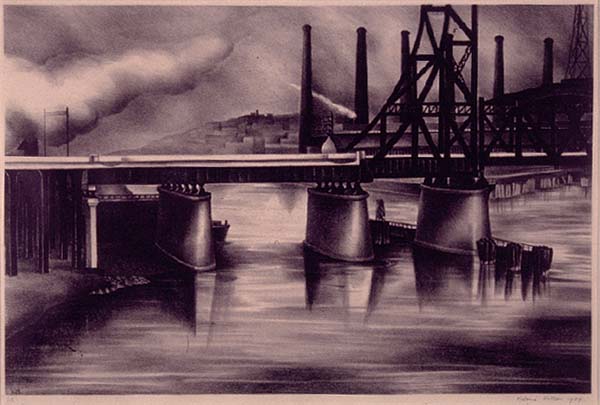
inequalities, and unemployment exacerbated by the Great Depression. (left:
Victoria Hutson (1900-1971), Lackawanna Bridge, 1934, lithograph,
9 x 13 1/4 inches, Gift of the PWAP of NYC)
The Everson Museum of Art will present Public Works of Art Project
of 1934: Works on Paper beginning March 3, 2000 and running through
May 14, 2000. The exhibition, culled from the Everson Museum' s permanent
collection, will explore the depth of work created under this early federal
work relief program. Works in the exhibition by approximately twenty artists
- including Mortimer Borne, Paul Busch, Don Freeman, Mabel Dwight, Victoria
Hutson Huntley, Agnes Tait, Prentiss Taylor, Georges Schreiber and Emil
Holzhaver - will portray scenes of the urban landscape and traditional views
of rural life, as well as social problems of the early 1930s - racism, class
inequalities, and unemployment exacerbated by the Great Depression. (left:
Victoria Hutson (1900-1971), Lackawanna Bridge, 1934, lithograph,
9 x 13 1/4 inches, Gift of the PWAP of NYC)