Saint Louis Art Museum
St. Louis, MO
314-721-0072
http://www.slam.org
Useful Beauty: Early American Decorative
Arts from St. Louis Collections
 The
Colonial period, and the 18th century in particular, is revered as the Golden
Age of American craftsmanship. The decorative arts produced during the period
were stylistically expressive and artistically charged. Although Colonial
Americans seldom recorded their thoughts about these objects, the visual
richness of materials, textures and surfaces show that aesthetic pleasure
was an integral element in their making as well as their consumption.
The
Colonial period, and the 18th century in particular, is revered as the Golden
Age of American craftsmanship. The decorative arts produced during the period
were stylistically expressive and artistically charged. Although Colonial
Americans seldom recorded their thoughts about these objects, the visual
richness of materials, textures and surfaces show that aesthetic pleasure
was an integral element in their making as well as their consumption.
Useful Beauty: Early American Decorative Arts from St.
Louis Collections presents 50 superior 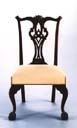 examples
of furniture, silver and needlework made in America between 1700 and 1800.
The decorative arts of 18th-century America reflected new ideas and attitudes
that set this period apart. By about 1700, furniture, silver and other household
objects became more numerous and more responsive to stylistic change. Many
new kinds of decorative arts were designed for increasingly socialized customs.
Throughout the century, the growing assemblage of furniture and furnishings
was accompanied by new modes of comportment and etiquette that were part
of a larger trend in social refinement. The everyday lives of Americans
were increasingly ordered by conventions of behavior and by objects such
as formal chairs, tables and table wares that reinforced the public aspect
of social rituals.
examples
of furniture, silver and needlework made in America between 1700 and 1800.
The decorative arts of 18th-century America reflected new ideas and attitudes
that set this period apart. By about 1700, furniture, silver and other household
objects became more numerous and more responsive to stylistic change. Many
new kinds of decorative arts were designed for increasingly socialized customs.
Throughout the century, the growing assemblage of furniture and furnishings
was accompanied by new modes of comportment and etiquette that were part
of a larger trend in social refinement. The everyday lives of Americans
were increasingly ordered by conventions of behavior and by objects such
as formal chairs, tables and table wares that reinforced the public aspect
of social rituals.
Tea drinking, dining and card playing exemplify everyday
activities transformed into expressions of a cultivated lifestyle when accompanied
by beautiful and useful objects. Consumption of tea played a central role
in the lives of Colonial Americans, particularly women. The ritual fueled
the development of an array of household goods, including ceramics, silver
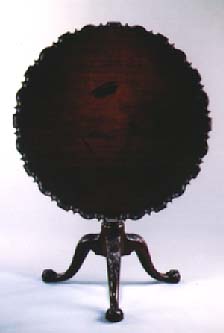
wares and furniture. This Philadelphia rococo-style tea table displays a
boldly carved top and would have provided an ornamental surface for the
display of fashionable tea wares. A similar tea table and chairs made by
Eliphalet Chapin for the marriage of John and Anna Marsh illustrate the
kind of goods the young couple would need to furnish a fashionable parlor
in 18th-century Connecticut.
In the dining roam, long rectangular tables were common
prior to the 18th century. The change from rectangular to round tables in
the 18th century seems to mark a departure from the hierarchy based on proximity
to the "chair man" at the head of the table to a more congenial
arrangement of genteel diners seated in sets of chairs at a round table.
Other objects intended for the dining room include sideboards for serving
food and for the display of silver tankards, canns, sauceboats, candlesticks
and other forms as well as imported glassware and ceramics.
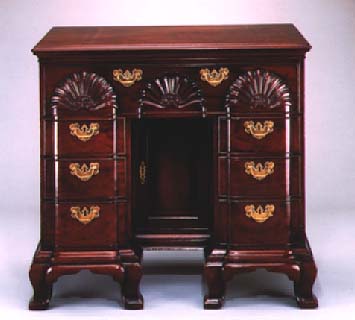
Furnishings used in Colonial bedchambers include case furniture
such as the high chest of drawers and chest on  chest designed for the storage and safekeeping of
clothing and other textiles and dressing and bureau tables for grooming
rituals. The dressing tables in this exhibition illustrate formal and stylistic
variations in the design of bedchamber furniture made in 18th-century New
England, the mid-Atlantic region and the South. Bed chambers
chest designed for the storage and safekeeping of
clothing and other textiles and dressing and bureau tables for grooming
rituals. The dressing tables in this exhibition illustrate formal and stylistic
variations in the design of bedchamber furniture made in 18th-century New
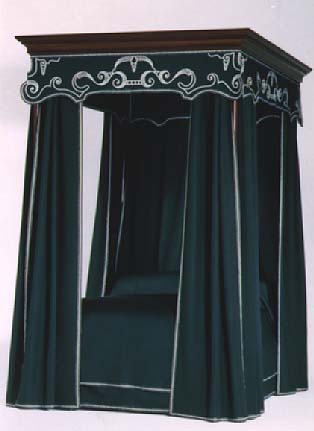
England, the mid-Atlantic region and the South. Bed chambers were characterized
by extensive textile furnishings such as bedding and bed hangings, window
curtains, chairs and easy chairs, couches or other seating furniture. Because
of the expense of their upholstery, easy chairs were never commonplace in
American homes and were rarely seen in the parlors of Colonial elites. Instead,
they most often were used in bedchambers, where they provided warm, comfortable
seating. In 18th-century households, the best bed, consisting of the bedstead,
the bed hangings and the bed or mattress, was among the most valuable household
goods an individual possessed.
were characterized
by extensive textile furnishings such as bedding and bed hangings, window
curtains, chairs and easy chairs, couches or other seating furniture. Because
of the expense of their upholstery, easy chairs were never commonplace in
American homes and were rarely seen in the parlors of Colonial elites. Instead,
they most often were used in bedchambers, where they provided warm, comfortable
seating. In 18th-century households, the best bed, consisting of the bedstead,
the bed hangings and the bed or mattress, was among the most valuable household
goods an individual possessed.
 Highlights
of the exhibition include superb Queen Anne and Chippendale-style furniture
made in Boston, Newport, New York and Philadelphia; silver wares by Myer
Myers, Paul Revere and Jacob Hurd; and an exquisite rococo-style needlework
coat of arms made in 1765 by Elizabeth Flower. All of the objects in the
exhibition were lent by private collectors in St. Louis. The special exhibition
Useful Beauty. Early American Decorative Arts from St. Louis Collections,
curated by David Conradsen, curatorial assistant of decorative arts and
design, opens June 19 and runs through August 15, 1999. The Museum has published
a full catalogue of the exhibition. The exhibition and accompanying catalogue
are made possible with the generous assistance of Mr. and Mrs. Paul R. Cahn,
Dr. and Mrs. George R. Schoedinger III, Mr. and Mrs. Edward J. Nusrala,
Dr. and Mrs. Matthew Newman, Mr. and Mrs. James F. Dierberg, the Acanthus
Society and Sotheby's.
Highlights
of the exhibition include superb Queen Anne and Chippendale-style furniture
made in Boston, Newport, New York and Philadelphia; silver wares by Myer
Myers, Paul Revere and Jacob Hurd; and an exquisite rococo-style needlework
coat of arms made in 1765 by Elizabeth Flower. All of the objects in the
exhibition were lent by private collectors in St. Louis. The special exhibition
Useful Beauty. Early American Decorative Arts from St. Louis Collections,
curated by David Conradsen, curatorial assistant of decorative arts and
design, opens June 19 and runs through August 15, 1999. The Museum has published
a full catalogue of the exhibition. The exhibition and accompanying catalogue
are made possible with the generous assistance of Mr. and Mrs. Paul R. Cahn,
Dr. and Mrs. George R. Schoedinger III, Mr. and Mrs. Edward J. Nusrala,
Dr. and Mrs. Matthew Newman, Mr. and Mrs. James F. Dierberg, the Acanthus
Society and Sotheby's.
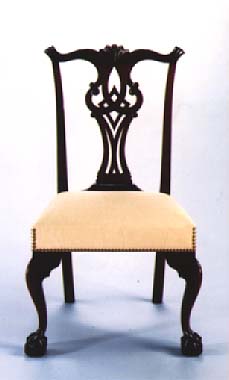
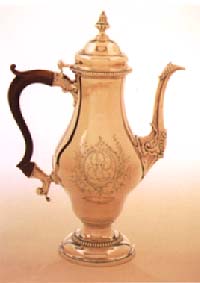
Images from top to bottom: William Hollingshead, working 1757-1785; Philadelphia,
Pennsylvania; Coffeepot, 1775-85; silver, wood; 12 1/2 x 10 x 5 inches;
34 oz 9 dwt gross (1068g); Private Collection. Eliphalet Chapin, 1741-1807;
East Windsor, Connecticut; Chair, 1775; cherry, pine; 38 1/2 x 23
3/4 x 22 inches; Private Collection. Newport, Rhode Island; Bureau Table,
1765-90; mahogany, chestnut, maple, pine; 33 1/4 x 36 3/4 x 21 inches; Private
Collection. Philadelphia, Pennsylvania; Bedstead, 1760-80; mahogany,
hickory; 93 1/2 x 77 x 57 inches; Private Collection. Philadelphia, Pennsylvania;
Tea Table, 1755-75; mahogany, iron; 27 3/4 x 33 3/4 x 23 inches;
Private Collection
Read more about the Saint
Louis Art Museum in Resource Library
Magazine
Search for more
articles and essays on American art in Resource Library. See America's Distinguished Artists for biographical information on historic artists.
This page was originally published in 1999 in Resource
Library Magazine. Please see Resource Library's Overview section for
more information.
Copyright 2012 Traditional
Fine Arts Organization, Inc., an Arizona nonprofit
corporation. All rights reserved.
 The
Colonial period, and the 18th century in particular, is revered as the Golden
Age of American craftsmanship. The decorative arts produced during the period
were stylistically expressive and artistically charged. Although Colonial
Americans seldom recorded their thoughts about these objects, the visual
richness of materials, textures and surfaces show that aesthetic pleasure
was an integral element in their making as well as their consumption.
The
Colonial period, and the 18th century in particular, is revered as the Golden
Age of American craftsmanship. The decorative arts produced during the period
were stylistically expressive and artistically charged. Although Colonial
Americans seldom recorded their thoughts about these objects, the visual
richness of materials, textures and surfaces show that aesthetic pleasure
was an integral element in their making as well as their consumption.