Museum of Northern Arizona
Flagstaff, AZ
520-774-5213
http://www.musnaz.org
Kaleidoscopes: Symmetry
in Motion
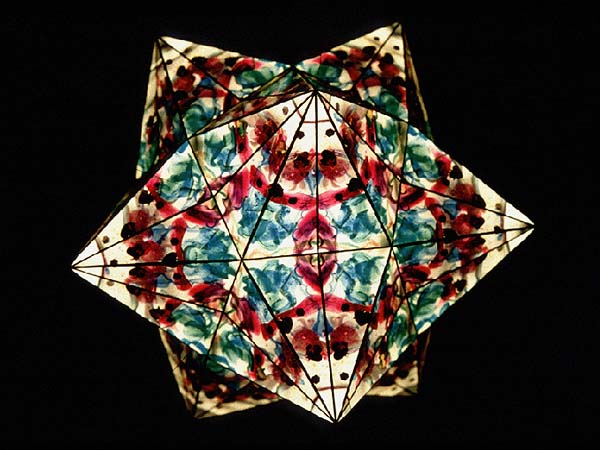
 Imagine a kaleidoscope large enough to stand
inside, kaleidoscopes you could wear, and those made of unusual materials
like alabaster, found objects, or zebra wood. Those are just a few of the
highlights of a new Museum of Northern Arizona exhibit Kaleidoscopes:
Symmetry in Motion, which runs through April 9, 2000. To further the
inherent fascination of kaleidoscopes, the Museum is offering children's
programs where kids can make their own visual creations with the assistance
of a Gallery Guide. These programs are offered to drop-in visitors for the
regular price of admission on the first and third Sundays of each month
the exhibit is open from 2 to 4 PM. (left: Kaleidoscope by Michael
Redmond, photo by Mike Thompson)
Imagine a kaleidoscope large enough to stand
inside, kaleidoscopes you could wear, and those made of unusual materials
like alabaster, found objects, or zebra wood. Those are just a few of the
highlights of a new Museum of Northern Arizona exhibit Kaleidoscopes:
Symmetry in Motion, which runs through April 9, 2000. To further the
inherent fascination of kaleidoscopes, the Museum is offering children's
programs where kids can make their own visual creations with the assistance
of a Gallery Guide. These programs are offered to drop-in visitors for the
regular price of admission on the first and third Sundays of each month
the exhibit is open from 2 to 4 PM. (left: Kaleidoscope by Michael
Redmond, photo by Mike Thompson)
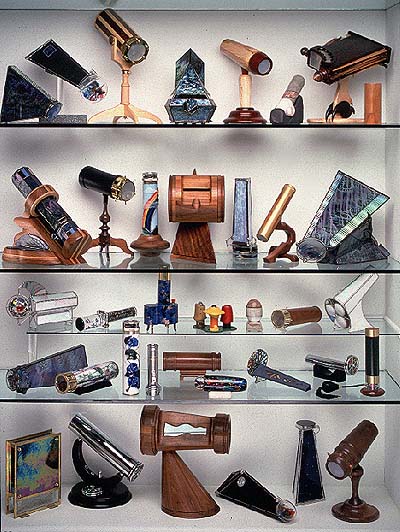
Over 200 kaleidoscopes were selected for Kaleidoscopes:
Symmetry in Motion from the personal collection of  Tess and Marty Scherer, who own a kaleidoscope art
gallery in Sedona, Ariz. Marty began collecting the optical wonders 40 years
ago and even owns the first patented kaleidoscope, invented by Scottish
physicist Sir David Brewster in 1817. Brewster said of his invention, "It
will create in a single hour what a thousand artists could not invent in
the course of a year" (right: Kaleidoscopes from the Scherer
Collection, photo by Mike Thompson)
Tess and Marty Scherer, who own a kaleidoscope art
gallery in Sedona, Ariz. Marty began collecting the optical wonders 40 years
ago and even owns the first patented kaleidoscope, invented by Scottish
physicist Sir David Brewster in 1817. Brewster said of his invention, "It
will create in a single hour what a thousand artists could not invent in
the course of a year" (right: Kaleidoscopes from the Scherer
Collection, photo by Mike Thompson)
The exhibit explores many of the facets that intrigued
Brewster, including the math and science behind the optics, as well as ideas
like optical milestones, the history of kaleidoscopes, and biographies of
the nearly 20 artists who made the kaleidoscopes featured in the exhibit.
Some of the artists utilize slumped glass, stained glass,
flame-worked glass, alabaster, and fine and rare woods. The exhibit incorporates
an array of kaleidoscopes including miniatures, jewelry, toys, marble-filled,
liquid-filled, polyangular, those crafted from found objects, and a few
featuring three-dimensional illusions. The collection's eclectic and awe-inspiring
nature offers the perfect opportunity for MNA to fulfill its mission of
art education.
 "We
chose the Museum of Northern Arizona because of its dedication to the community
in offering comprehensive exhibits that are not only displayed well, but
also have an emphasis on education," said Tess Scherer. (left:
Interior View, photo by Tess Scherer)
"We
chose the Museum of Northern Arizona because of its dedication to the community
in offering comprehensive exhibits that are not only displayed well, but
also have an emphasis on education," said Tess Scherer. (left:
Interior View, photo by Tess Scherer)
Basically, a kaleidoscope is a series of two or three mirrors
of equal length and width, placed together to form a triangle. Objects are
placed at one end of the mirror-system and viewed through the opposite end;
they are reflected internally from the surfaces of the mirrors to form interesting
patterns. The number of reflections and the complexity of the patterns seen
are directly related to the angles between the mirrors. Today there are
over 150 craftsmen making kaleidoscopes, which range from the familiar cardboard
toys to sophisticated artistic designs.
Revised 2/23/00
Read more about the Museum
of Northern Arizona in Resource Library
Magazine
rev. 12/27/10
Search Resource
Library for thousands of articles and essays on American art.
Copyright 2010 Traditional Fine Arts Organization, Inc., an Arizona nonprofit corporation. All rights
reserved.
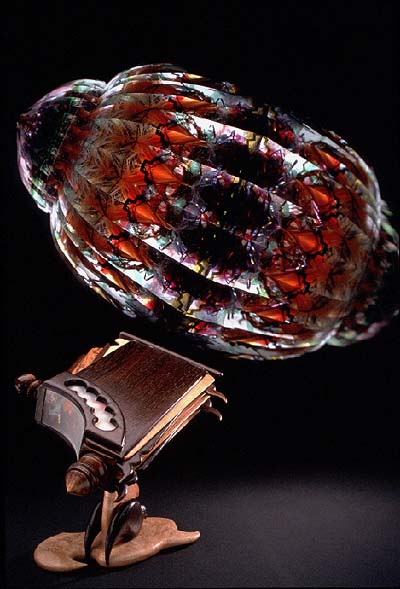 Imagine a kaleidoscope large enough to stand
inside, kaleidoscopes you could wear, and those made of unusual materials
like alabaster, found objects, or zebra wood. Those are just a few of the
highlights of a new Museum of Northern Arizona exhibit Kaleidoscopes:
Symmetry in Motion, which runs through April 9, 2000. To further the
inherent fascination of kaleidoscopes, the Museum is offering children's
programs where kids can make their own visual creations with the assistance
of a Gallery Guide. These programs are offered to drop-in visitors for the
regular price of admission on the first and third Sundays of each month
the exhibit is open from 2 to 4 PM. (left: Kaleidoscope by Michael
Redmond, photo by Mike Thompson)
Imagine a kaleidoscope large enough to stand
inside, kaleidoscopes you could wear, and those made of unusual materials
like alabaster, found objects, or zebra wood. Those are just a few of the
highlights of a new Museum of Northern Arizona exhibit Kaleidoscopes:
Symmetry in Motion, which runs through April 9, 2000. To further the
inherent fascination of kaleidoscopes, the Museum is offering children's
programs where kids can make their own visual creations with the assistance
of a Gallery Guide. These programs are offered to drop-in visitors for the
regular price of admission on the first and third Sundays of each month
the exhibit is open from 2 to 4 PM. (left: Kaleidoscope by Michael
Redmond, photo by Mike Thompson)