Nevada Museum of Art
Reno, NV
775-329-3333
http://www.nevadaart.org/
Edward Borein: On the Range
December 11, 1999 - February 6, 2000
The traditions of cattle ranching
and the western buckaroo are explored in this exhibition of watercolors,
etchings, drawings and memorabilia by artist Edward Borein, presented at
the Nevada Museum of Art (NMA) from Saturday, December 11, 1999 through
Sunday, February 6, 2000.
 Along
with friend and contemporary Charles M. Russell, Borein (1872-1945) was
among the foremost interpreters of the Old West in American art and created
works inspired by the experiences of the buckaroo and vaquero. (left:
photo of Will Rogers, Fred Stone, Ed Borein at Rogers' home in Santa Monica,
1934)
Along
with friend and contemporary Charles M. Russell, Borein (1872-1945) was
among the foremost interpreters of the Old West in American art and created
works inspired by the experiences of the buckaroo and vaquero. (left:
photo of Will Rogers, Fred Stone, Ed Borein at Rogers' home in Santa Monica,
1934)
Edward Borein: On the Range
presents a broad selection of approximately 100 works highlighting Borein's
long career as a cowboy artist and his understanding of the evolution of
western history. Subjects include cowboys, vaqueros, rodeo stunt riders,
Native Americans and California missions. Borein specialized in printmaking
and watercolor painting, but also created works in oil as well as intricate
miniature saddles, bridles and animals. The exhibit will also include many
of Borein's personal artifacts such as his saddle, Mexican charro style
parade suit, drawing table, etching press and several of the miniatures
he produced later in his career.
Edward Borein was a self-trained artist and a native Californian.
He was born in San Leandro near Oakland, where as a boy, he began to sketch
and eventually served as an apprentice for a saddle  maker. He studied for only one month at the San Francisco
Art Association School before working as a vaquero on the large Spanish
ranches of the area. His horse became his primary mode of transportation
and he could rope, herd, and brand cattle alongside the skillful Mexican
vaqueros still working in the far West. It was on the ranch that he would
draw and sketch the postures, gestures, and costumes of the riders along
with the characteristics of horses and cattle in motion. Throughout his
career, most of his images retained the freshness of these on-site sketches.
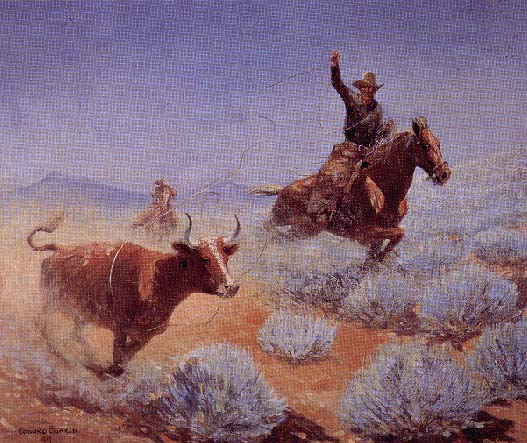
(right: Edward Borein, Cowboy Roping a Steer, 1919, oil on
canvas, 20 x 24 inches)
maker. He studied for only one month at the San Francisco
Art Association School before working as a vaquero on the large Spanish
ranches of the area. His horse became his primary mode of transportation
and he could rope, herd, and brand cattle alongside the skillful Mexican
vaqueros still working in the far West. It was on the ranch that he would
draw and sketch the postures, gestures, and costumes of the riders along
with the characteristics of horses and cattle in motion. Throughout his
career, most of his images retained the freshness of these on-site sketches.
(right: Edward Borein, Cowboy Roping a Steer, 1919, oil on
canvas, 20 x 24 inches)
Borein's first patrons were the publishers of 10-cent magazines
such as Sunset or Colliers, who used his simple and direct
drawings to illustrate popular western stories and advertisements. From
1907 to 1919, Borein resided mainly in New York City where he built contacts
with dealers and with other artists, including Charles Russell. While in
the city, he would draw upon prior experiences and used his wealth of old
sketches to create new works. Borein periodically returned West, traveling
through Western Canada and "Old Mexico" as well as Arizona and
New Mexico. He brought these experiences to life again and again within
the many paintings and prints created during this period.
 Borein's
career began to thrive when he moved to Santa Barbara, California in 1921.
it was in Santa Barbara that he began his most intensive period of printmaking
while experimenting with new inks and techniques. Borein sold the works
from his downtown studio, greeting customers as the door while telling cowboy
stories. He maintained a wide circle of friends including Charles Russell,
Will Rogers, Leo Carrillo, Carl Oscar Borg, and Joe Delong (Charles Russell's
only pupil). In addition to his own artwork, he practiced his leatherworking
skills and produced numerous carefully worked miniature saddles, bridles,
riatas, etc. At the time of his death in 1945, Borein had become a legend
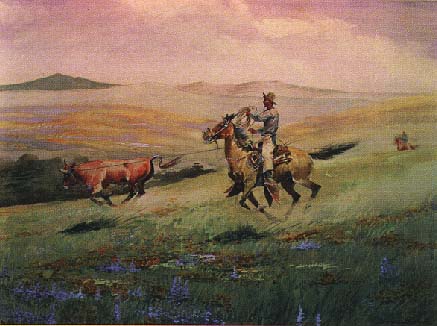
in Santa Barbara. (left: Edward Borein, Runaway Steer, watercolor,
14 1/2 x 19 1/2 inches, Courtesy of Gerald Peters Gallery, Santa Fe, NM)
Borein's
career began to thrive when he moved to Santa Barbara, California in 1921.
it was in Santa Barbara that he began his most intensive period of printmaking
while experimenting with new inks and techniques. Borein sold the works
from his downtown studio, greeting customers as the door while telling cowboy
stories. He maintained a wide circle of friends including Charles Russell,
Will Rogers, Leo Carrillo, Carl Oscar Borg, and Joe Delong (Charles Russell's
only pupil). In addition to his own artwork, he practiced his leatherworking
skills and produced numerous carefully worked miniature saddles, bridles,
riatas, etc. At the time of his death in 1945, Borein had become a legend
in Santa Barbara. (left: Edward Borein, Runaway Steer, watercolor,
14 1/2 x 19 1/2 inches, Courtesy of Gerald Peters Gallery, Santa Fe, NM)
Overall, the exhibition examines the cultural insights
of the buckaroo and vaquero traditions. Through his work, Borein depicts
a comprehensive understanding of the lifeways of the rural ranch hand.
EXHBITION CATALOGUE
The NMA has published a 64 page catalogue documenting the
exhibition. The catalogue includes essays by Paul Starrs, professor of Geography
at the University of Nevada, Reno, and Diane Deming, Curator at the Nevada
Museum of Art, as well as color plates and reproductions of works featured
in the exhibit. The catalogue is on sale in the NMA Museum Store.
EXHBITION SPONSORS
This exhibition is made possible by a generous grant from
the E. L. Wiegand Foundation. Additional support provided by The Charles
Redd Center for Western Studies, KOLO News Channel 8, and the Nevada Appeal.
Edward Borein: On the Range is organized in conjunction with the
Santa Barbara Historical Society, Santa Barbara, California.
 ADDITIONAL
EXHIBITION
ADDITIONAL
EXHIBITION
Also on exhibit during the Borein exhibition, NMA is presenting
Dreamings: Suzanne Kanatsiz, generously supported by the Nevada Arts
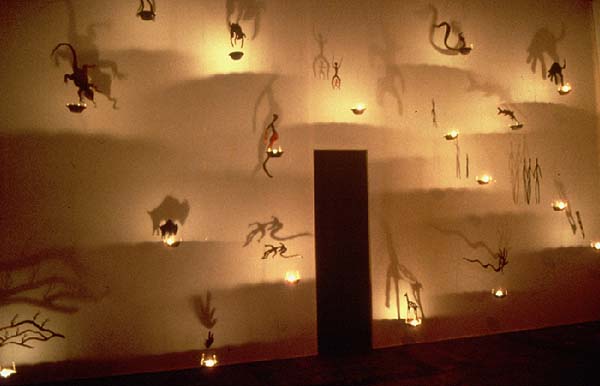
Council, University of Nevada, Reno and Nevada Museum of Art. (left:
Suzanne Kanatsiz, The Inside Passage, 1995, 20 x 16 x 100 inches,
mixed media installation)
Please also see our previously published articles: Edwin Borein: The Artist 's Life and Works
(6/5/99), Edward Borein: The Artist's
Life and Work (1/13/99) and Edward
Borein (1872 - 1945)
Read more about the Nevada Museum
of Art in Resource Library Magazine
For further biographical information on selected artists
cited above please see America's Distinguished
Artists, a national registry of historic artists.
rev. 11/26/10
Search Resource
Library for thousands of articles and essays on American art.
Copyright 2010 Traditional Fine Arts Organization, Inc., an Arizona nonprofit corporation. All rights
reserved.
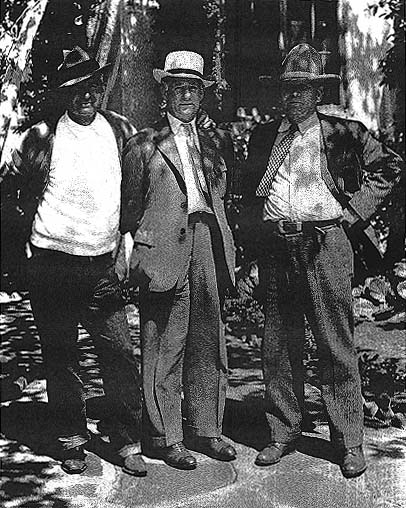 Along
with friend and contemporary Charles M. Russell, Borein (1872-1945) was
among the foremost interpreters of the Old West in American art and created
works inspired by the experiences of the buckaroo and vaquero. (left:
photo of Will Rogers, Fred Stone, Ed Borein at Rogers' home in Santa Monica,
1934)
Along
with friend and contemporary Charles M. Russell, Borein (1872-1945) was
among the foremost interpreters of the Old West in American art and created
works inspired by the experiences of the buckaroo and vaquero. (left:
photo of Will Rogers, Fred Stone, Ed Borein at Rogers' home in Santa Monica,
1934)