Memorial Art Gallery of the University
of Rochester
Rochester, NY
716-473-7720
http://www.rochester.edu/MAG/
Maxfield Parrish, 1870-1966
 The New York Times calls him "one
of the country's first brand-name artists" and notes that his images
"helped define the mood and style of an era." Smithsonian
magazine calls him "the common man's Rembrandt." By the 1920s,
he was the highest paid artist in America, and his prints were said to hang
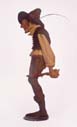
in one out of every four households. (left: Gnome (Snow White),
ca. 1916, Painted figure cutout with jigsaw, 16 1/2 x 5 inches, American
Precision Museum, Windsor, VT.)
The New York Times calls him "one
of the country's first brand-name artists" and notes that his images
"helped define the mood and style of an era." Smithsonian
magazine calls him "the common man's Rembrandt." By the 1920s,
he was the highest paid artist in America, and his prints were said to hang
in one out of every four households. (left: Gnome (Snow White),
ca. 1916, Painted figure cutout with jigsaw, 16 1/2 x 5 inches, American
Precision Museum, Windsor, VT.)
His name was Maxfield Parrish, and his long and prolific
career is the focus of a major exhibition which opened at the Memorial Art
Gallery February 20, 2000. Organized by the Pennsylvania Academy of the
Fine Arts and The American Federation of Arts, Maxfield Parrish, 1870-1966
is the first-ever critical retrospective of one of America's most beloved
artists-and the largest and most expensive exhibition ever shown at the
Gallery.
The exhibition, which remains on view through April 30,
2000 comprises more than 130 paintings,  drawings, prints, photos and ephemera from the artist's
70-year career. Among the key works in this traveling exhibition is a painting
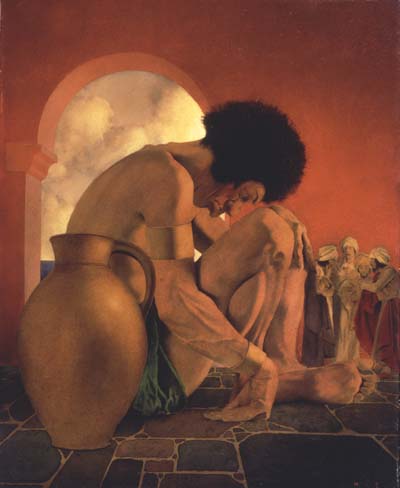
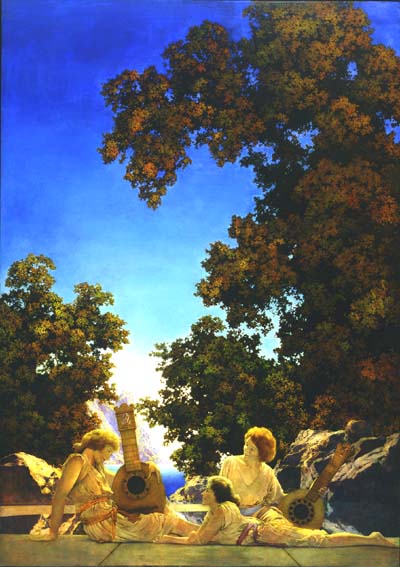
well known to Memorial Art Gallery visitors. Interlude: The Lute Players,
which George Eastman commissioned for Rochester's Eastman Theater, is on
permanent loan to the Gallery from the Eastman School of Music. (right:
Sinbad Plots Against the Giant,1907, Oil on cardboard, 20 1/8 x 16
1/8 inches, Philadelphia Museum of Art, Centennial gift of Mrs. Francis
P. Garvan.)
drawings, prints, photos and ephemera from the artist's
70-year career. Among the key works in this traveling exhibition is a painting
well known to Memorial Art Gallery visitors. Interlude: The Lute Players,
which George Eastman commissioned for Rochester's Eastman Theater, is on
permanent loan to the Gallery from the Eastman School of Music. (right:
Sinbad Plots Against the Giant,1907, Oil on cardboard, 20 1/8 x 16
1/8 inches, Philadelphia Museum of Art, Centennial gift of Mrs. Francis
P. Garvan.)
The Stuff that Dreams Are Made Of
 Deeply
committed to the popularization of art, Maxfield Parrish was one of the
first artists to take advantage of technological advances in the color printing
industry. For seven decades, he made a fine living turning out magazine
covers, book illustrations, posters, calendars, murals and paintings. He
actually conceived many of his paintings with a mind to how they would look
as prints. For their part, Americans delighted in his visions of fantasy,
with overtones of nostalgia, innocence and humor. They loved his hyperrealistic
renderings and his signature "Parrish blue"--an iridescent blend
of cobalt, emerald, Indian yellow and rose madder. As Brace Watson sums
it up in Smithsonian: "In a hustling world where skies were
too often gray and gardens no bigger than a Brooklyn back-yard, Parrish
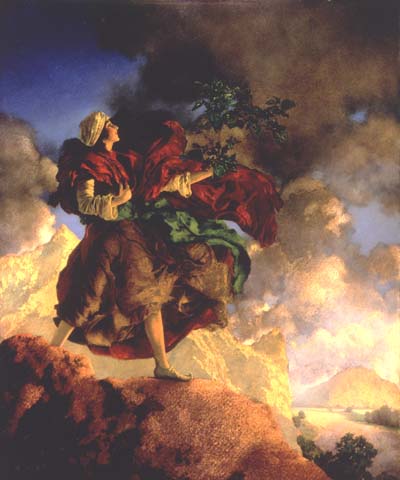
painted the stuff dreams are made of." (left: Princess Parizade
Bringing Home the Singing Tree, 1906, Oil on stretched paper, 20 1/16
x 16 1/16 inches, Pennsylvania Academy of the Fine Arts, Gift of Mrs. Francis
P. Garvan.)
Deeply
committed to the popularization of art, Maxfield Parrish was one of the
first artists to take advantage of technological advances in the color printing
industry. For seven decades, he made a fine living turning out magazine
covers, book illustrations, posters, calendars, murals and paintings. He
actually conceived many of his paintings with a mind to how they would look
as prints. For their part, Americans delighted in his visions of fantasy,
with overtones of nostalgia, innocence and humor. They loved his hyperrealistic
renderings and his signature "Parrish blue"--an iridescent blend
of cobalt, emerald, Indian yellow and rose madder. As Brace Watson sums
it up in Smithsonian: "In a hustling world where skies were
too often gray and gardens no bigger than a Brooklyn back-yard, Parrish
painted the stuff dreams are made of." (left: Princess Parizade
Bringing Home the Singing Tree, 1906, Oil on stretched paper, 20 1/16
x 16 1/16 inches, Pennsylvania Academy of the Fine Arts, Gift of Mrs. Francis
P. Garvan.)


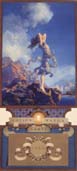
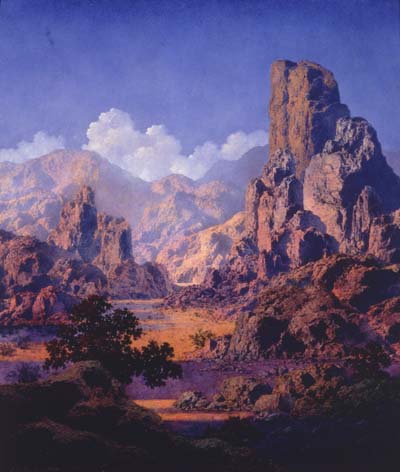
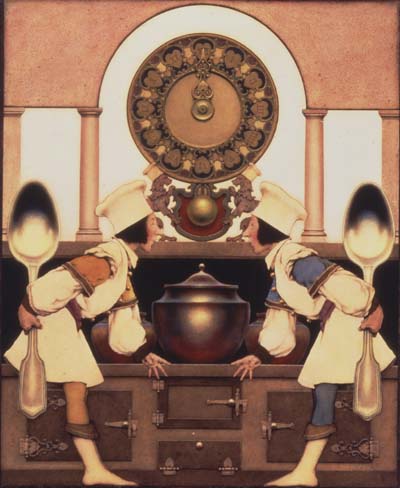
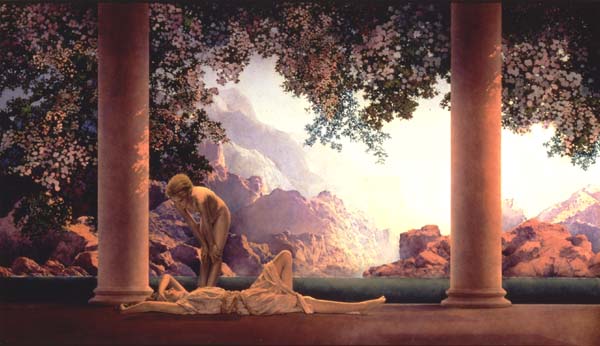
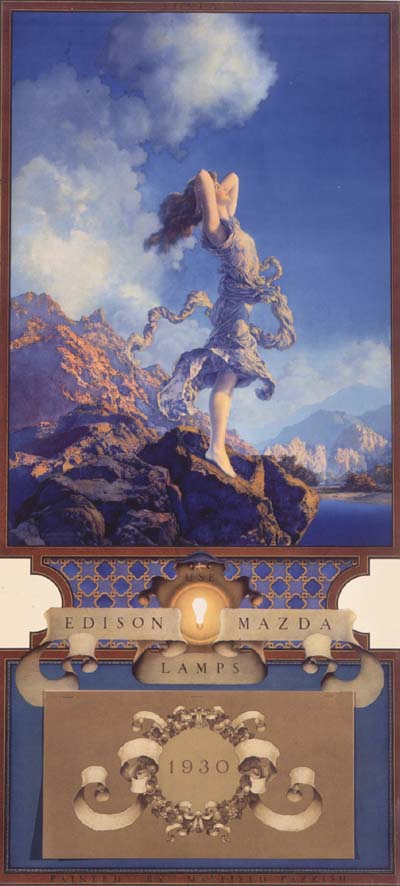
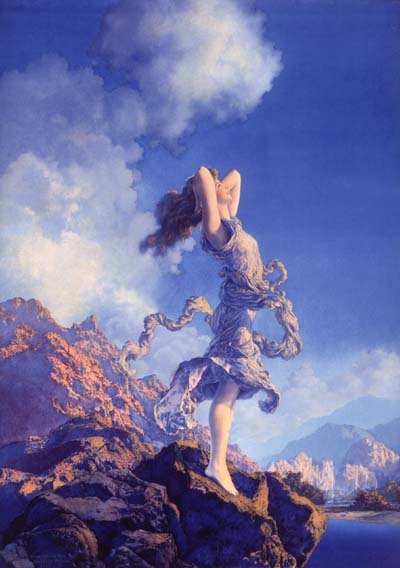
left to right: Arizona, 1950, Oil on board, 20 1/2 x 17 inches,
Phoenix Art Museum. Bequest of Thelma Kieckhefer; Two Pastry Cooks: Blue
Hose and Yellow Hose, 1921, Oil and paper laid down on panel, 20 1/8
x 16 1/4 inches, Private collection; Daybreak, 1922, Oil on panel,
26 x 45 inches, Private collection; Edison Mazda Lamps Calendar: Ecstasy,
1930, Lithograph on paper, 33 7/8 x 15 3/8 inches, Rare Book Department,
The Free Library of Philadelphia; detail of Edison Mazda Lamps Calendar:
Ecstasy
In 1936, Time magazine went so far as to proclaim
Maxfield Parrish one of the three most popular artists in the world--the
others being Van Gogh and Cézanne. But such unashamed commercialism
did not sit well with the critics, and it would be another three decades
before the art world--spurred by such Parrish enthusiasts as Andy Warhol--would once again embrace
Maxfield Parrish.
A Second Look
In 1964, an exhibition of Parrish's work opened at Bennington
College. There was surprise in some quarters when it turned out that the
artist was not dead, but alive and well at his hilltop home in New Hampshire.
He was 94 years old and had only recently painted what would be his last
picture. Parrish, once denounced as hopelessly middlebrow, suddenly found
himself lionized by the critics and hailed as a progenitor of Pop Art.
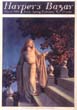

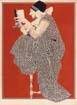
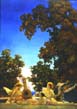
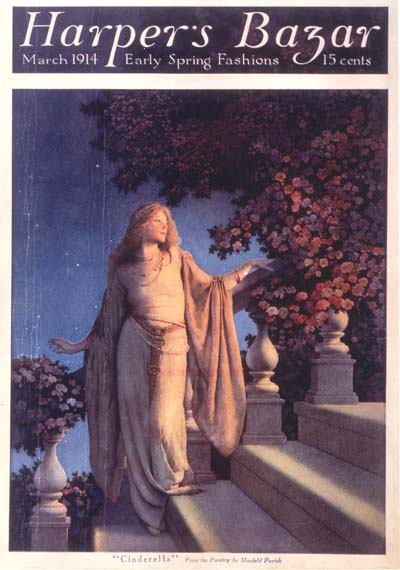
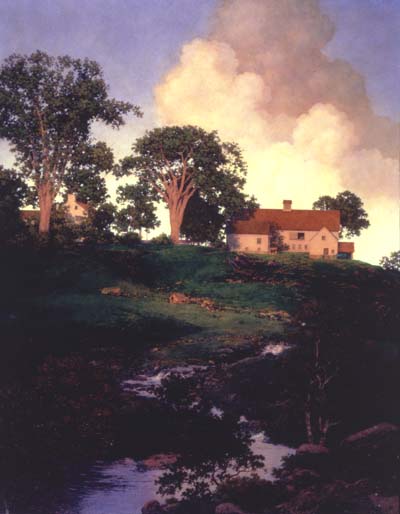
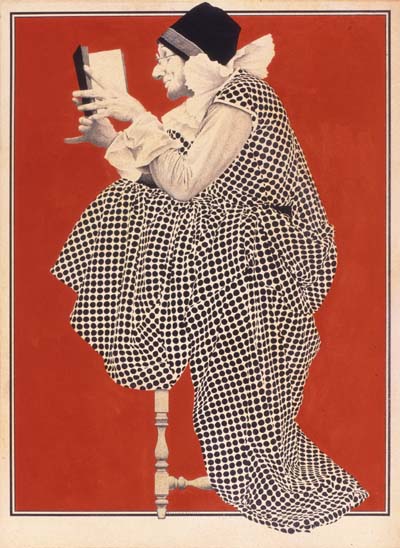
left to right: Harper's Bazar: Cinderella, 1914, Lithograph on
paper, 14 1/4 x 9 3/4 inches, Rare Book Department, The Free Library of
Philadelphia; Hunt Farm, 1948, Oil on board, 23 x 18 7/8 inches,
Hood Museum of Art, Dartmouth College, Hanover, NH. Gift of the artist,
through the Friends of the Library; The Idiot, 1910, Oil paint over
graphite and ink on stretched paper, 22 x 16 inches, The Fine Arts Museums
of San Francisco, Achenbach Foundation for Graphic Arts, Bequest of Arthur
W. Barney; Interlude (The Lute Players), 1922, Oil on canvas, 6 feet
1I inches x 4 feet 11 inches,. Memorial Art Gallery, permanent loan from
the Eastman School of Music.
Thirty-five years later, Maxfield Panish is enjoying yet
another wave of interest, in the wake of the current retrospective. His
works are setting records at auction. Celebrities from George Lucas to Jack
Nicholson are collectors, following in the footsteps of Andy Warhol a generation
ago. Parrish images are showing up on mouse pads and refrigerator magnets.
And Daybreak--the image which once hung in a quarter of all American
homes--has even been featured on bank checks.
Catalog
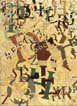 A
lavishly illustrated catalog, co-published by the Pennsylvania Academy of
the Fine Arts and Harry N. Abrams, Inc., is available in the Gallery Store.
It features an essay by exhibition curator Sylvia Yount on Parrish's achievements
and legacy; and another by Mark F. Bockrath, paintings conservator at the
Henry Francis du Pont Winterthur Museum, on Parrish's working methods. Both
Yount and Bockrath will speak at the Gallery in conjunction with the exhibition.
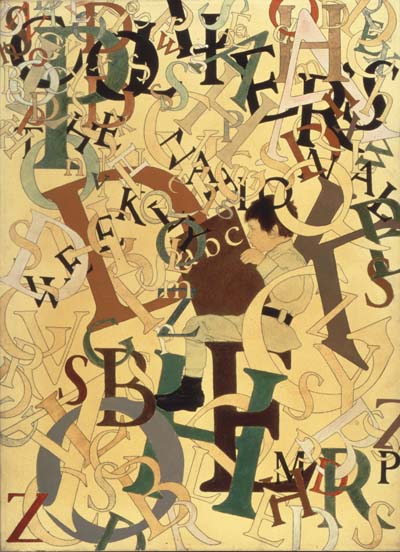
(left: School Days (Alphabet), 1908, Oil on board, 22 x 16
inches, Collection of Joan Purves Adams.)
A
lavishly illustrated catalog, co-published by the Pennsylvania Academy of
the Fine Arts and Harry N. Abrams, Inc., is available in the Gallery Store.
It features an essay by exhibition curator Sylvia Yount on Parrish's achievements
and legacy; and another by Mark F. Bockrath, paintings conservator at the
Henry Francis du Pont Winterthur Museum, on Parrish's working methods. Both
Yount and Bockrath will speak at the Gallery in conjunction with the exhibition.
(left: School Days (Alphabet), 1908, Oil on board, 22 x 16
inches, Collection of Joan Purves Adams.)
National tour
- Pennsylvania Academy of the Fine Arts, Philadelphia (June
19-September 25, 1999)
- Currier Gallery of Art, Manchester, NH (November 6, 1999-January
23, 2000)
- Memorial Art Gallery, Rochester, NY (February 20-April
30, 2000)
- Brooklyn Museum of Art (May 26-August 6, 2000)
The exhibition tour is organized by the American Federation
of Arts.


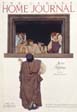
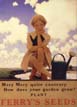

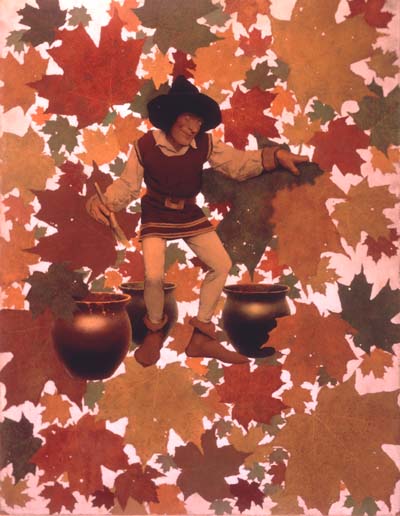
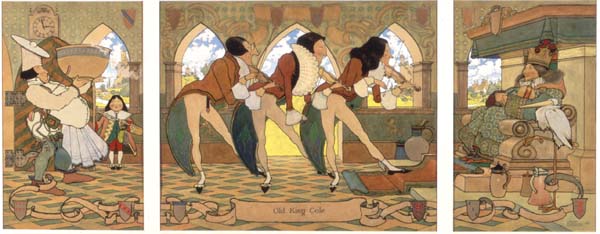
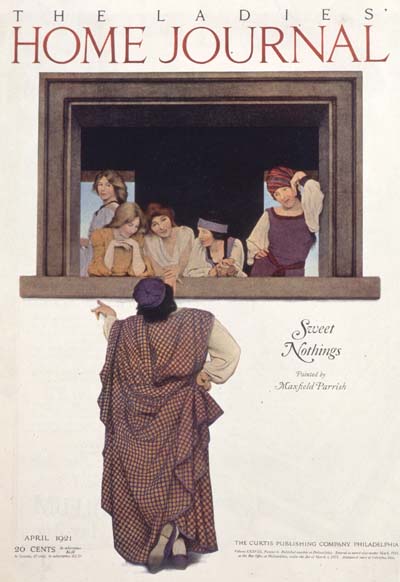
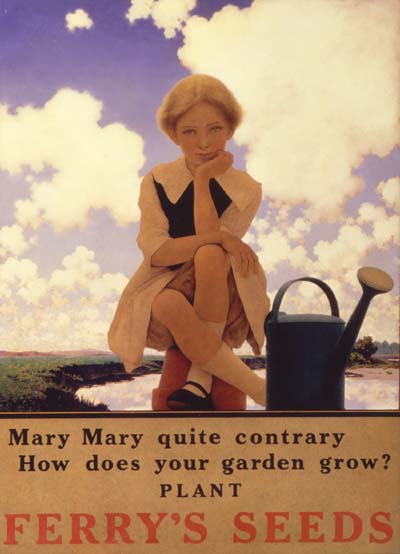
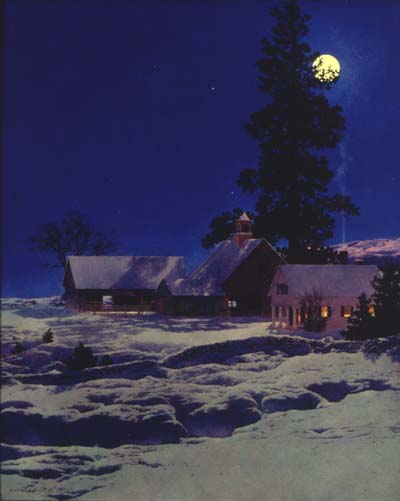
left to right: Jack Frost, 1936, Oil on board, 25 x 19 inches,The
Haggin Museum, Stockton, CA.; Old King Cole, 1894, Ink, watercolor,
gouache and graphite on wove paper, 13 1/2 x 32 inches, Pennsylvania Academy
of the Fine Arts, Gilpin Fund Purchase; Ladies' Home Journal: Sweet Nothings,
1921, Lithograph on paper, 14 x 10 3/4 inches, Rare Book Department, The
Free Library of Philadelphia; Ferry's Seeds: Mary, Mary Quite Contrary,
1921, Oil on board, 27 x 20 inches, Department of Special Collections, University
of California Library, Davis, CA.; Moonlight Night: Winter, 1942,
Oil on board, 19 1/8 x 15 3/4 inches, The Free Library of Philadelphia,
Rare Book Department.
Related articles in our magazine include:
Read more about the Memorial Art Gallery
of the University of Rochester in Resource
Library Magazine
For further biographical information please see America's Distinguished Artists, a national
registry of historic artists.
rev. 12/27/10
Search Resource
Library for thousands of articles and essays on American art.
Copyright 2010 Traditional Fine Arts Organization, Inc., an Arizona nonprofit corporation. All rights
reserved.
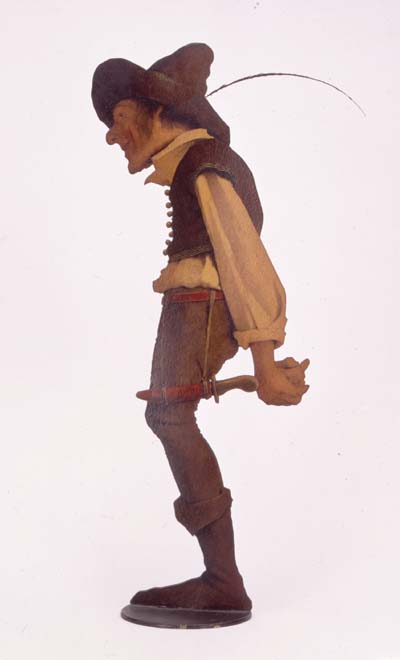 The New York Times calls him "one
of the country's first brand-name artists" and notes that his images
"helped define the mood and style of an era." Smithsonian
magazine calls him "the common man's Rembrandt." By the 1920s,
he was the highest paid artist in America, and his prints were said to hang
in one out of every four households. (left: Gnome (Snow White),
ca. 1916, Painted figure cutout with jigsaw, 16 1/2 x 5 inches, American
Precision Museum, Windsor, VT.)
The New York Times calls him "one
of the country's first brand-name artists" and notes that his images
"helped define the mood and style of an era." Smithsonian
magazine calls him "the common man's Rembrandt." By the 1920s,
he was the highest paid artist in America, and his prints were said to hang
in one out of every four households. (left: Gnome (Snow White),
ca. 1916, Painted figure cutout with jigsaw, 16 1/2 x 5 inches, American
Precision Museum, Windsor, VT.)