Philharmonic Center for the Arts
Naples, FL
941-597-1111 ext. 276
http://www.naplesphilcenter.org
The Human Factor: Figuration
in American Art
February 1 - March 24, 2000
The last quarter
of the 20th century has witnessed a return to the human figure in art as
a valid subject and an important vehicle for self-discovery and self-definition.
The human figure had been a dominant subject in Western art until the abstract
expressionist movement. With modern art, the image of man was transformed
and distorted and almost disappeared as a subject. This selection of 50
paintings, sculptures, prints and drawings provides a mini-survey of many
aesthetics, issues and ideas contained within the figurative idiom of the
United States over the past several decades.
Each artist uses the human figure as a common vehicle through
which he or she expresses personal and aesthetic issues alluding to the
human condition of our time. Among the artists represented are David Hockney,
Chuck Close, Robert Rauschenberg, Keith Haring , George Segal, Susan Rothenberg,
Romare Bearden, Alice Neel, Louise Bourgeois, Robert Gwathmey, David Salle,
Eric Fischl and many others.
 In
his early 20s, during the Harlem Renaissance, Romare Bearden experienced
first hand the diversity and community of artists, musicians, writers, poets,
and filmmakers. Music played an important role in Bearden's art, specifically
jazz and blues, as it developed as a uniquely American urban music among
the New York City artists of the 1930s. Jazz's highly structured
composition reflects Bearden's interest in mathematical organization (he
earned a degree in Mathematics from NYU in 1935) as well as the looseness
and improvisation of jazz music. (left: Romare Bearden (1914 - 1988), Jazz,
1979, hand colored photo etching)
In
his early 20s, during the Harlem Renaissance, Romare Bearden experienced
first hand the diversity and community of artists, musicians, writers, poets,
and filmmakers. Music played an important role in Bearden's art, specifically
jazz and blues, as it developed as a uniquely American urban music among
the New York City artists of the 1930s. Jazz's highly structured
composition reflects Bearden's interest in mathematical organization (he
earned a degree in Mathematics from NYU in 1935) as well as the looseness
and improvisation of jazz music. (left: Romare Bearden (1914 - 1988), Jazz,
1979, hand colored photo etching)
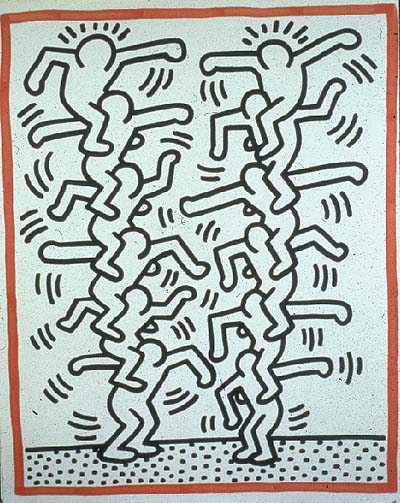
 Keith
Haring's boldly outlined, energetic figures have become almost iconic in
our society. His familiar images of dancing, radiant, cheerful figures pervaded
pop culture of the 1980s and reflected Haring's successful combination of
street art with gallery art. His images first showed up in 1980 in the Manhattan
subway stations. He also designed stage sets, playground walls, T-shirts,
record covers, logos, and even the sets of MTV. Born in Kutztown, Pennsylvania,
Haring moved to Manhattan when he was 20 in order to attend the School of
Visual Arts. In his short lifetime, he had over 40 solo exhibitions worldwide.
"I consider myself a perfect product of the space age not only because
I was born in the year that the first man was launched into space, but also
because I grew up with Walt Disney cartoons." One critic commented
that his "hieroglyphics were like the markings of an urban tribe that
we all belonged to." (left: Keith Haring (1958 - 1990), Untitled,
1985, color lithograph)
Keith
Haring's boldly outlined, energetic figures have become almost iconic in
our society. His familiar images of dancing, radiant, cheerful figures pervaded
pop culture of the 1980s and reflected Haring's successful combination of
street art with gallery art. His images first showed up in 1980 in the Manhattan
subway stations. He also designed stage sets, playground walls, T-shirts,
record covers, logos, and even the sets of MTV. Born in Kutztown, Pennsylvania,
Haring moved to Manhattan when he was 20 in order to attend the School of
Visual Arts. In his short lifetime, he had over 40 solo exhibitions worldwide.
"I consider myself a perfect product of the space age not only because
I was born in the year that the first man was launched into space, but also
because I grew up with Walt Disney cartoons." One critic commented
that his "hieroglyphics were like the markings of an urban tribe that
we all belonged to." (left: Keith Haring (1958 - 1990), Untitled,
1985, color lithograph)
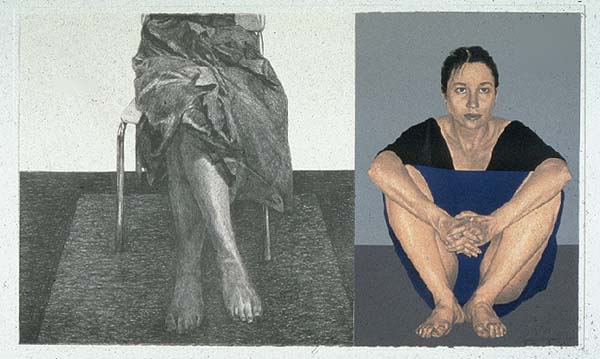
 Minna
Resnick's diptych uses the female form to express personal meaning. The
two figures are in dichotomy with one another in color, in pose and in style.
One figure confronts us with her gaze while we cannot even see the face
of the opposing figure. This opposition continues much in the same way with
Resnick's use of vivid color on one side juxtaposed with a monochromatic
treatment on the other. The vulnerable yet guarded poses convey a personal
narrative as well. Indeed, even the title suggests a personal meaning of
the phrase "sitting pretty". Because Resnick provides us only
with glimpses of a story, we are able to bring our own personal references
to the piece to develop a dialogue with the image. (left: Minna Resnick
(1946 - ), Sitting Pretty, 1993, lithograph (diptych))
Minna
Resnick's diptych uses the female form to express personal meaning. The
two figures are in dichotomy with one another in color, in pose and in style.
One figure confronts us with her gaze while we cannot even see the face
of the opposing figure. This opposition continues much in the same way with
Resnick's use of vivid color on one side juxtaposed with a monochromatic
treatment on the other. The vulnerable yet guarded poses convey a personal
narrative as well. Indeed, even the title suggests a personal meaning of
the phrase "sitting pretty". Because Resnick provides us only
with glimpses of a story, we are able to bring our own personal references
to the piece to develop a dialogue with the image. (left: Minna Resnick
(1946 - ), Sitting Pretty, 1993, lithograph (diptych))
The exhibition was organized by the Sheldon Memorial Art
Gallery and Sculpture Garden.
Read more about the Philharmonic Center
for the Arts in Resource Library Magazine
For further biographical information on selected artists
cited above please see America's Distinguished
Artists, a national registry of historic artists.
rev. 12/27/10
Search Resource
Library for thousands of articles and essays on American art.
Copyright 2010 Traditional Fine Arts Organization, Inc., an Arizona nonprofit corporation. All rights
reserved.
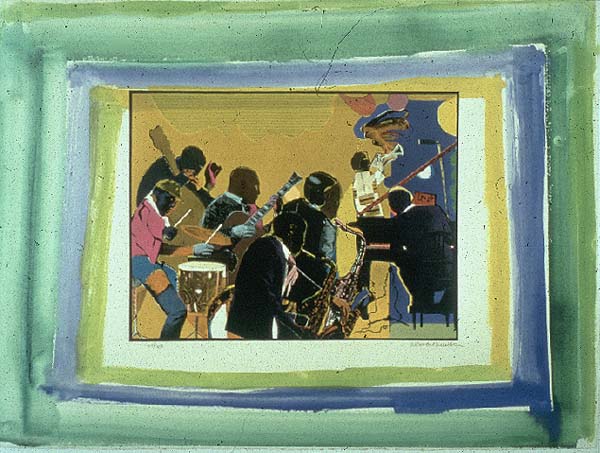 In
his early 20s, during the Harlem Renaissance, Romare Bearden experienced
first hand the diversity and community of artists, musicians, writers, poets,
and filmmakers. Music played an important role in Bearden's art, specifically
jazz and blues, as it developed as a uniquely American urban music among
the New York City artists of the 1930s. Jazz's highly structured
composition reflects Bearden's interest in mathematical organization (he
earned a degree in Mathematics from NYU in 1935) as well as the looseness
and improvisation of jazz music. (left: Romare Bearden (1914 - 1988), Jazz,
1979, hand colored photo etching)
In
his early 20s, during the Harlem Renaissance, Romare Bearden experienced
first hand the diversity and community of artists, musicians, writers, poets,
and filmmakers. Music played an important role in Bearden's art, specifically
jazz and blues, as it developed as a uniquely American urban music among
the New York City artists of the 1930s. Jazz's highly structured
composition reflects Bearden's interest in mathematical organization (he
earned a degree in Mathematics from NYU in 1935) as well as the looseness
and improvisation of jazz music. (left: Romare Bearden (1914 - 1988), Jazz,
1979, hand colored photo etching)