Henry Art Gallery
University of Washington / Seattle, WA
206-543-2280
http://www.henryart.org/
Coming to Life, The Figure in American
Art 1955-1965
February 25 through June 13, 1999
Coming to Life, The Figure in American
Art 1955-1965, is the third and final exhibition
in the Henry Art  Gallery's
series focusing on the figure in an since mid-century. Coming to Life
explores the pivotal ten-year period from 1955 to 1965 that marked significant
shifts in artistic notions about and response to the body. The work of more
than fifty artists from the Henry's collection and private and public collections
from across the U.S, will be presented in the North Galleries from February
25 through June 13, 1999. Included are:
Gallery's
series focusing on the figure in an since mid-century. Coming to Life
explores the pivotal ten-year period from 1955 to 1965 that marked significant
shifts in artistic notions about and response to the body. The work of more
than fifty artists from the Henry's collection and private and public collections
from across the U.S, will be presented in the North Galleries from February
25 through June 13, 1999. Included are:
- Diane Arbus, Richard Artschwager, Romare Bearden, Wallace
Berman, Elmer Bischoff, Charles Brittin, Joan Brown, Harry Callahan, Bruce
Conner, Roy DeCarava, Jay DeFeo, Willem de Kooning, Richard Diebenkorn,
Lee Friedlander, Leon Golub, Philip Guston, Grace Hartigan, Wally Hedrick,
George Herms, Jess, William Klein, Lee Krasner, Marisol, Bruce McGaw, Peter
Moore, Robert Morris, Claes Oldenburg, Nathan Oliveira, Robert Rauschenberg,
Larry Rivers, James Rosenquist, Lucas Samaras, Carolee Schneemann, George
Segal, Aaron Siskind, Jack Smith, Frederick Sommer, Robert Stanley, Andy
Warhol, Robert Watts, Garry Winogrand
A timeline of social attitudes and current events loosely
covering the ten-year period will be installed in the exhibition to underscore
contemporary events and their connection to the artists' milieu.
The period from the late 1950s and the early 1960s saw
extraordinary social change and the evolving ideas of artists were no less
exceptional." says Senior Curator Sheryl Conkelton. "This is acknowledged
by many young artists working right now, in their reaching back to art from
this period in order to question or recontextualize issues today. The shift
from expressionist painting to "happenings" and Pop commodification
reveals the body as the central arena for the acting out of new ideas during
these ten years. This exhibition explores the new treatments artists applied
to the body and the atomized, energized and sexualized imagery that comprised
a new American avant garde."
 The
exhibition is organized with attention to chronology so parallel ideas and
motifs can be seen in works from different parts of the country. The ten-year
period between 1955 and 1965 was one of extraordinary artistic experimentation,
and the human body served as an important arena reflecting changing approaches.
Coming to Life starts with an examination of how the expressionist
representation of the body in the 1950s gave way to a variety of artistic
notions of the body, culminating in the radical shifts embodied in the Performance
work of the mid-1960s. The exhibition traces a social and philosophical
shift toward an avant garde approach to the body.
The
exhibition is organized with attention to chronology so parallel ideas and
motifs can be seen in works from different parts of the country. The ten-year
period between 1955 and 1965 was one of extraordinary artistic experimentation,
and the human body served as an important arena reflecting changing approaches.
Coming to Life starts with an examination of how the expressionist
representation of the body in the 1950s gave way to a variety of artistic
notions of the body, culminating in the radical shifts embodied in the Performance
work of the mid-1960s. The exhibition traces a social and philosophical
shift toward an avant garde approach to the body.
Artists such as Andy Warhol and George Segal used the body
to critique contemporary consumerist culture removed from its emotional
dimension--in what came to be known as Pop Art. Concurrently, in Los Angeles
and San Francisco, Funk Art presented a West Coast flip side to Pop Art
with highly sexualized work that alluded to the body through objects, exemplified
by works by Wallace Berman and George Herms in the exhibition. Another thread
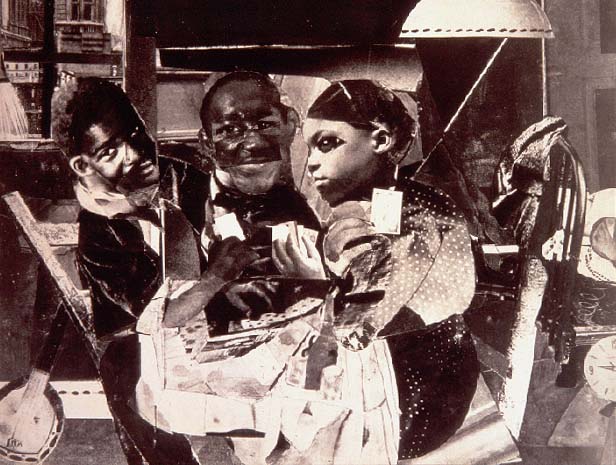
in work of the period can be characterized by the fragmentation of the body,
seen in the works of Romare Bearden and Jay DeFeo, whose work reflects a
surrealist edge.
By the mid 1960s a number of artist were pursuing forms
in which the body presented new relationships to the viewer. The exhibition
includes a number of works of art that were part of performances as well
as documentation by Peter Moore of early performance works by Yoke One,
Carolee Schneemann and Robert Rauchenberg. The body has become active and
is often no longer removed from the viewer through time. Artistic media
is re-evaluated for its ability to convey the artist's participation. Carolee
Schneemann's performance works Eye Body, 1963, and Meat Joy;
1964, and their documentation, offer an opportunity to understand the often
shocking and powerfully influential impact of this period in the work of
artists in the last thirty years.
Support for Coming to Life has been provided by
Henry Art Gallery Special Exhibition
Read more about the Henry
Art Gallery in Resource Library
Magazine
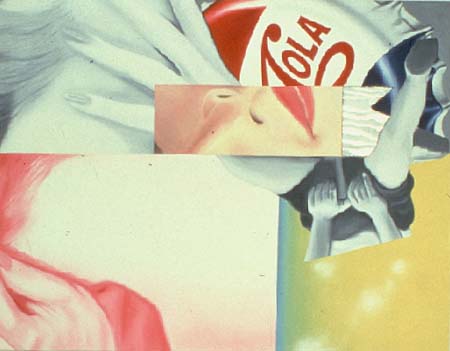
From top to bottom: Romare Bearden, Evening 9:10, 461
Lenox Avenue, 1964, photomechanical reproduction, synthetic polymer
and pencil on paperboard, 49 x 64 inches, courtesy Bearden Foundation/ACA
Galleries, New York, NY, © Romare Bearden Foundation, Inc./Licensed
by VAGA, N.Y.; James Rosenquist, Vestigal Appendage, 1962, oil on
canvas, 72 x 93 1/4 inches, courtesy Panza Collection, Museum of Contemporary
Art, Los Angeles, © James Rosenquist, Licensed by VAGA, N.Y.
For further biographical information on selected artists
cited above please see America's Distinguished
Artists, a national registry of historic artists.
rev. 9/20/10
Search Resource
Library for thousands of articles and essays on American art.
Copyright 2010 Traditional Fine Arts Organization, Inc., an Arizona nonprofit corporation. All rights
reserved.
 Gallery's
series focusing on the figure in an since mid-century. Coming to Life
explores the pivotal ten-year period from 1955 to 1965 that marked significant
shifts in artistic notions about and response to the body. The work of more
than fifty artists from the Henry's collection and private and public collections
from across the U.S, will be presented in the North Galleries from February
25 through June 13, 1999. Included are:
Gallery's
series focusing on the figure in an since mid-century. Coming to Life
explores the pivotal ten-year period from 1955 to 1965 that marked significant
shifts in artistic notions about and response to the body. The work of more
than fifty artists from the Henry's collection and private and public collections
from across the U.S, will be presented in the North Galleries from February
25 through June 13, 1999. Included are: