Boca Raton Museum of Art
Boca Raton, FL
561-392-2500
http://www.bocamuseum.org/
Leon Kroll: Figuratively Speaking
March 22 - May 7, 2000
 Leon Kroll is quintessentially a 20th century American realist artist.
His work is idealized, classical, contemplative. Born in New York City in
1884, Kroll attended the Art Students' League, where his first instructor
was American Impressionist John H. Twatchman. While studying at the Acádemie
Julien in Paris, he won the Grand Prix for painting the nude. By 1912 in
America, Kroll was an award-winning artist, with colleagues Glackens, Henri,
and Bellows, and the friendship of Winslow Homer. His painting was shaped
early on by realism, softened by French Impressionism, and the Post-impressionism
of Renoir and Cézanne. Though Kroll painted landscapes and still
lifes, the single, constant theme of his work was the female form. He painted
distinguished murals for the Justice Building in Washington, and at Johns
Hopkins University, and his work is in the collections of the Whitney Museum
of American Art, The Metropolitan Museum of Art, and the National Collection
of Fine Arts, Smithsonian. (left: Untitled (portrait), n.d.,
charcoal on paper, 19 3/4 x 12 3/4 inches, courtesy of a private collector,
Connecticut)
Leon Kroll is quintessentially a 20th century American realist artist.
His work is idealized, classical, contemplative. Born in New York City in
1884, Kroll attended the Art Students' League, where his first instructor
was American Impressionist John H. Twatchman. While studying at the Acádemie
Julien in Paris, he won the Grand Prix for painting the nude. By 1912 in
America, Kroll was an award-winning artist, with colleagues Glackens, Henri,
and Bellows, and the friendship of Winslow Homer. His painting was shaped
early on by realism, softened by French Impressionism, and the Post-impressionism
of Renoir and Cézanne. Though Kroll painted landscapes and still
lifes, the single, constant theme of his work was the female form. He painted
distinguished murals for the Justice Building in Washington, and at Johns
Hopkins University, and his work is in the collections of the Whitney Museum
of American Art, The Metropolitan Museum of Art, and the National Collection
of Fine Arts, Smithsonian. (left: Untitled (portrait), n.d.,
charcoal on paper, 19 3/4 x 12 3/4 inches, courtesy of a private collector,
Connecticut)
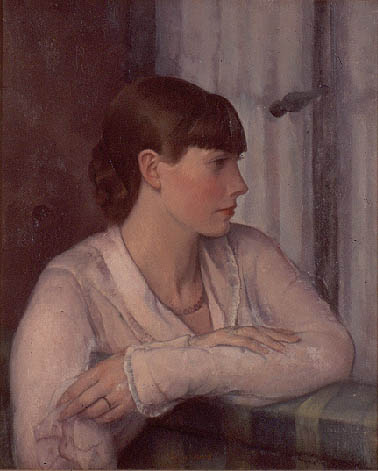
Interpreting Kroll's treatment of the female form, Boca
Raton Museum of Art Executive Director George S.  Bolge writes in the exhibition's catalogue: "The
single, constant theme of Kroll's work is the female body in infinite variation
but always subjected to a formal and monumental treatment. His figures are
based on a firm geometric framework meticulously composed and characterized
by fullness of forms and a carefully studied balance of masses. His solid
forms and clearly defined volumes recall Cézanne's observation that
all natural forms are based on the cone, the sphere, and the cylinder. Kroll's
figures are constructions of volumes - closed and firm. All details are
subordinated to the total form: the clarity of the volumes and their relation
remains untroubled." (right: Mary (profile), c. 1935,
oil on canvas, 24 x 18 1/2 inches, Collection of Jodie and Matthew Carone)
Bolge writes in the exhibition's catalogue: "The
single, constant theme of Kroll's work is the female body in infinite variation
but always subjected to a formal and monumental treatment. His figures are
based on a firm geometric framework meticulously composed and characterized
by fullness of forms and a carefully studied balance of masses. His solid
forms and clearly defined volumes recall Cézanne's observation that
all natural forms are based on the cone, the sphere, and the cylinder. Kroll's
figures are constructions of volumes - closed and firm. All details are
subordinated to the total form: the clarity of the volumes and their relation
remains untroubled." (right: Mary (profile), c. 1935,
oil on canvas, 24 x 18 1/2 inches, Collection of Jodie and Matthew Carone)
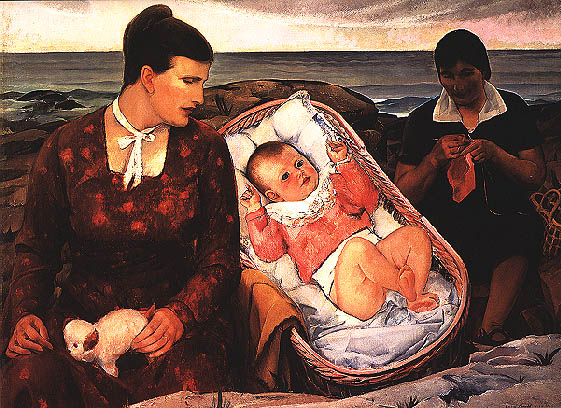
 Bolge
continues: "Here is a sudden manifestation
of the highest plasticism of form
combined with a warm sensualism that, nevertheless,
breathes classical serenity. This classicism
is, moreover, not the result of a
romantic nostalgia, but of a Mediterranean, classical
substance. He tried to combine the wholeness
and order of classical sculpture with
a feeling for warm reality." (left:
The Baby, 1929, oil on canvas, 41 x 50 inches, courtesy of a private
collector, Connecticut)
Bolge
continues: "Here is a sudden manifestation
of the highest plasticism of form
combined with a warm sensualism that, nevertheless,
breathes classical serenity. This classicism
is, moreover, not the result of a
romantic nostalgia, but of a Mediterranean, classical
substance. He tried to combine the wholeness
and order of classical sculpture with
a feeling for warm reality." (left:
The Baby, 1929, oil on canvas, 41 x 50 inches, courtesy of a private
collector, Connecticut)
Biography of Leon Kroll (1884-1974)
Leon Kroll was born in New York to an impoverished music
loving family. Kroll, however, was drawn to the visual arts, when as a child
he would haunt the old red brick and granite Metropolitan Museum of Art.
He was earning his own way at fifteen and earned his tuition for the Art
Students League by sweeping floors and washing paint brushes. Kroll's first
art instructor was John Henry Twachtman and it was at the League that Winslow
Homer recognized his talent and encouraged the young Kroll to pursue a career
in painting. From 1906 to 1908 he further studied at the National Academy
of Design, there winning a scholarship to study at the Academie Julian in
Paris under the tutelage of Jean-Paul Laurens. After one year of study he
won the Grand Prix in the concours for painting the nude.
On returning to New York in 1910, Kroll earned critical
and popular success with his one-man exhibition at the National Academy
of Design. He became associated with a circle of artists that included George
Bellows, Robert Henri, William Glackens, George Luks, Ernest Lawson, and
Edward Hopper. In 1913 Kroll participated in the now famous Armory Show
that for the first time introduced 'modern' art to the American public and
stimulated American artists to revise their attitudes to art and the tradition
of representational painting.
Leon Kroll's career was long and successful. He taught
and lectured at such prestigious institutions as the National Academy of
Design, the Pennsylvania Academy, and the Chicago Art Institute. He won
almost every major prize in painting and is included in the collections
of museums throughout the country.
Read more about the Boca
Raton Museum of Art in Resource Library
Magazine
For further biographical information on selected artists
cited above please see America's Distinguished
Artists, a national registry of historic artists.
Please click on thumbnail images bordered by a red line
to see enlargements.
rev. 1/15/11
Search Resource
Library for thousands of articles and essays on American art.
Copyright 2011 Traditional Fine Arts Organization, Inc., an Arizona nonprofit corporation. All rights
reserved.
 Leon Kroll is quintessentially a 20th century American realist artist.
His work is idealized, classical, contemplative. Born in New York City in
1884, Kroll attended the Art Students' League, where his first instructor
was American Impressionist John H. Twatchman. While studying at the Acádemie
Julien in Paris, he won the Grand Prix for painting the nude. By 1912 in
America, Kroll was an award-winning artist, with colleagues Glackens, Henri,
and Bellows, and the friendship of Winslow Homer. His painting was shaped
early on by realism, softened by French Impressionism, and the Post-impressionism
of Renoir and Cézanne. Though Kroll painted landscapes and still
lifes, the single, constant theme of his work was the female form. He painted
distinguished murals for the Justice Building in Washington, and at Johns
Hopkins University, and his work is in the collections of the Whitney Museum
of American Art, The Metropolitan Museum of Art, and the National Collection
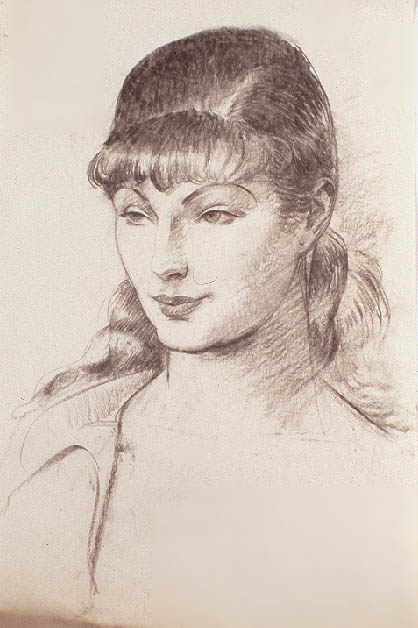
of Fine Arts, Smithsonian. (left: Untitled (portrait), n.d.,
charcoal on paper, 19 3/4 x 12 3/4 inches, courtesy of a private collector,
Connecticut)
Leon Kroll is quintessentially a 20th century American realist artist.
His work is idealized, classical, contemplative. Born in New York City in
1884, Kroll attended the Art Students' League, where his first instructor
was American Impressionist John H. Twatchman. While studying at the Acádemie
Julien in Paris, he won the Grand Prix for painting the nude. By 1912 in
America, Kroll was an award-winning artist, with colleagues Glackens, Henri,
and Bellows, and the friendship of Winslow Homer. His painting was shaped
early on by realism, softened by French Impressionism, and the Post-impressionism
of Renoir and Cézanne. Though Kroll painted landscapes and still
lifes, the single, constant theme of his work was the female form. He painted
distinguished murals for the Justice Building in Washington, and at Johns
Hopkins University, and his work is in the collections of the Whitney Museum
of American Art, The Metropolitan Museum of Art, and the National Collection
of Fine Arts, Smithsonian. (left: Untitled (portrait), n.d.,
charcoal on paper, 19 3/4 x 12 3/4 inches, courtesy of a private collector,
Connecticut)