Levy Gallery for the Arts in Philadelphia
Moore College of Art and Design
Philadelphia, PA
215-568-4515, ext. 4044
http://thegalleriesatmoore.org/
Waxwork
November 15 through December 12, 1999
Wax as an artistic medium has a venerable
and significant history; with a multiplicity of functions, sculptures and
paintings with wax as a final medium have abounded. From encaustic painting
in ancient Greece to votive sculpture fashioned throughout the Middle Ages
and the Renaissance, from medical and anatomical studies to miniature portraits
and curiosities created well into the19th century, wax has been a desirable
and suitable medium for the depiction of the human face and body. Waxwork,
traditionally defined as an effigy or bust, was concerned with naturalistic
depiction, exact replication.
 "Waxwork,"
presented in the Levy Gallery for the Arts in Philadelphia, seeks to broaden
the meaning of this term. The exhibition examines this evocative material
in the hands of a selection of Philadelphia artists, and in the context
of several historical works (on loan from the Philadelphia Museum of Art
and the Mutter Museum, College of Physicians of Philadelphia). A medium
of duplicity--liquid and solid, opaque and translucent, fragile and lasting-wax
has held the imaginations of artists for its material capabilities and its
symbolic associations. Wax has become a medium exploited for its unique
and inherent physical qualities, including the ability to mediate form and
image.
"Waxwork,"
presented in the Levy Gallery for the Arts in Philadelphia, seeks to broaden
the meaning of this term. The exhibition examines this evocative material
in the hands of a selection of Philadelphia artists, and in the context
of several historical works (on loan from the Philadelphia Museum of Art
and the Mutter Museum, College of Physicians of Philadelphia). A medium
of duplicity--liquid and solid, opaque and translucent, fragile and lasting-wax
has held the imaginations of artists for its material capabilities and its
symbolic associations. Wax has become a medium exploited for its unique
and inherent physical qualities, including the ability to mediate form and
image.
Sarah Biemiller uses wax as a protective preservative.
In One Hour of Breath, the ephemeral is captured in the medium, made
semi-solid, visually definable within a paraffin trap. Astrid Bowlby's sculptures
are loci of association. Their varied layers, patches, and parts-shiny,
gooey, mottled, speckled-could be viscera, perhaps edible, and are always
tactile. John Dini's landscapes are abstracted and built from a thick, lush
encaustic. Dini's process proves truly atmospheric, mediating horizon lines
and vistas, transforming geographical locations into places of memory that
evoke the passage of time.
Encaustic also suffuses Anthony DeMelas's subjects. His
images of beginnings are layered and 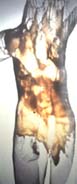 scored; his constructed surfaces allow the viewer
a survey of wax's ability to coat and reveal, to be both fluid and hard,
thick and thin. Frank Hyder has assembled wax-iced "treasure"
boxes for almost a decade. For him, wax is a protective coating, perhaps
the residue of ritual activity, partially obscuring both the exterior faces
and the relic/votives inside. Ellen Kahn's objects and environments, each
enveloped in a skin of wax, are ambiguously organic and intimately tangible.
Without offering the viewer explicit meanings, the small-scale multiples
seem to create a variable landscape of symbolic connections. Kevin Kautenburger
is inspired by the natural genesis of wax as a secretion. He does not layer
or mold it, but injects and pours it to adhere and pool within his Basin.
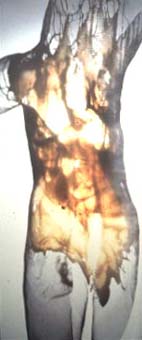
Wax constructs the interiors of K. M. Marking's anatomical projections.
She uses the material to suggest the figure's structure, making them at
once biological and painterly.
scored; his constructed surfaces allow the viewer
a survey of wax's ability to coat and reveal, to be both fluid and hard,
thick and thin. Frank Hyder has assembled wax-iced "treasure"
boxes for almost a decade. For him, wax is a protective coating, perhaps
the residue of ritual activity, partially obscuring both the exterior faces
and the relic/votives inside. Ellen Kahn's objects and environments, each
enveloped in a skin of wax, are ambiguously organic and intimately tangible.
Without offering the viewer explicit meanings, the small-scale multiples
seem to create a variable landscape of symbolic connections. Kevin Kautenburger
is inspired by the natural genesis of wax as a secretion. He does not layer
or mold it, but injects and pours it to adhere and pool within his Basin.
Wax constructs the interiors of K. M. Marking's anatomical projections.
She uses the material to suggest the figure's structure, making them at
once biological and painterly.
The artists in "Waxwork" have made a commitment
to wax as a source of their inspiration and an essential part of their working
process; it informs, coats, protects, blurs, intercedes, or bonds in these
artists' works, shaping subject, narrative, and form by its presence.
The opening for "Waxwork" will be held on Friday,
November 5, from 6:30 to 8:00 pm. Levy Gallery curator Lisa Melandri will
speak on "Likeness and Bees: The Evolving Tradition of Wax as an Artistic
Medium" on Tuesday, November 9, at 6:00 pm in the Moore Auditorium.
"Wax and Wane: A Malleable Family Workshop," led by Tristin Lowe,
will allow children, ages 5 to 16, and their caregivers to sculpt wax miniatures
on Saturday, November 20, from 10 am to 12 noon in the Moore Atrium. Admission
is $2, but reservations are required; phone 215.568.4515, ext. 4044.
The Galleries at Moore are located at 20th Street &
The Parkway, Philadelphia, Pennsylvania 19103 and are open to the public,
free of charge, Tuesday through Friday from 10am to 5 pm, Saturday and Sunday,
12 noon to 4 pm.
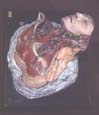
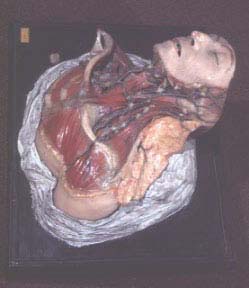
Images from top to bottom: On loan from the Mutter Museum, College of
Physicians of Philadelphia: Model showing the lymphatics of the head and
neck. Purchased from Vasseur and Tramond, Paris, ca; 1870-1880. Materials:
Wax, wood, metal, cloth, 21 inches wide x16 3/4 inches deep x12 3/4 inches
high; K. M. Marking: Umbra de Ipse, 1999, bronze screen and wax 60
x 16 x 16 inches
Why was this sub-index page prepared?
When Resource Library publishes over time
more than one article concerning an institution, there is created as an
additional resource for readers a sub-index page containing links to each
Resource Library article or essay concerning that institution, plus
available information on its location and other descriptive information.
Unless otherwise noted, all text and image materials
relating to the above institutional source were provided by that source.
Before reproducing or transmitting text or
images please read Resource Library's user
agreement.
Traditional Fine Arts Organization's catalogues provide many more useful resources:
 Search
Resource Library for thousands of articles and essays on American
art.
Search
Resource Library for thousands of articles and essays on American
art.
Copyright 2009 Traditional Fine Arts Organization, Inc., an Arizona nonprofit corporation. All rights
reserved.
 "Waxwork,"
presented in the Levy Gallery for the Arts in Philadelphia, seeks to broaden
the meaning of this term. The exhibition examines this evocative material
in the hands of a selection of Philadelphia artists, and in the context
of several historical works (on loan from the Philadelphia Museum of Art
and the Mutter Museum, College of Physicians of Philadelphia). A medium
of duplicity--liquid and solid, opaque and translucent, fragile and lasting-wax
has held the imaginations of artists for its material capabilities and its
symbolic associations. Wax has become a medium exploited for its unique
and inherent physical qualities, including the ability to mediate form and
image.
"Waxwork,"
presented in the Levy Gallery for the Arts in Philadelphia, seeks to broaden
the meaning of this term. The exhibition examines this evocative material
in the hands of a selection of Philadelphia artists, and in the context
of several historical works (on loan from the Philadelphia Museum of Art
and the Mutter Museum, College of Physicians of Philadelphia). A medium
of duplicity--liquid and solid, opaque and translucent, fragile and lasting-wax
has held the imaginations of artists for its material capabilities and its
symbolic associations. Wax has become a medium exploited for its unique
and inherent physical qualities, including the ability to mediate form and
image.