University of Michigan Museum of Art
Ann Arbor, MI
734-764-0395
http://www.umich.edu/~umma/
Ansel Adams Photographs
December 19, 1999 to February 27, 2000
Works on Paper Gallery
The majestic American landscape was
a constant subject for the lens of photographer Ansel Adams (1902-1984).
Scenes of the wilderness areas of the western United States have become
icons in the American conservation movement, particularly of the Sierra
Club, an organization with which Adams was closely linked for many years.
The black and white photographs in this exhibition record locations such
as Yosemite Valley, Canyon de Chelly, and the Grand Tetons with starkly
dramatic light.
Many of the images in the exhibition come from the Museum
Set Edition, a portfolio that Adams produced toward the end of his life
that included prints from negatives dating back to the 1940s. This portfolio
came to the Museum through the generosity of alumnus and photography dealer
and collector Harry H. Lunn, Jr. Lunn, who was editor-in-chief of the Michigan
Daily during his student years at the University of Michigan, remained
interested in the U-M and the Museum of Art until his untimely death earlier
this year.
 When
you ask someone to describe the western portion of the country, the image
that most Americans carry in their minds is of the Rocky Mountains, the
Grand Canyon, the Pacific coast, and other majestic features of the American
landscape. Photographer Ansel Adams (1902-1984) captured the stark grandeur
of the American West, combining dramatic compositions and thorough knowledge
of technique to create monumental black and white prints of these quintessential
American landmarks. Although monochromatic, Adam's photographs convey the
same pristine beauty and dramatic appeal as the paintings executed by artists
working in the West as that portion of the country was opened up to European
settlers from the East. Rarely does the presence of man intrude upon these
works; they situate the viewer in a virgin wilderness not unlike those encountered
a century before by painters such as Albert Bierstadt and Thomas Moran.
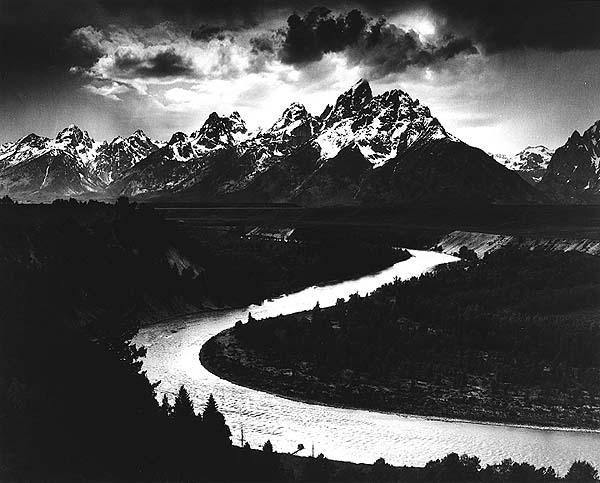
(left: Ansel Adams, Tetons and the Snake River, 1942, Gelastin
silver print, 15 11/16 x 19 1/8 inches, The University of Michigan Museum
of Art, 1982/2.74)
When
you ask someone to describe the western portion of the country, the image
that most Americans carry in their minds is of the Rocky Mountains, the
Grand Canyon, the Pacific coast, and other majestic features of the American
landscape. Photographer Ansel Adams (1902-1984) captured the stark grandeur
of the American West, combining dramatic compositions and thorough knowledge
of technique to create monumental black and white prints of these quintessential
American landmarks. Although monochromatic, Adam's photographs convey the
same pristine beauty and dramatic appeal as the paintings executed by artists
working in the West as that portion of the country was opened up to European
settlers from the East. Rarely does the presence of man intrude upon these
works; they situate the viewer in a virgin wilderness not unlike those encountered
a century before by painters such as Albert Bierstadt and Thomas Moran.
(left: Ansel Adams, Tetons and the Snake River, 1942, Gelastin
silver print, 15 11/16 x 19 1/8 inches, The University of Michigan Museum
of Art, 1982/2.74)
Just as Moran's paintings of Yellowstone contributed to
the designation of that land by Congress as America's first national park,
so Adams' photographs had been embraced by conservation groups such as the
Sierra Club, on whose board Adams served for many years. Ironically, Adams'
photographs have contributed to the increased visitorship at America's national
parks and wilderness areas. This burgeoning popularity of America's National
Parks was of great concern to Adams because of the effect of these visits
on the degradation of the land. As he wrote, "Wilderness is rapidly
becoming one of those aspects of the American dream which is more of the
past than of the present. Wilderness is not only a condition of nature,
but a state of mind and mood and heart."
Ansel Adam's subject matter ranged from specific peaks
in the Rocky Mountains to single snow-covered trees, from the forests of
Oregon and Washington to the deserts of Arizona and New Mexico. Of the sites
included in the exhibition, Yosemite National Park was a subject which had
special signifigance to the artist. After a visit with his family in 1916
Adams returned to Yosemite every year for the rest of his life. Under different
seasons and varying weather conditions, the Half Dome and other peaks in
Yosemite Valley were conveyed with a forceful intensity. His photographs
become almost an archetypal image of America's remaining Western wilderness
areas. What do you picture in your mind when you think of the American West?
Most likely, among the mental images that you carry there will a number
of photographs by Ansel Adams.
Rev. 11/29/99
Read more about the University of Michigan
Museum of Art in Resource Library Magazine
For further biographical information on selected artists
cited above please see America's Distinguished
Artists, a national registry of historic artists.
rev. 11/22/10
Search Resource
Library for thousands of articles and essays on American art.
Copyright 2010 Traditional Fine Arts Organization, Inc., an Arizona nonprofit corporation. All rights
reserved.
 When
you ask someone to describe the western portion of the country, the image
that most Americans carry in their minds is of the Rocky Mountains, the
Grand Canyon, the Pacific coast, and other majestic features of the American
landscape. Photographer Ansel Adams (1902-1984) captured the stark grandeur
of the American West, combining dramatic compositions and thorough knowledge
of technique to create monumental black and white prints of these quintessential
American landmarks. Although monochromatic, Adam's photographs convey the
same pristine beauty and dramatic appeal as the paintings executed by artists
working in the West as that portion of the country was opened up to European
settlers from the East. Rarely does the presence of man intrude upon these
works; they situate the viewer in a virgin wilderness not unlike those encountered
a century before by painters such as Albert Bierstadt and Thomas Moran.
(left: Ansel Adams, Tetons and the Snake River, 1942, Gelastin
silver print, 15 11/16 x 19 1/8 inches, The University of Michigan Museum
of Art, 1982/2.74)
When
you ask someone to describe the western portion of the country, the image
that most Americans carry in their minds is of the Rocky Mountains, the
Grand Canyon, the Pacific coast, and other majestic features of the American
landscape. Photographer Ansel Adams (1902-1984) captured the stark grandeur
of the American West, combining dramatic compositions and thorough knowledge
of technique to create monumental black and white prints of these quintessential
American landmarks. Although monochromatic, Adam's photographs convey the
same pristine beauty and dramatic appeal as the paintings executed by artists
working in the West as that portion of the country was opened up to European
settlers from the East. Rarely does the presence of man intrude upon these
works; they situate the viewer in a virgin wilderness not unlike those encountered
a century before by painters such as Albert Bierstadt and Thomas Moran.
(left: Ansel Adams, Tetons and the Snake River, 1942, Gelastin
silver print, 15 11/16 x 19 1/8 inches, The University of Michigan Museum
of Art, 1982/2.74)