Charles H. MacNider Museum
Mason City, IA
515-421-3666
America Seen: People and Place
The MacNider Art Museum is pleased
to present America Seen: People and Place, an exhibition of approximately
eighty paintings, prints, and photographs, exploring aspects of American
pictorial art from the late 1920s through the early 1950s. On exhibit through
March 14, 1999, America Seen: People and Place, records the social
and political turmoil of the 1920s and 1930s, when America was seeking to
discover itself in a world which had been dominated by events, both political
and aesthetic, in Europe.
This special exhibition focuses on those visual artists
who were trying to define the historical, political, and cultural traits
of America's transition from isolation to world domination. It includes
visual reference to both world wars, the Great Depression, the New Deal,
the growth of the American city and nostalgia for American rural life. Among
the renowned artists in the exhibit are Grant Wood, Norman Rockwell, John
Steuart Curry, Thomas Hart Benton, Charles Sheeler, Alexander Brook, Edward
Hopper, Dorothea Lange, Walker Evans and Isabel Bishop.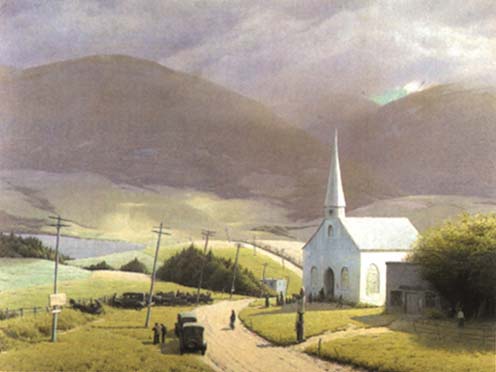
The decline of the rural population base and the industrialization
of agriculture gave rise to popular and sometimes sentimental images of
the rural South and the Midwest by the "Regionalists," a group
of artists spearheaded by Thomas Hart Benton, Grant Wood, and John Steuart
Curry. These three artists, along with many others, embraced the values
and traditions of fading rural America. Paralleling the rural revivalists,
were urban artists such as Reginald Marsh and Isabel Bishop, who captured
the labor and leisure of daily city life. The "Urban Regionalists"
connected the benign routine of city life with the vivacity and emotional
content that was neither romantic or contrived.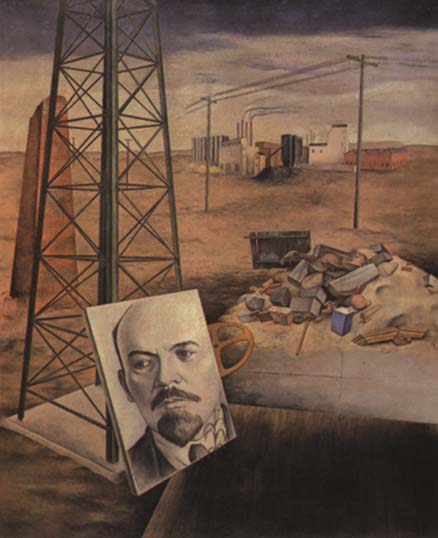
In response to the Depression, federally subsidized art
projects were developed through programs such as the Works Progress Administration
(WPA), to assist artists and to cultivate and broaden the visual arts in
American culture. The multitude of these arts projects ranged from public
building murals to posters and photographic documentaries, creating a wide
variety of art works illustrating the images of American life. The WPA Projects
expanded the diversity of artistic resources by emphasizing the inclusion
of regional artists, many of whom lacked the notoriety and financial success
of better established artists located in urban areas. The opportunities
for such artists were greatly enhanced by the support of Federal art projects.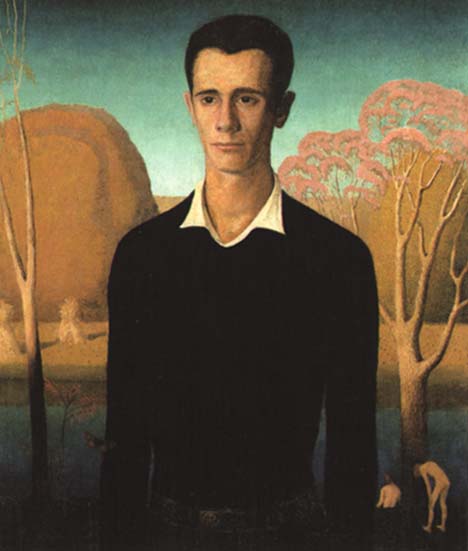
Norman Rockwell's extraordinarily fine example of art as
illustration, The County Agricultural Agent, conveys a sentimental
view of "the good life," which becomes in its own distinct way
a fabricated sort of portrait reality. By the early 1950s, much of this
type of representational art had lost its vitality and was eclipsed by the
advent of Abstract Expressionism, which firmly placed America, that is to
say New York, at the center of the advanced art scene within the international
art circles. Fifty years later it seems appropriate to reconsider and assess
the American Scene artists' individual contributions to this era in the
development of the cultural and visual art history of our nation.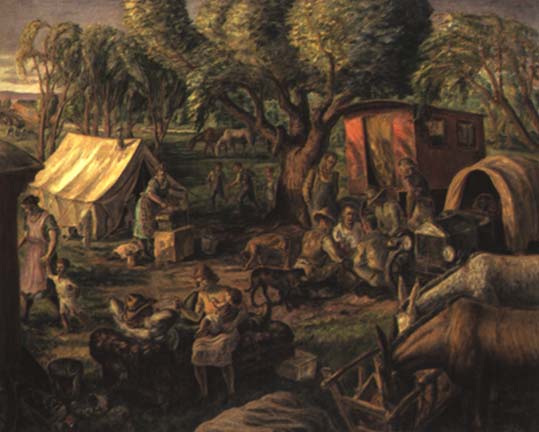
This exhibit has been organized for national tour by the
Sheldon Memorial Art Gallery of the University of Nebraska at Lincoln. With
the assistance of Smith Kramer, Inc., a fine arts service company located
in Kansas City, Missouri, the exhibition will travel to fifteen American
museums over the next three years.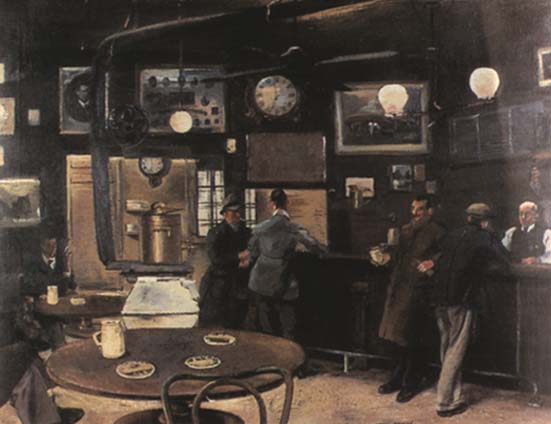
The Charles H. MacNider Museum is located at 303 2nd Street, SE, Mason City, IA.
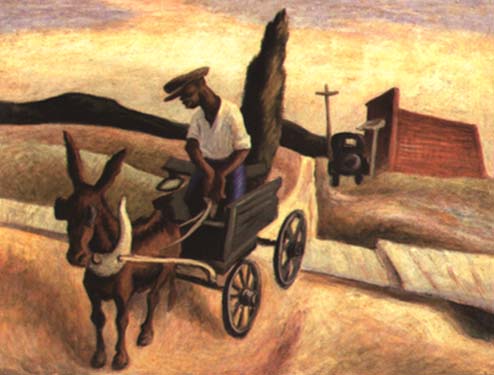
From top to bottom: Thomas Hart Benton, Lonesome Road, 1927, tempera on masonite, 25 x 34 inches; Ogden Fleissner, Morning Mass, 1928, oil on canvas, 42 x 54 inches; O. Louis Guglielmi, Phoenix, 1935, oil on canvas, 30 x 25 inches; Grant Wood, Arnold Comes of Age, 1930, oil on board, 26 3/4 x 23 inches; John Steuart Curry, Roadmenders' Camp, 1929, oil on canvas, 40 1/4 x 52 1/4 inches; Louis Bouche, McSorley's, 1940, oil on canvas, 41 x 50 inches.
Read more about the Charles H. MacNider Museum in Resource Library Magazine
For further biographical information on selected artists cited above please see America's Distinguished Artists, a national registry of historic artists.
rev. 9/20/10
Search Resource Library for thousands of articles and essays on American art.
Copyright 2010 Traditional Fine Arts Organization, Inc., an Arizona nonprofit corporation. All rights reserved.