New Mexico State University Art Gallery,
Williams Hall
Las Cruces, NM
505-646-2545
http://www.nmsu.edu
El Favor de los Santos: The Retablo Collection
of New Mexico State University
La Sagrada Familia, the Holy Family. La Mano Poderosa, the Powerful Hand.
Nuestra Senora del Refugio, Our Lady of Refuge. The images of hope
and faith have graced countless home altars in Mexico and the Southwest
United States.
 Known
as retablos, these small oil paintings of religious figures, usually on
tin, have obvious links to the strong Catholicism of the Spanish explorers
who colonized vast areas of the New World. But they also have roots in Mexico's
pre-Columbian culture, according to scholars who are taking a closer look
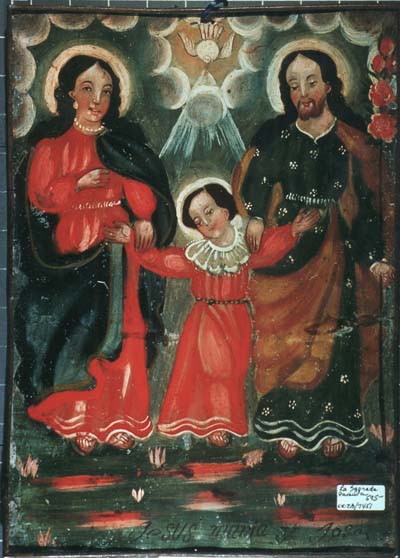
at the art form. (left: La Sagrada Familia, The Holy Family.
Anonymous, Mexico. From the New Mexico State University Art Gallery collection)
Known
as retablos, these small oil paintings of religious figures, usually on
tin, have obvious links to the strong Catholicism of the Spanish explorers
who colonized vast areas of the New World. But they also have roots in Mexico's
pre-Columbian culture, according to scholars who are taking a closer look
at the art form. (left: La Sagrada Familia, The Holy Family.
Anonymous, Mexico. From the New Mexico State University Art Gallery collection)
A major exhibition at the New Mexico State University Art
Gallery in Las 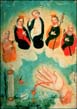 Cruces
aims to show as never before the cultural context of the retablo. "El
Favor de los Santos: The Retablo Collection of New Mexico State University"
opens Nov. 21 at the University Art Gallery and remains on display there
through Feb. 7, 2000. After that, the exhibition will travel for three years
to museums in Mexico, the United States and Spain. It is the most comprehensive
exhibition to date on the subject of 19th century Mexican retablos, says
Gallery Director Charles Lovell. It will feature 180 retablos and related
works from the gallery's collection of more than 1,700 pieces -- the largest
public collection of Mexican retablos in the country -- plus about 75 works
of art borrowed from institutions such as the Museo Franz Mayer and the
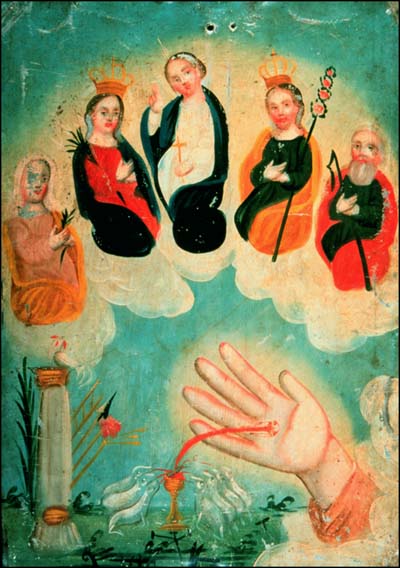
National Museum of Anthropology, both in Mexico City. (right: La
Mano Poderosa/Las Cinco Personas, The Powerful Hand/ The Five Persons. Anonymous,
Mexico. From the New Mexico State University Art Gallery collection)
Cruces
aims to show as never before the cultural context of the retablo. "El
Favor de los Santos: The Retablo Collection of New Mexico State University"
opens Nov. 21 at the University Art Gallery and remains on display there
through Feb. 7, 2000. After that, the exhibition will travel for three years
to museums in Mexico, the United States and Spain. It is the most comprehensive
exhibition to date on the subject of 19th century Mexican retablos, says
Gallery Director Charles Lovell. It will feature 180 retablos and related
works from the gallery's collection of more than 1,700 pieces -- the largest
public collection of Mexican retablos in the country -- plus about 75 works
of art borrowed from institutions such as the Museo Franz Mayer and the
National Museum of Anthropology, both in Mexico City. (right: La
Mano Poderosa/Las Cinco Personas, The Powerful Hand/ The Five Persons. Anonymous,
Mexico. From the New Mexico State University Art Gallery collection)
"The intent is to show the relationship of retablos
to other forms of votive art from pre-Columbian times to the present,"
Lovell said. The Aztecs, for instance, mass produced clay images of deities
that were venerated in households before the arrival of the Spanish. "El
Favor de los Santos" will include a recreation of an Aztec household
altar. Other installations that will help explain the retablo tradition
include a baroque altarpiece, showing the European influence; a typical
19th century bedroom shrine from Mexico; and a contemporary altar, showing
how the tradition continues today.
 Although
derived from a variety of sources, the retablos are distinctly Mexican.
The country's art, "like Mexican culture in general ... must be understood
as a separate, distinct phenomenon, related to Spanish culture in many ways
but just as often finding its own values," wrote Marcus B. Burke, curator
of paintings at the Hispanic Society of America in New York. "Nowhere
is this more apparent than in the rich and varied imagery of the santos
and retablos." Burke is one of a dozen scholars whose essays will appear
in a full-color catalog for "El Favor de los Santos." He and others
who have studied the NMSU retablo collection will share their research at
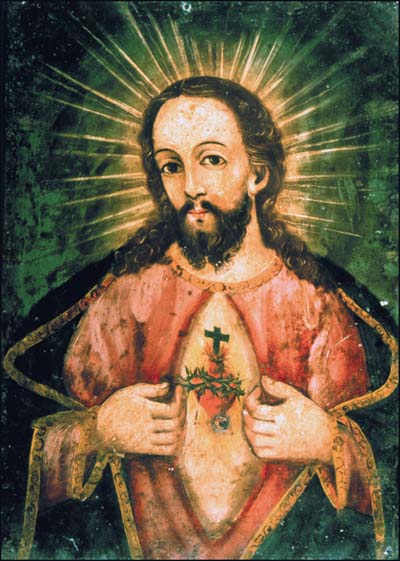
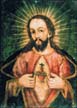
a symposium in Las Cruces Dec. 13 and 14. (left: El Sagrado Corazon
de Jesus, The Sacred Heart of Jesus. Anonymous, Mexico. From the New
Mexico State University Art Gallery collection)
Although
derived from a variety of sources, the retablos are distinctly Mexican.
The country's art, "like Mexican culture in general ... must be understood
as a separate, distinct phenomenon, related to Spanish culture in many ways
but just as often finding its own values," wrote Marcus B. Burke, curator
of paintings at the Hispanic Society of America in New York. "Nowhere
is this more apparent than in the rich and varied imagery of the santos
and retablos." Burke is one of a dozen scholars whose essays will appear
in a full-color catalog for "El Favor de los Santos." He and others
who have studied the NMSU retablo collection will share their research at
a symposium in Las Cruces Dec. 13 and 14. (left: El Sagrado Corazon
de Jesus, The Sacred Heart of Jesus. Anonymous, Mexico. From the New
Mexico State University Art Gallery collection)
Most Mexican tin retablos were produced in the latter part
of the 19th century, said Elizabeth  Zarur, assistant professor of art at NMSU and co-curator
of the exhibition. In the 1830s, Mexico began producing tin for roofing
and other uses, giving artists a cheap material for mass producing the devotional
paintings that were in great demand in the country. At the turn of the 20th
century, however, inexpensive chromolithography replaced oil-on-tin retablos,
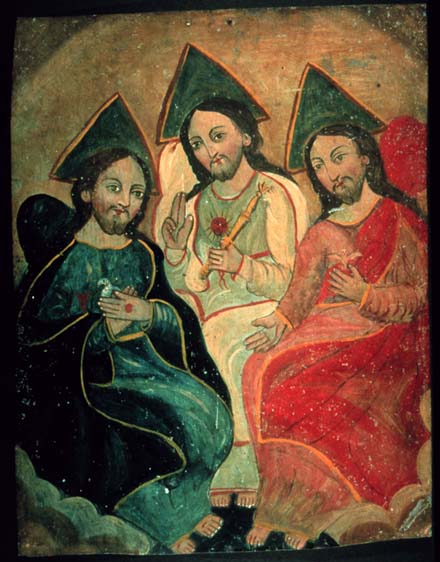
"so we're talking about only 70 years," Zarur said. (right:
La Trinidad, The Trinity. Anonymous, Mexico. From the New Mexico
State University Art Gallery collection)
Zarur, assistant professor of art at NMSU and co-curator
of the exhibition. In the 1830s, Mexico began producing tin for roofing
and other uses, giving artists a cheap material for mass producing the devotional
paintings that were in great demand in the country. At the turn of the 20th
century, however, inexpensive chromolithography replaced oil-on-tin retablos,
"so we're talking about only 70 years," Zarur said. (right:
La Trinidad, The Trinity. Anonymous, Mexico. From the New Mexico
State University Art Gallery collection)
Perhaps 10 to 15 percent of all retablos were painted by
academically trained artists, working on commission for churches or individuals
who could afford them, Lovell said. "Most retablos were done by self-trained
folk artists," he said. "They were mass produced in workshops
and sold near sanctuaries."
A related form of art featured in the exhibition is the
ex-voto, which combines visual images and text to depict a miraculous cure
or rescue. "With the ex-voto, the artist had more freedom," Zarur
said. "The top section usually has a painting of a scene, which might
be an accident or an illness." The image of a saint or holy figure
is another visual part of the ex-voto, she said, and the legend explains
what favor was requested and granted. "It is a public testimony that
a miracle happened," she said. The ex-voto section of the exhibition
will include examples of the art form and photo-murals showing how ex-votos
are displayed publicly at three sanctuaries in Mexico and at the Santuario
de Chimayo in northern New Mexico.
A members-only preview for Friends of the Gallery will
be held from 6 to 8 p.m. Saturday, Nov. 20. The exhibition opens on Sunday,
Nov. 21, and a public reception will be held at the gallery from 5:30 to
7:30 p.m. Tuesday, Nov. 23.
Major support for the exhibition has come from the Rockefeller
Foundation Museum Program, the U.S./Mexico Fund for Culture, the Stockman
Family Foundation, the New Mexico Office of Cultural Affairs, and the New
Mexico Arts Division.
Read more about the New Mexico State
University Art Gallery, Williams Hall in Resource
Library Magazine
rev. 10/20/10
Search Resource
Library for thousands of articles and essays on American art.
Copyright 2010 Traditional Fine Arts Organization, Inc., an Arizona nonprofit corporation. All rights
reserved.
 Known
as retablos, these small oil paintings of religious figures, usually on
tin, have obvious links to the strong Catholicism of the Spanish explorers
who colonized vast areas of the New World. But they also have roots in Mexico's
pre-Columbian culture, according to scholars who are taking a closer look
at the art form. (left: La Sagrada Familia, The Holy Family.
Anonymous, Mexico. From the New Mexico State University Art Gallery collection)
Known
as retablos, these small oil paintings of religious figures, usually on
tin, have obvious links to the strong Catholicism of the Spanish explorers
who colonized vast areas of the New World. But they also have roots in Mexico's
pre-Columbian culture, according to scholars who are taking a closer look
at the art form. (left: La Sagrada Familia, The Holy Family.
Anonymous, Mexico. From the New Mexico State University Art Gallery collection)