Editor's note: The Katonah Museum of Art provided
source material to Resource Library Magazine for the following
article or essay. If you have questions or comments regarding the source
material, please contact the Katonah Museum of Art directly through either
this phone number or web address:
Maine and the Modern Spirit
 One of the most beautiful and compelling exhibitions of the summer
will open at the Katonah Museum of Art on July 16, 2000. "Maine and
the Modern Spirit" explores the myth - perpetuated by artists, writers,
reformers, and poets -- that Maine is a uniquely modern American Eden. It
also shows how this rugged New England state served the evolution of modern
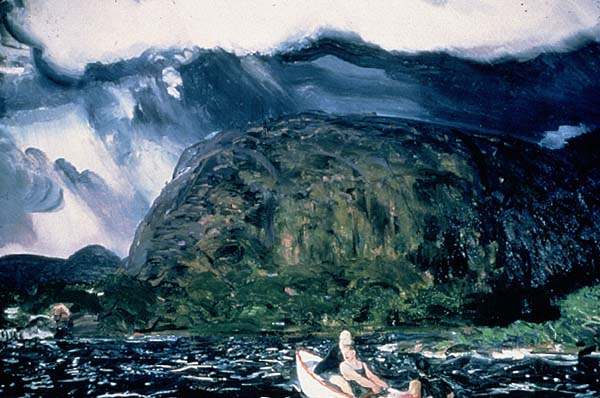
American art. (left: George Bellows, In a Rowboat, 1916, oil
on canvas, The Montclair Art Museum, Montclair, NJ, Purchase made possible
through a special gift from Mr. and Mrs. H. St. John Webb)
One of the most beautiful and compelling exhibitions of the summer
will open at the Katonah Museum of Art on July 16, 2000. "Maine and
the Modern Spirit" explores the myth - perpetuated by artists, writers,
reformers, and poets -- that Maine is a uniquely modern American Eden. It
also shows how this rugged New England state served the evolution of modern
American art. (left: George Bellows, In a Rowboat, 1916, oil
on canvas, The Montclair Art Museum, Montclair, NJ, Purchase made possible
through a special gift from Mr. and Mrs. H. St. John Webb)
Featured are fifty-eight works, mostly oil paintings in
a broad range of styles, from the figurative to the abstract, that allude
to Maine's wild grandeur and isolation -- its craggy shores, seacoast towns,
 virgin
forests, and diverse wildlife. The works were created by twenty-eight well-known
artists such as George
Bellows, Marsden Hartley, John Marin, Edward Hopper, Fairfield Porter,
Louise Nevelson, Alex Katz, Yasuo Kuniyoshi, Robert Indiana and others --
each interpreting Maine in different ways, contributing to its mystique.
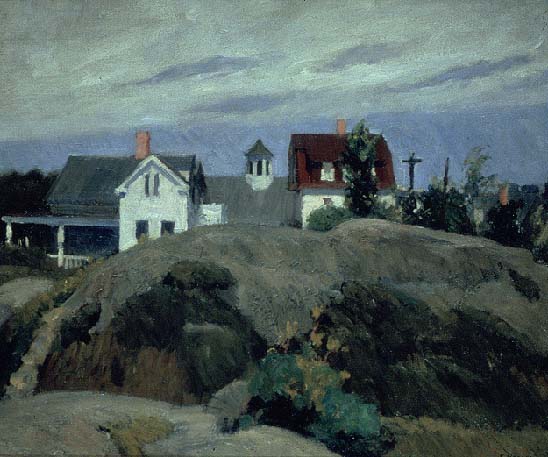
This groundbreaking show will be on view until September 24. (right:
Edward Hopper, Rocks and Houses, Ogunquit, 1914, oil on canvas, Whitney
Museum of American Art, New York, NY, Josephine N, Hopper bequest, 70.1202)
virgin
forests, and diverse wildlife. The works were created by twenty-eight well-known
artists such as George
Bellows, Marsden Hartley, John Marin, Edward Hopper, Fairfield Porter,
Louise Nevelson, Alex Katz, Yasuo Kuniyoshi, Robert Indiana and others --
each interpreting Maine in different ways, contributing to its mystique.
This groundbreaking show will be on view until September 24. (right:
Edward Hopper, Rocks and Houses, Ogunquit, 1914, oil on canvas, Whitney
Museum of American Art, New York, NY, Josephine N, Hopper bequest, 70.1202)
 "Maine
and the Modern Spirit" was organized by the Katonah Museum of Art and
was curated by Susan C. Larsen, PhD., formerly Chief Curator of the Farnsworth
Art Museum in Rockland, Maine, and Curator of the Permanent Collection at
the
"Maine
and the Modern Spirit" was organized by the Katonah Museum of Art and
was curated by Susan C. Larsen, PhD., formerly Chief Curator of the Farnsworth
Art Museum in Rockland, Maine, and Curator of the Permanent Collection at
the  Whitney
Museum of American Art in New York (1988-1991). A 40-page illustrated catalogue
accompanies the exhibition in which Dr. Larsen's comprehensive essay explores
modernists' views of Maine and documents their view of social and environmental
change. During the past century, artists, through their various voices,
have contributed not only to the mystique of Maine, but to the history of
modern art. "Maine set the stage for a dramatic interface between man
and his natural and social environment," Dr. Larsen observes. Maine
is the place where artistic imaginations often found new material for personal
dreams -- "a remote and wild place, where fundamental questions about
man's place in this world present themselves with an unusual clarity,"
she writes. "This is the radical Maine cherished by our poets, philosophers,
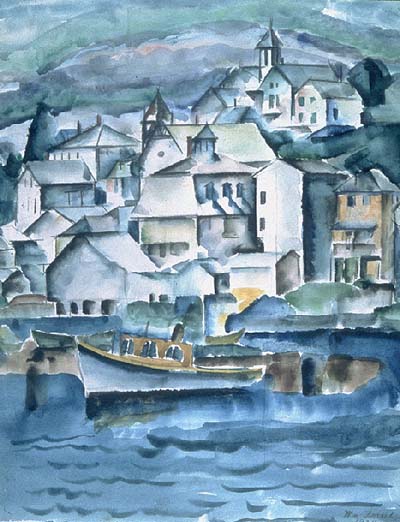
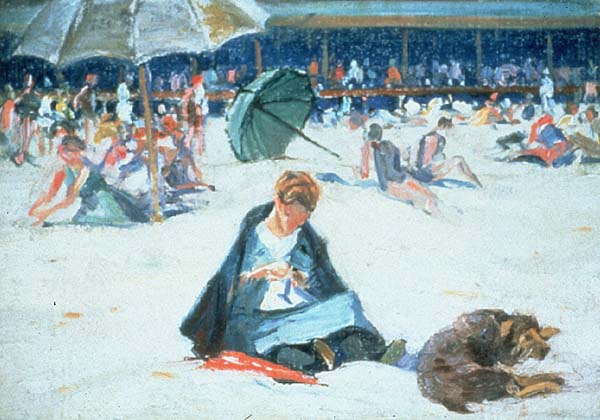
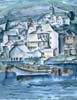
and artists." (left: William Zorach, Stonington Maine,
1920, watercolor, William Kelly Simpson; right: Charles Woodbury, Ogunquit
Bath House with Lady and Dog, c. 1912, oil on bord, Portland Museum
of Art)
Whitney
Museum of American Art in New York (1988-1991). A 40-page illustrated catalogue
accompanies the exhibition in which Dr. Larsen's comprehensive essay explores
modernists' views of Maine and documents their view of social and environmental
change. During the past century, artists, through their various voices,
have contributed not only to the mystique of Maine, but to the history of
modern art. "Maine set the stage for a dramatic interface between man
and his natural and social environment," Dr. Larsen observes. Maine
is the place where artistic imaginations often found new material for personal
dreams -- "a remote and wild place, where fundamental questions about
man's place in this world present themselves with an unusual clarity,"
she writes. "This is the radical Maine cherished by our poets, philosophers,
and artists." (left: William Zorach, Stonington Maine,
1920, watercolor, William Kelly Simpson; right: Charles Woodbury, Ogunquit
Bath House with Lady and Dog, c. 1912, oil on bord, Portland Museum
of Art)
For over a century, artists have traveled to Maine, attracted
by its isolation, stark beauty, and unspoiled environment. It was Thomas
Cole and Frederic Edwin Church, artists of the Hudson River School, who
first captured the state's scenery on canvas (albeit a romantic view) and
stimulated interest in this  remote state. Before long, the modernists arrived,
finding Maine to be the place that
remote state. Before long, the modernists arrived,
finding Maine to be the place that 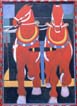 offered
them the space and time to think. It had "dynamic forces, free play,
and power," as Dr. Larsen describes it, "where they felt free
to move beyond established cultural and personal boundaries to notice the
smaller, telling; details of life that point to larger truths." Early
American modernists used Maine's wild nature and social constraints -- its
sense of presentness and plainness -- to separate themselves from their
European counterparts. "Perhaps, better than most, modern artists sensed
and understood the inherent cultural contradictions of Maine," she
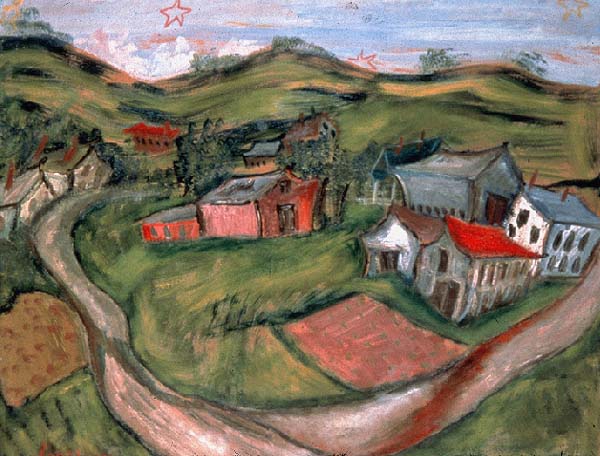
writes. (left: Louise Nevelson, Maine Meadows: Old Country Road,
c. 1933, oil on panel, The Farnsworth Museum; right: CHarles DuBack, Horse
Pull, Union Fair, c. 1956, oil on canvas, collection of the artist)
offered
them the space and time to think. It had "dynamic forces, free play,
and power," as Dr. Larsen describes it, "where they felt free
to move beyond established cultural and personal boundaries to notice the
smaller, telling; details of life that point to larger truths." Early
American modernists used Maine's wild nature and social constraints -- its
sense of presentness and plainness -- to separate themselves from their
European counterparts. "Perhaps, better than most, modern artists sensed
and understood the inherent cultural contradictions of Maine," she
writes. (left: Louise Nevelson, Maine Meadows: Old Country Road,
c. 1933, oil on panel, The Farnsworth Museum; right: CHarles DuBack, Horse
Pull, Union Fair, c. 1956, oil on canvas, collection of the artist)
 In
"Maine and the Modern Spirit," the artists' styles are as diverse
as the times in which their works were created. Charles H. Woodbury's fluid
painterly style, based on his understanding of French Impressionism, is
evident in Ogunquit Bath House with Lady and Dog, which colorfully
depicts vacationers at a crowded beach. George Bellows's In a Rowboat
recalls an actual event, in 1916, when a sudden storm threatened to drown
him and his party at sea. "The painting, with its abstractions, captures
their vulnerability against the enormous energy of the ocean," notes
Evelyn Fay, who
In
"Maine and the Modern Spirit," the artists' styles are as diverse
as the times in which their works were created. Charles H. Woodbury's fluid
painterly style, based on his understanding of French Impressionism, is
evident in Ogunquit Bath House with Lady and Dog, which colorfully
depicts vacationers at a crowded beach. George Bellows's In a Rowboat
recalls an actual event, in 1916, when a sudden storm threatened to drown
him and his party at sea. "The painting, with its abstractions, captures
their vulnerability against the enormous energy of the ocean," notes
Evelyn Fay, who  served
as Museum project director of this exhibition. By contrast, the artist's
Romance of Autumn, with its broad range of colors and tones, inspired
by two of Maine's small coastal islands, reflect a rapturous mood and dreamlike
sense of space. Edward Hopper's stark images of Maine's lighthouses, fishing
boats and small towns, painted in 1912, contrast the pulse of modern life
with the simplicity of a quieter past. Marsden Hartley's Granite by the
Sea, Seguin Light, Georgetown (1937-38) makes use of tilted planes to
evoke a massive pile of granite boulders. (upper left: Janice Kasper,
Endangered Species Act, 1999, oil on canvas, Caldbeck Gallery, Rockland,ME;
lower left: Lois Dodd, Eclipse in Seven Stages, 1997, oil on canvas,
Caldbeck Gallery, Rockland,ME)
served
as Museum project director of this exhibition. By contrast, the artist's
Romance of Autumn, with its broad range of colors and tones, inspired
by two of Maine's small coastal islands, reflect a rapturous mood and dreamlike
sense of space. Edward Hopper's stark images of Maine's lighthouses, fishing
boats and small towns, painted in 1912, contrast the pulse of modern life
with the simplicity of a quieter past. Marsden Hartley's Granite by the
Sea, Seguin Light, Georgetown (1937-38) makes use of tilted planes to
evoke a massive pile of granite boulders. (upper left: Janice Kasper,
Endangered Species Act, 1999, oil on canvas, Caldbeck Gallery, Rockland,ME;
lower left: Lois Dodd, Eclipse in Seven Stages, 1997, oil on canvas,
Caldbeck Gallery, Rockland,ME)
 William
Kienbusch brought his abstract expressionist sensibility to Island Balancing
on Four Pines (1952) in which he depicts the effect of weather on the
forms and scale of the sea. Another of his paintings relays the chill of
winter wind in the Maine night sky. For thirty years, contemporary artist
Alex Katz found in Maine a refuge and inspiration. His paintings, with their
flattened, abbreviated style, capture transitory moments in the landscape.
Lois Dodd's
William
Kienbusch brought his abstract expressionist sensibility to Island Balancing
on Four Pines (1952) in which he depicts the effect of weather on the
forms and scale of the sea. Another of his paintings relays the chill of
winter wind in the Maine night sky. For thirty years, contemporary artist
Alex Katz found in Maine a refuge and inspiration. His paintings, with their
flattened, abbreviated style, capture transitory moments in the landscape.
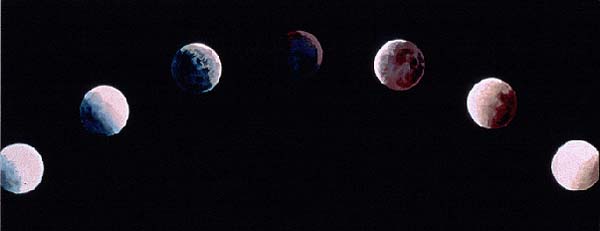
Lois Dodd's  Eclipse in Seven Stages
(1997) is a simple, yet powerful depiction of an evening in which the moon
waxed and waned. Robert Indiana's Autoportraits Vinalhaven Suite
(1980) provides a window into Vinalhaven's working-class character through
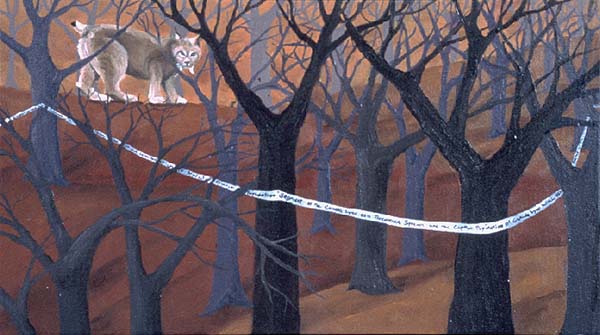
brash and tender graphic imagery. Janice Kasper, an avid environmentalist,
protests the clear-cutting of Maine's forests in Now You See Them and
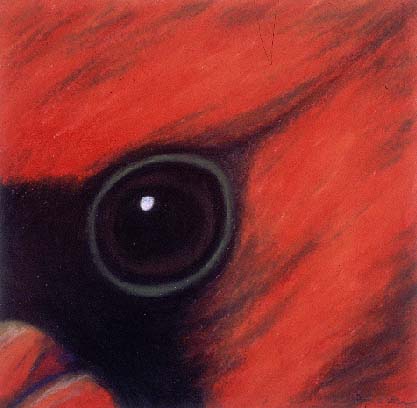
Now You Don't (1989). Father Paul Plante, an avid birder, uses a
square of paper to reveal a fragment of life. His Maine Favorites
(1999) and Northern Cardinal (2000) focus on the bird's eye to provide
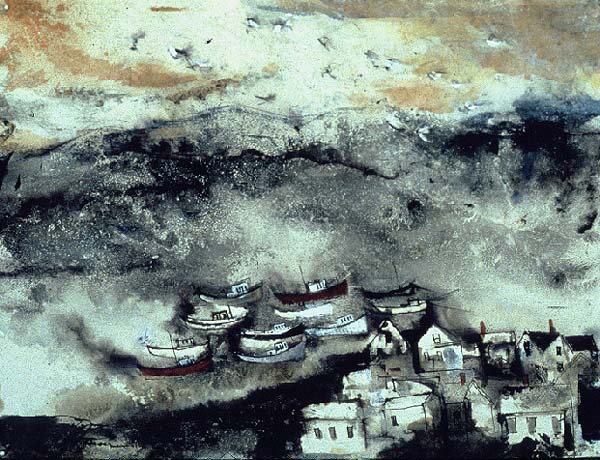
a glimpse of its life. (left: Father Paul Plante, Northern Cardinal,
2000, oil pastel on paper, collection of the artist; right: William Thon,
Northern Fishing Village, c. 1989, watercolor on paper, Caldbeck
Gallery, Rockland,ME)
Eclipse in Seven Stages
(1997) is a simple, yet powerful depiction of an evening in which the moon
waxed and waned. Robert Indiana's Autoportraits Vinalhaven Suite
(1980) provides a window into Vinalhaven's working-class character through
brash and tender graphic imagery. Janice Kasper, an avid environmentalist,
protests the clear-cutting of Maine's forests in Now You See Them and
Now You Don't (1989). Father Paul Plante, an avid birder, uses a
square of paper to reveal a fragment of life. His Maine Favorites
(1999) and Northern Cardinal (2000) focus on the bird's eye to provide
a glimpse of its life. (left: Father Paul Plante, Northern Cardinal,
2000, oil pastel on paper, collection of the artist; right: William Thon,
Northern Fishing Village, c. 1989, watercolor on paper, Caldbeck
Gallery, Rockland,ME)
"Modern art has not always been mainstream in Maine,
but the story of 20th-century modernism is incomplete without the contributions
of these artists working in their adopted and complex American Eden,"
Dr. Larsen notes.
Read more articles and essays concerning this institutional
source by visiting the sub-index page for the Katonah
Museum of Art in Resource Library Magazine
Please click on thumbnail images bordered by a red line
to see enlargements.
For further biographical information on selected artists
cited above please see America's Distinguished
Artists, a national registry of historic artists.
This page was originally published in Resource
Library Magazine. Please see Resource Library's Overview section for
more information. rev. 3/2/11
Search Resource
Library for thousands of articles and essays on American art.
Copyright 2011 Traditional Fine Arts Organization, Inc., an Arizona nonprofit corporation. All rights
reserved.
 One of the most beautiful and compelling exhibitions of the summer
will open at the Katonah Museum of Art on July 16, 2000. "Maine and
the Modern Spirit" explores the myth - perpetuated by artists, writers,
reformers, and poets -- that Maine is a uniquely modern American Eden. It
also shows how this rugged New England state served the evolution of modern
American art. (left: George Bellows, In a Rowboat, 1916, oil
on canvas, The Montclair Art Museum, Montclair, NJ, Purchase made possible
through a special gift from Mr. and Mrs. H. St. John Webb)
One of the most beautiful and compelling exhibitions of the summer
will open at the Katonah Museum of Art on July 16, 2000. "Maine and
the Modern Spirit" explores the myth - perpetuated by artists, writers,
reformers, and poets -- that Maine is a uniquely modern American Eden. It
also shows how this rugged New England state served the evolution of modern
American art. (left: George Bellows, In a Rowboat, 1916, oil
on canvas, The Montclair Art Museum, Montclair, NJ, Purchase made possible
through a special gift from Mr. and Mrs. H. St. John Webb)