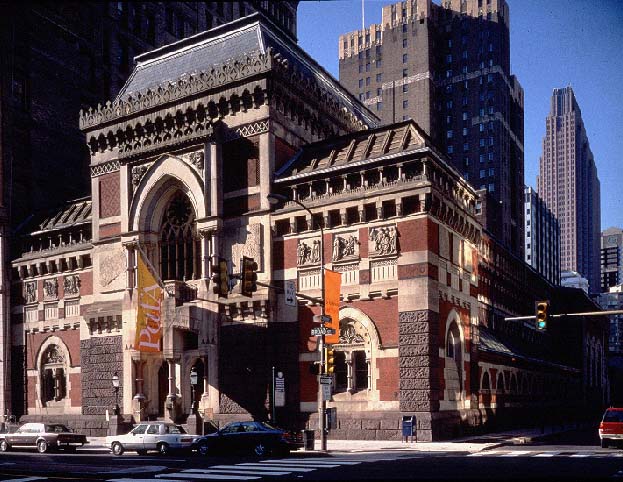
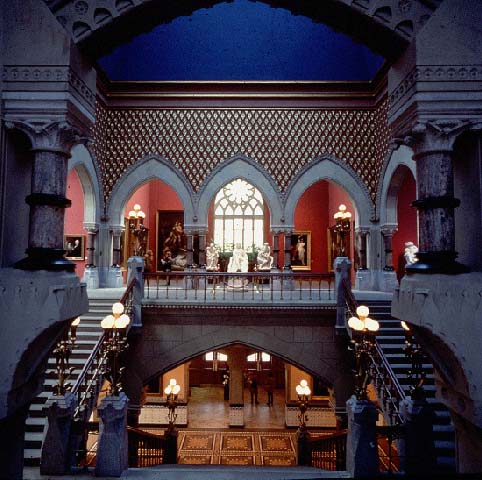
Pennsylvania Academy of the Fine Arts
Left photo: David Graham, Right photo: Nathan Benn
Philadelphia, PA
215-972-7600
Robert Gwathmey: Master Painter
This compelling traveling exhibition, for which the Pennsylvania Academy of the Fine Arts serves as the only East Coast venue and its final stop, surveys the career of Robert Gwathmey (1903-1988). It will be on view in Philadelphia from June 17 to August 13, 2000. One of the most committed social realists of his generation, Gwathmey received a degree from the Pennsylvania Academy in 1930. A native Virginian, he was highly regarded during the postwar period for his sensitive observations of the Southern Scene, painted in a modernist idiom of geometric forms and bold colors firmly grounded in representation. This retrospective of more than 60 paintings and graphics explores the work of a complex man, remembered as one of the first white artists to produce dignified and empathetic images of African American life at a particular time and place.
 Organized
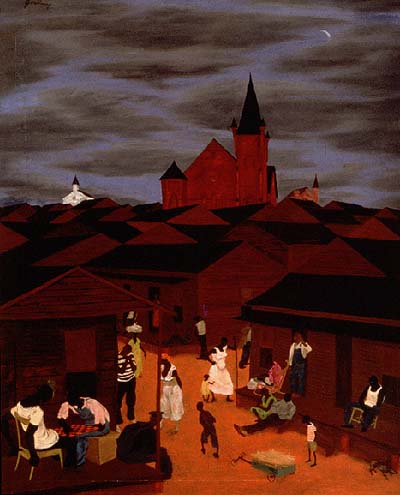
chronologically and thematically, the exhibition focuses on five decades
of Gwathmey's production. This survey will highlight his incisive look at
the stark structure of Southern society, defined by race and caste, throughout
the late 1930s, 1940s and 1950s, as well as the artist's pointed takes on
contemporary events, social relations, and excessive materialism of the
1960s and 1970s. Dubbed by the New York Times, at the time of his
death from Parkinson's disease, an "artist of social passions and style,"
Gwathmey consistently viewed himself as an observer-rather than a moralist--dually
committed to art and civil action. (left: Street Scene, 1938,
oil on canvas, 36 3/16 x 30 1/16 inches, Pennsylvania Academy of the Fine
Arts, Joseph E. Temple Fund, 1942.4)
Organized
chronologically and thematically, the exhibition focuses on five decades
of Gwathmey's production. This survey will highlight his incisive look at
the stark structure of Southern society, defined by race and caste, throughout
the late 1930s, 1940s and 1950s, as well as the artist's pointed takes on
contemporary events, social relations, and excessive materialism of the
1960s and 1970s. Dubbed by the New York Times, at the time of his
death from Parkinson's disease, an "artist of social passions and style,"
Gwathmey consistently viewed himself as an observer-rather than a moralist--dually
committed to art and civil action. (left: Street Scene, 1938,
oil on canvas, 36 3/16 x 30 1/16 inches, Pennsylvania Academy of the Fine
Arts, Joseph E. Temple Fund, 1942.4)
 After
a year of artistic study at Baltimore's Maryland Institute of Design, a
sojourn that marked Gwathmey's first trip North (although he had visited
Europe the previous year), he trained at the Pennsylvania Academy from 1926
to 1930. Working with a variety of instructors, Gwathmey had yet to settle
on his distinctive cubist-derived style and social subject matter. Nevertheless,
his formative years in Philadelphia would shape his future practice on a
variety of levels.Gwathmey received his greatest acclaim in the 1940s. By
this time, he was largely based in New York, where he maintained an active
presence in the gallery scene and his work was collected by major museums.
In 1942, he joined the faculty of the Cooper Union as a drawing instructor,
a position he held until 1968. An inspiring teacher who encouraged his students
to concern themselves with ethics and morality in both aesthetic and social
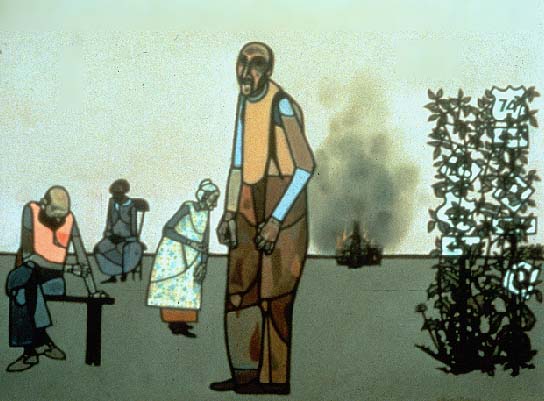
terms, Gwathmey influenced many younger artists. (The contemporary African
American artist Faith Ringgold credits Gwathmey for her interest in fusing
aesthetic and life experiences in her multimedia production.) (left:
Isolation, 1977, oil on canvas, 30 1/4 x 40 1/4 inches, Stephens,
Inc., Little Rock, Arkansas)
After
a year of artistic study at Baltimore's Maryland Institute of Design, a
sojourn that marked Gwathmey's first trip North (although he had visited
Europe the previous year), he trained at the Pennsylvania Academy from 1926
to 1930. Working with a variety of instructors, Gwathmey had yet to settle
on his distinctive cubist-derived style and social subject matter. Nevertheless,
his formative years in Philadelphia would shape his future practice on a
variety of levels.Gwathmey received his greatest acclaim in the 1940s. By
this time, he was largely based in New York, where he maintained an active
presence in the gallery scene and his work was collected by major museums.
In 1942, he joined the faculty of the Cooper Union as a drawing instructor,
a position he held until 1968. An inspiring teacher who encouraged his students
to concern themselves with ethics and morality in both aesthetic and social
terms, Gwathmey influenced many younger artists. (The contemporary African
American artist Faith Ringgold credits Gwathmey for her interest in fusing
aesthetic and life experiences in her multimedia production.) (left:
Isolation, 1977, oil on canvas, 30 1/4 x 40 1/4 inches, Stephens,
Inc., Little Rock, Arkansas)
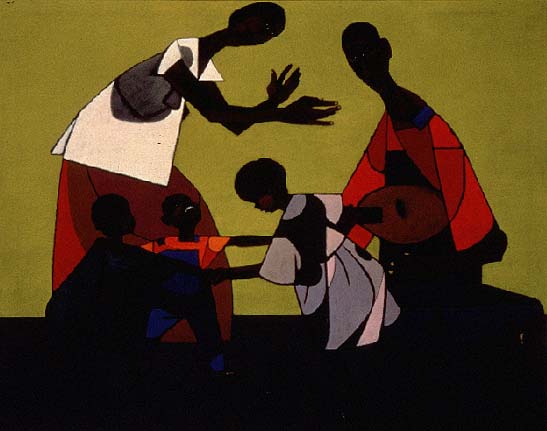 During
the 1950s, Gwathmey's figurative work, along with that of his colleagues
Philip Evergood, Ben Shahn , and Jacob Lawrence, was overshadowed by the
critical dominance of abstract painting. By the 1960s, a decade of civil
unrest, his art of social protest was again back in fashion. In 1973, Gwathmey
was elected to the American Academy and Institute of Arts and Letters and,
in 1976, he became an associate member of the National Academy of Design.
(left: Children Dancing, 1948, oil on canvas, 32 x 40 inches, The
Butler Institute of American Art, Youngstown, Ohio, Museum purchase, 1948)
During
the 1950s, Gwathmey's figurative work, along with that of his colleagues
Philip Evergood, Ben Shahn , and Jacob Lawrence, was overshadowed by the
critical dominance of abstract painting. By the 1960s, a decade of civil
unrest, his art of social protest was again back in fashion. In 1973, Gwathmey
was elected to the American Academy and Institute of Arts and Letters and,
in 1976, he became an associate member of the National Academy of Design.
(left: Children Dancing, 1948, oil on canvas, 32 x 40 inches, The
Butler Institute of American Art, Youngstown, Ohio, Museum purchase, 1948)
Organized by The Butler Institute of American Art, "Robert Gwathmey: Master Painter" will coincide with the exhibition "Andy Warhol: Social Observer," also on view at the Academy starting in June 2000. As a complementary pair, the exhibitions examine the documentary currents of social realism, which dominated the American art scene during the 1930s and early 1940s, and explore their connections to the later media-based strategies employed by Andy Warhol. The concurrent display of two "social commentators"--one under-recognized, Gwathmey, and the other canonic, Warhol--presents the Academy with a unique opportunity to reaffirm its historical mission by reshaping conceptions of postwar American art.
Read more about the Pennsylvania Academy of the Fine Arts in Resource Library Magazine.
Please click on thumbnail images bordered by a red line to see enlargements.
For further biographical information on selected artists cited above please see America's Distinguished Artists, a national registry of historic artists.
This page was originally published in Resource Library Magazine. Please see Resource Library's Overview section for more information. rev. 3/2/11
Search Resource Library for thousands of articles and essays on American art.
Copyright 2011 Traditional Fine Arts Organization, Inc., an Arizona nonprofit corporation. All rights reserved.