Williams College Museum of Art
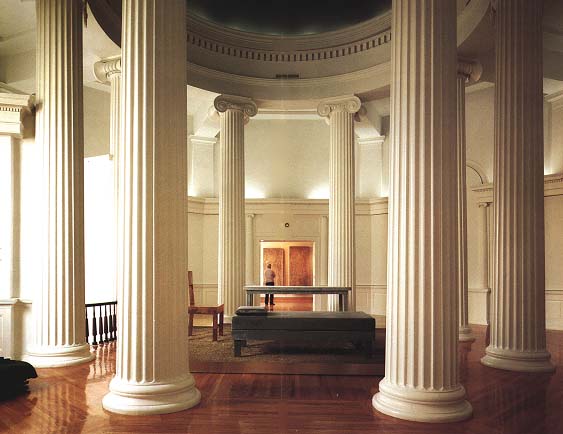
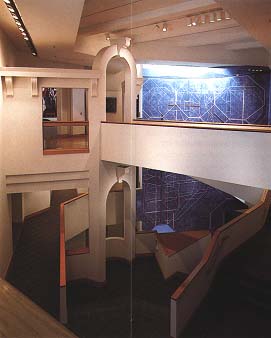
left: original 1846 rotunda, now the Faison Gallery, sculpture: Robert Morris, Hearing, 1972, © 1986 Steve Rosenthal; right: the atrium with WALLWORKS installation by William Ramage, 1988, photo by Nicholas Whitman
Williamstown, Massachusetts
413-597-2429
The Art of Leisure: Maurice and Charles Prendergast in the Williams College Museum of Art
July 1, 2000 - August, 2001
 Two artist-brothers, whose combined careers spanned some 50 years
(1890s to 1940s) of American art, were fascinated by what Americans did
in the brief moments of relaxation allowed them by a long workweek. In an
exhibition of approximately 50 watercolors, oils, and gilded panels drawn
from the Prendergast collection of the Williams College Museum of Art (WCMA),
all aspects of turn-of-the-century leisure come to life. Fashionable skirts
fluttering in the breeze, children playing on the beach, the pageantry of
Venice-could anything be more leisurely than the Prendergasts' view of the
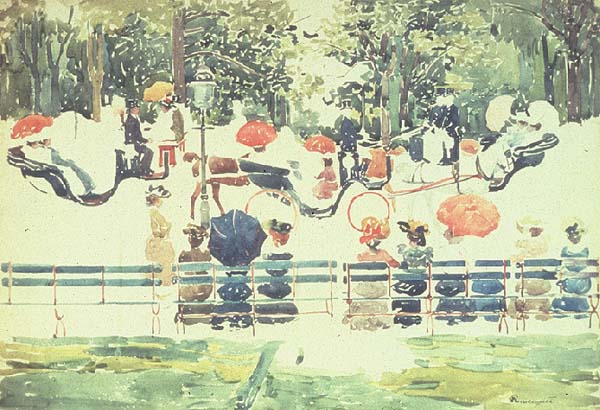
world? (left: Maurice Brazil Prendergast (1858-1924), Central
Park, c. 1901, watercolor and pencil on paper, Williams College Museum
of Art, gift of Mrs. Charles Prendergast in memory of Maurice and Charles
Prendergast, 67.13)
Two artist-brothers, whose combined careers spanned some 50 years
(1890s to 1940s) of American art, were fascinated by what Americans did
in the brief moments of relaxation allowed them by a long workweek. In an
exhibition of approximately 50 watercolors, oils, and gilded panels drawn
from the Prendergast collection of the Williams College Museum of Art (WCMA),
all aspects of turn-of-the-century leisure come to life. Fashionable skirts
fluttering in the breeze, children playing on the beach, the pageantry of
Venice-could anything be more leisurely than the Prendergasts' view of the
world? (left: Maurice Brazil Prendergast (1858-1924), Central
Park, c. 1901, watercolor and pencil on paper, Williams College Museum
of Art, gift of Mrs. Charles Prendergast in memory of Maurice and Charles
Prendergast, 67.13)
Maurice Brazil Prendergast (18581924) set the stage when he returned to Boston in 1895 after several years of art studies in Paris. With Impressionism still fresh in his mind, he began to paint the beaches, parks, and urban crowds of Boston and New York. To these he added colorful tourist views from periodic trips to France and Italy and became nationally known as a painter of modern life. He participated in historic exhibitions of modern art in New York, such as the exhibition of "The Eight" in 1908 and the Armory Show of 1913.
 In
addition to his deft handling of color and light, Maurice Prendergast's
scenes of American leisure can also be enjoyed for the glimpses he allows
us of the larger social issues of his day. Social activists and labor movements
joined in extolling the virtues of leisure for the working population and
the necessity of establishing a 40-hour workweek. Great civic parks were
created in and around metropolitan areas for healthful recreation; resort
hotels and seaside parks were built in conjunction with new modes of mass
transportation; foreign travel came within the reach of working Americans
thanks to inexpensive organized tours. Art itself was considered an important
example of the uplifting leisure activities available to an enlightened
society. Self-expression in making art and attendance at massive exhibitions
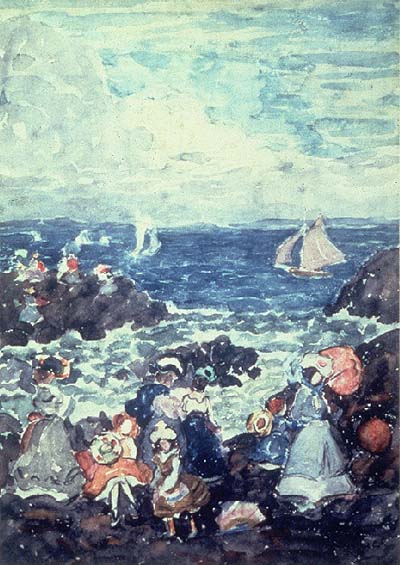
of modern art became part of the new, 20th-century culture. (left:
Maurice Brazil Prendergast (1858-1924), Surf, Nantucket, c. 1900-05,
watercolor and pencil on paper, Williams College Museum of Art, gift of
Mrs. Charles Prendergast in memory of Maurice and Charles Prendergast, 86.18.60)
In
addition to his deft handling of color and light, Maurice Prendergast's
scenes of American leisure can also be enjoyed for the glimpses he allows
us of the larger social issues of his day. Social activists and labor movements
joined in extolling the virtues of leisure for the working population and
the necessity of establishing a 40-hour workweek. Great civic parks were
created in and around metropolitan areas for healthful recreation; resort
hotels and seaside parks were built in conjunction with new modes of mass
transportation; foreign travel came within the reach of working Americans
thanks to inexpensive organized tours. Art itself was considered an important
example of the uplifting leisure activities available to an enlightened
society. Self-expression in making art and attendance at massive exhibitions
of modern art became part of the new, 20th-century culture. (left:
Maurice Brazil Prendergast (1858-1924), Surf, Nantucket, c. 1900-05,
watercolor and pencil on paper, Williams College Museum of Art, gift of
Mrs. Charles Prendergast in memory of Maurice and Charles Prendergast, 86.18.60)
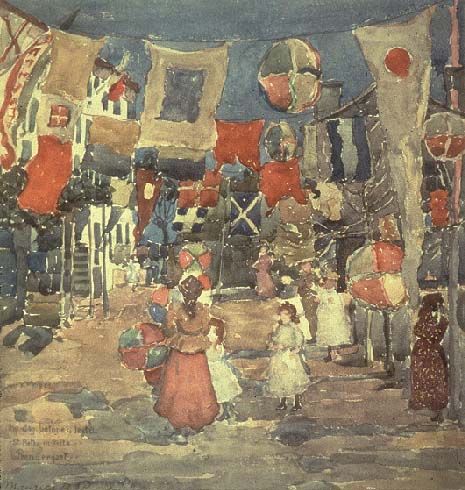 Maurice
Prendergast's interests in leisure and modern life were carried on by his
brother Charles Prendergast (18631948), who had originally made his
reputation as a frame and furniture maker in an Arts and Crafts style. After
Maurice's death in the 1920s, Charles developed his own version of American
leisure activities. His beach scenes, circuses, and polo-players are crafted
in a "naïve" style that both hides and reveals his long association
with modern art. (left: Maurice Brazil Prendergast (1858-1924), Fiesta-Venice-S.
Pietro in Volta, c. 1898-99, watercolor and pencil on paper, Williams
College Museum of Art, gift of Mrs. Charles Prendergast in memory of Maurice
and Charles Prendergast, 86.18.76)
Maurice
Prendergast's interests in leisure and modern life were carried on by his
brother Charles Prendergast (18631948), who had originally made his
reputation as a frame and furniture maker in an Arts and Crafts style. After
Maurice's death in the 1920s, Charles developed his own version of American
leisure activities. His beach scenes, circuses, and polo-players are crafted
in a "naïve" style that both hides and reveals his long association
with modern art. (left: Maurice Brazil Prendergast (1858-1924), Fiesta-Venice-S.
Pietro in Volta, c. 1898-99, watercolor and pencil on paper, Williams
College Museum of Art, gift of Mrs. Charles Prendergast in memory of Maurice
and Charles Prendergast, 86.18.76)
The exhibition was organized by Nancy Mowll Mathews, Eugénie Prendergast Curator. It is accompanied by catalogues of WCMA's Prendergast collection, which is the largest such collection in the world.
rev. 7/12/00
Read more about the Williams College Museum of Art in Resource Library.
Please click on thumbnail images bordered by a red line to see enlargements.
For further biographical information on selected artists cited above please see America's Distinguished Artists, a national registry of historic artists.
This page was originally published in Resource Library Magazine. Please see Resource Library's Overview section for more information. rev. 3/2/11
Search Resource Library for thousands of articles and essays on American art.
Copyright 2011 Traditional Fine Arts Organization, Inc., an Arizona nonprofit corporation. All rights reserved.