Whitney Museum of American Art
New York, NY
212-570-3600
http://www.whitney.org/
The Art of Alice Neel
Alice Neel (1900-1984), whose unflinching
paintings of friends, lovers, family, neighbors, and fellow artists are
among the most powerful portraits of the twentieth century, will be the
subject of a landmark retrospective exhibition. Organized by the Philadelphia
Museum of Art to celebrate the centennial of the artist's birth, "The
Art of Alice Neel" is the first full-scale reappraisal of Neel's work
since her death in 1984. "The Art of Alice Neel" debuts at the
Whitney Museum of American Art from June 29 to September 17, 2000, before
traveling to the Addison Gallery of American Art at Phillips Academy (Andover,
Massachusetts), the Philadelphia Museum of Art, and the Walker Art Center
(Minneapolis).
 "This
is the first-ever exhibition to present Alice Neel's work in its full complexity,"
said Ann Temkin, The Muriel and Philip Berman Curator of Modern and Contemporary
Art at the Philadelphia Museum of Art, and organizer of "The Art of
Alice Neel." "The exhibition will reveal a remarkable range of
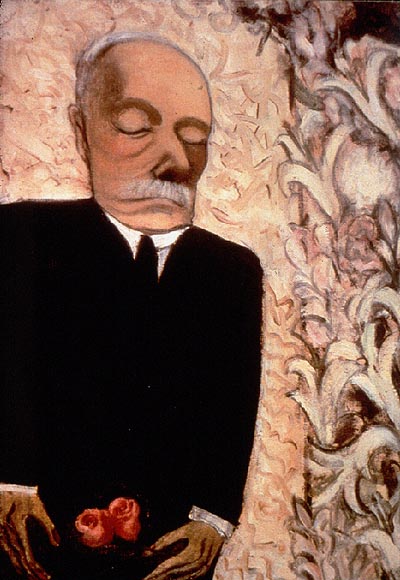
subjects and evolution of style over the course of six decades. (left:
Dead Father, 1946, oil on canvas, 19 1/2 x 28 inches, Private collection)
"This
is the first-ever exhibition to present Alice Neel's work in its full complexity,"
said Ann Temkin, The Muriel and Philip Berman Curator of Modern and Contemporary
Art at the Philadelphia Museum of Art, and organizer of "The Art of
Alice Neel." "The exhibition will reveal a remarkable range of
subjects and evolution of style over the course of six decades. (left:
Dead Father, 1946, oil on canvas, 19 1/2 x 28 inches, Private collection)
The exhibition features 75 paintings and watercolors, many
never before shown in any museum. Among the works on view, covering a period
of more than 50 years, are portraits of Neel's friends and neighbors in
Greenwich Village, Spanish Harlem, and the Upper West Side, images that
not only capture the essence of her sitters but chronicle an artist's life
in New York City. Her paintings, unforgiving yet tender, possess a singular
intensity and psychological depth.
Alice Neel was born in 1900 in a small town outside Philadelphia.
In 1921, she enrolled in the Philadelphia School of Design for Women (now
Moore College of Art and Design). In 1925, Neel married the Cuban painter
Carlos Enriquez; the couple lived in Havana, where Neel gave birth to their
first daughter, Santillana, who died of diphtheria one year later. Neel
and Enriquez moved to New York in 1927, where she bore her second child,
Isabetta. The next few years brought a series of hardships, including the
end of her marriage, separation from her daughter, a nervous breakdown,
a suicide attempt, and the destruction of her work by a jealous lover. In
1938, Neel moved uptown to Spanish Harlem, where she raised two sons--Richard,
born in 1939, and Hartley, born in 1941--and where she lived and worked
for the next 20 years.
 Details
of Neel's early years in Cuba and New York City have, until now, remained
obscure. Employed by the W.P.A. during the Great Depression, Neel painted
scenes of the city streets, including the impoverished and the homeless.
Her paintings of the 1930s also initiated a lifelong exploration of portraiture,
the form for which she is best known. Her evolution over the next five decades
reflects a commitment to depict the world with compassion, acuity, and freedom.
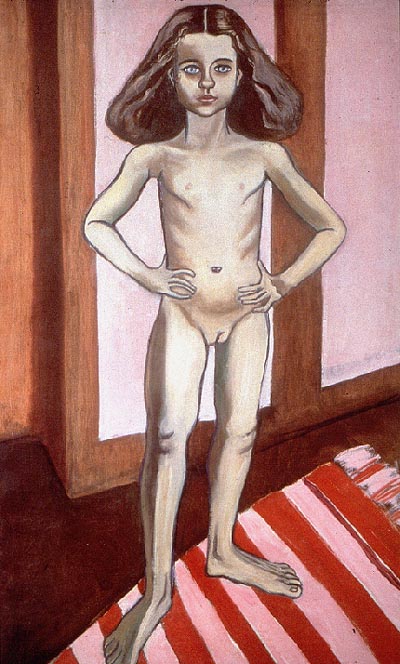
Among the highlights of "The Art of Alice Neel" is the nude portrait
of Isabetta (1934), in which the artist portrays her young daughter
in an assertive pose that contrasts strikingly with 19th-century depictions
of childhood innocence. Neel's brave, harrowing honesty is seen in Last
Sickness (1953), which captures the fear and discomfort of the artist's
mother in the final months of her life. (left: Isabetta, 1934,
oil on canvas, 43 x 25 1/4 inches, Collection of Johnathan and MonikaBrand,
Portland, OR)
Details
of Neel's early years in Cuba and New York City have, until now, remained
obscure. Employed by the W.P.A. during the Great Depression, Neel painted
scenes of the city streets, including the impoverished and the homeless.
Her paintings of the 1930s also initiated a lifelong exploration of portraiture,
the form for which she is best known. Her evolution over the next five decades
reflects a commitment to depict the world with compassion, acuity, and freedom.
Among the highlights of "The Art of Alice Neel" is the nude portrait
of Isabetta (1934), in which the artist portrays her young daughter
in an assertive pose that contrasts strikingly with 19th-century depictions
of childhood innocence. Neel's brave, harrowing honesty is seen in Last
Sickness (1953), which captures the fear and discomfort of the artist's
mother in the final months of her life. (left: Isabetta, 1934,
oil on canvas, 43 x 25 1/4 inches, Collection of Johnathan and MonikaBrand,
Portland, OR)
Neel's revelatory paintings from the decades between 1930
and 1960 shed new light on the body of work for which she is most famous:
the portraits created in the last two decades of her life. Many of these
portraits document the vibrant art world of which she suddenly found herself
a celebrated member. She painted the poets, artists, performers and critics
she knew, including Frank O'Hara, Robert Smithson, Faith Ringgold, Marisol,
Jackie Curtis, and Meyer Schapiro, as well as her famous and haunting portrait
of Andy Warhol (1970), whom she depicted shirtless, exposing the
scars from the attempt made on his life. Neel's keen observation and sense
of the uncanny are equally powerful in her still lifes and interiors, such
as the unexpected image of a capon defrosting in the sink (Thanksgiving,
1965).
 In
the 1970s, Neel became a celebrity, an enormously popular public speaker,
and appeared twice on "The Tonight Show" with Johnny Carson. Her
paintings continued to present a disconcerting blend of intimacy and monumentality.
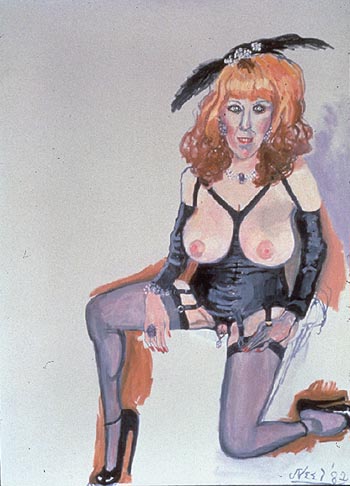
Referring to her portraits, she paraphrased Gogol, and called herself "a
collector of souls." A few months before her death in 1984, while discussing
her portraits with Henry Geldzahler in Interview, Neel responded
to the description of her as a "translator" by saying, "That's
what I really am, yes. A sympathetic, or sometimes not so sympathetic translator.
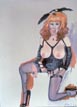
(left: Annie Sprinkle, 1982, oil on canvas, 60 x 44 inches,
Estate of Alice Neel)
In
the 1970s, Neel became a celebrity, an enormously popular public speaker,
and appeared twice on "The Tonight Show" with Johnny Carson. Her
paintings continued to present a disconcerting blend of intimacy and monumentality.
Referring to her portraits, she paraphrased Gogol, and called herself "a
collector of souls." A few months before her death in 1984, while discussing
her portraits with Henry Geldzahler in Interview, Neel responded
to the description of her as a "translator" by saying, "That's
what I really am, yes. A sympathetic, or sometimes not so sympathetic translator.
(left: Annie Sprinkle, 1982, oil on canvas, 60 x 44 inches,
Estate of Alice Neel)
Whitney Museum Director Maxwell L. Anderson noted, "The
Whitney Museum is proud to have been the first institution to honor Alice
Neel with a retrospective of her work in 1974. Her emotionally charged portraits
claim a unique place in the history of American portraiture, and we are
honored to be part of this tour." Neel was featured in the Whitney's
1972 "Annual Exhibition: Contemporary American Painting," and
her work was also included in such Whitney exhibitions as "Decade in
Review: Selections from the 70s in 1979;" "American Painting of
the 60s and 70s--The Real, The Ideal, The Fantastic: Selections from the
Whitney Museum of American Art" in 1980; "Portraits: On a Human
Scale" in 1983; "Figurative Works from the Permanent Collection"
in 1992; and, more recently, "Views from Abroad: European Perspectives
on American Art" in 1997 and in The American Century.
"Recent years have seen the remarkable resurgence
of portraiture as a vital field for new artists working in a variety of
mediums, and as a compelling subject for exhibitions, such as the recent
retrospectives of Ingres and Daumier," added Anne dHarnoncourt, Director
and Chief Executive Officer of the Philadelphia Museum of Art. "This
centenary salute to Alice Neel marks a particularly opportune moment for
the first full examination of an artist who transformed the contemporary
portrait and, in doing so, influenced succeeding generations.
"The Art of Alice Neel" is organized and installed
by Ann Temkin, The Muriel and Philip Berman Curator of Modern and Contemporary
Art, Philadelphia Museum of Art. The exhibition is coordinated for the Whitney
Museum of American Art by Barbara Haskell, Curator of Pre-War American Art.
The exhibition is accompanied by a fully illustrated catalogue with essays
by Ms. Temkin; Susan Rosenberg, Assistant Curator of Modern and Contemporary
Art, Philadelphia Museum of Art; and Richard Flood, Chief Curator, Walker
Art Center. Temkin discusses interconnections between Neel's art and life;
Rosenberg explores Neel's artistic roots in the 1930s; and Flood focuses
on the art-world portraits of the 1960s and 1970s. The catalogue, richly
illustrated with many previously unpublished photographs, includes entries
on each work, reminiscences by Neel's portrait subjects, and the first detailed
chronology of Neel's life.
The Whitney Museum of American Art presentation is made
possible by generous gifts from The Horace W. Goldsmith Foundation, Mrs.
Edwin A. Malloy, Hartley S. Neel, Richard Neel, and an anonymous donor.
Editor's note: RL readers
may also enjoy:
TFAO also suggests these DVD or VHS videos:
- Alice Neel, 30-minute 1975
Alice Neel interview from the Video Data
Bank, a resource for videotapes by and about contemporary artists is
a video available through the Sullivan
Video Library at The Speed Art Museum which holds a sizable collection
of art-related videos available to educators at no charge.
-
- Alice Neel, 1900-1984. An
appreciative look back at the formidable, yet endearirig, Alice Neel. This
video features an interview with Neel conducted shortly before her death,
and includes footage of two exhibitions of her work at the Robert Miller
Gallery. 1990, 28 minutes. VHS,
-
- Alice Neel, (NR, USA, 86
mins.). A portraitist's grandson creates her portrait on film in a fascinating
documentary. The biography of this influential, emotionally troubled painter
could have been titled "Form Follows Function" since it achieves
the documentary format's basic goal of illuminating history while also
demonstrating through filmmaking choices, how an artist's style reveals
his or her personality. Cape Cod Museum
of Art showed this film in January, 2008. (9/5/08 note: Google
Video contains a 3-minute trailer on the documentary)
-
- Alice Neel: Collector of Souls 28 minute / 1977 / CINE - "Cringing at the term 'portrait
painter,' Alice Neel preferred to refer to herself as a "collector
of souls." Combining bold brushstrokes, vibrant colors and sharply
contrasting highlights and shadows, Neel deftly captured the human psyche
on canvas. The film uses a variety of techniques to reveal the character
of the ebullient Neel."
TFAO does not maintain a lending library of videos or sell videos.
Click here
for information on how to borrow or purchase copies of VHS videos and DVDs
listed in TFAO's Videos -DVD/VHS, an authoritative guide to videos in VHS and DVD format
Please click on thumbnail images bordered by a red line
to see enlargements.
For further biographical information please see America's Distinguished Artists, a national
registry of historic artists.
Links to sources of information outside of our web site
are provided only as referrals for your further consideration. Please use
due diligence in judging the quality of information contained in these and
all other web sites. Information from linked sources may be inaccurate or
out of date. TFAO neither recommends or endorses these referenced organizations.
Although TFAO includes links to other web sites, it takes no responsibility
for the content or information contained on those other sites, nor exerts
any editorial or other control over them. For more information on evaluating
web pages see TFAO's General Resources
section in Online Resources for Collectors and Students of Art History.
This page was originally published in Resource
Library Magazine. Please see Resource Library's Overview section for
more information. rev. 3/2/11
Search Resource
Library for thousands of articles and essays on American art.
Copyright 2011 Traditional Fine Arts Organization, Inc., an Arizona nonprofit corporation. All rights
reserved.
 "This
is the first-ever exhibition to present Alice Neel's work in its full complexity,"
said Ann Temkin, The Muriel and Philip Berman Curator of Modern and Contemporary
Art at the Philadelphia Museum of Art, and organizer of "The Art of
Alice Neel." "The exhibition will reveal a remarkable range of
subjects and evolution of style over the course of six decades. (left:
Dead Father, 1946, oil on canvas, 19 1/2 x 28 inches, Private collection)
"This
is the first-ever exhibition to present Alice Neel's work in its full complexity,"
said Ann Temkin, The Muriel and Philip Berman Curator of Modern and Contemporary
Art at the Philadelphia Museum of Art, and organizer of "The Art of
Alice Neel." "The exhibition will reveal a remarkable range of
subjects and evolution of style over the course of six decades. (left:
Dead Father, 1946, oil on canvas, 19 1/2 x 28 inches, Private collection)