The Hyde Collection Art Museum
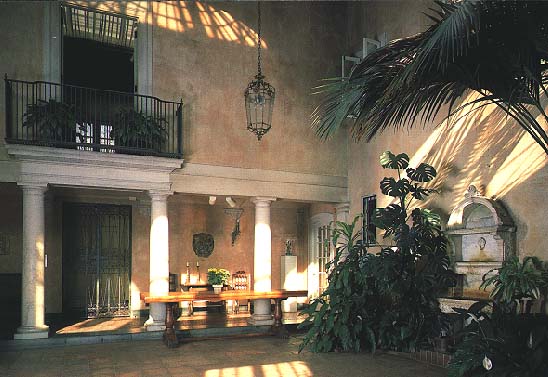
Courtyard, former residence of Louis and Charlotte Hyde, Bigelow and Wadsworth, Architects, built 1912, © 1987 The Hyde Collection, Glens Falls, New York
518-792-1761
Picturing Gentility: Portraits of Women in American Art
September 24 - December 3, 2000
"The American Will inhabits the skyscraper, the American Intellect the colonial mansion. The one is the sphere of the American man; the other, at least predominantly, of the American woman. The one is all aggressive enterprise, the other is all genteel tradition."
When the American philosopher George Santayana made this statement in 1911 during a public address at the University of California, he was referring to the generation of Gilded Age writers who together promoted the genteel tradition as the American cultural norm. Since Santayana coined this term, scholars have continued to write extensively on the genteel tradition in American literature. The visual arts, however, remain an untapped resource on this theme.
 The
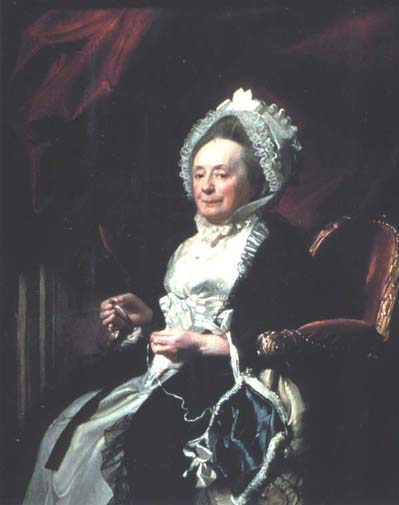
Hyde Collection will present "Picturing Gentility: Portraits of Women
in American Art" from September 24 through December 3, 2000 in the
Charles R. Wood Gallery. The exhibition will examine for the first time,
and with unprecedented depth, the genteel tradition in American art as portrayed
by images of refined women produced from the colonial period to the decade
precedes the Second World War. "Picturing Gentility" will be accompanied
by a fully illustrated catalogue and a range of public programs, including
a fall lecture series, to further enhance public understanding of the role
of women in the arts and culture. (left: John Singleton Copley (1728-1815),
Portrait of a Lady (Mrs. Seymour Fort), c. 1778, 49 1/2 x 39 5/8
in., oil on canvas.Wadsworth Atheneum, Hartford, Connecticut. The Gallery
Fund.)
The
Hyde Collection will present "Picturing Gentility: Portraits of Women
in American Art" from September 24 through December 3, 2000 in the
Charles R. Wood Gallery. The exhibition will examine for the first time,
and with unprecedented depth, the genteel tradition in American art as portrayed
by images of refined women produced from the colonial period to the decade
precedes the Second World War. "Picturing Gentility" will be accompanied
by a fully illustrated catalogue and a range of public programs, including
a fall lecture series, to further enhance public understanding of the role
of women in the arts and culture. (left: John Singleton Copley (1728-1815),
Portrait of a Lady (Mrs. Seymour Fort), c. 1778, 49 1/2 x 39 5/8
in., oil on canvas.Wadsworth Atheneum, Hartford, Connecticut. The Gallery
Fund.)
 "Picturing
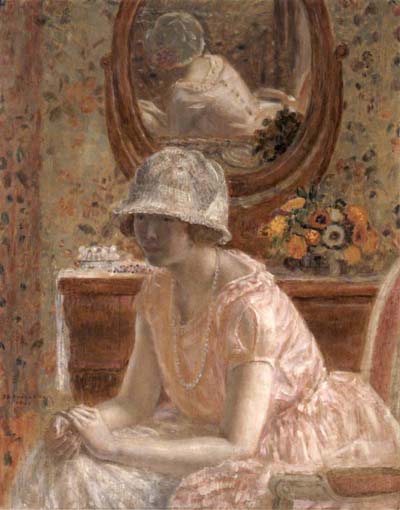
Gentility" will focus exclusively on this unique group of paintings
created by some of America's finest artists such as John Singleton Copley
, James Earl, Erastus Salisbury Field, Frederick Carl Frieseke,Joseph DeCamp,
Thomas Wilmer Dewing, Mary Cassatt, Edmund C. Tarbell and J. Alden Weir.
This one-time showing at The Hyde Collection will feature over 30 paintings
drawn from nationwide public collections including the Metropolitan Museum
of Art, the National Gallery of Art, the Museum of Fine Arts, Boston, Winterthur
Museum and the M.H. de Young Memorial Museum. (left: Frederick Carl
Frieseke (1874-1939), Young Girl Before a Mirror in a Pink Dress,
1923, oil on canvas, 36 x 29 in. The Hyde Collection.)
"Picturing
Gentility" will focus exclusively on this unique group of paintings
created by some of America's finest artists such as John Singleton Copley
, James Earl, Erastus Salisbury Field, Frederick Carl Frieseke,Joseph DeCamp,
Thomas Wilmer Dewing, Mary Cassatt, Edmund C. Tarbell and J. Alden Weir.
This one-time showing at The Hyde Collection will feature over 30 paintings
drawn from nationwide public collections including the Metropolitan Museum
of Art, the National Gallery of Art, the Museum of Fine Arts, Boston, Winterthur
Museum and the M.H. de Young Memorial Museum. (left: Frederick Carl
Frieseke (1874-1939), Young Girl Before a Mirror in a Pink Dress,
1923, oil on canvas, 36 x 29 in. The Hyde Collection.)
 The
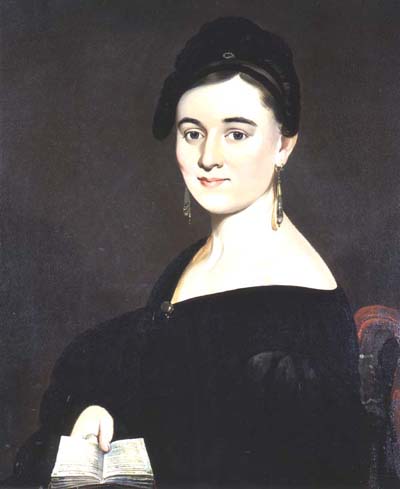
portraits selected for this exhibition contain specific emblems of refinement
that fit within the long-established iconography of the genteel. This art
historical convention can be traced to seventeenth century Dutch art, and
includes representations of middle- and upper-class women in refined dress,
amid their worldly possessions and performing sanctioned activities such
as sewing, reading, playing music and quietly reflecting. The genteel woman
embodied the feminine ideal; she was viewed as the guardian of the home
and the symbol of culture, refinement and idealized beauty. (left:
William Matthew Prior (1806-1873), Lucy A. Hartshorn, 1836, oil on
board, 24 7/16 x 20 15/16 in., Old Sturbridge Village, Sturbridge, Massachusetts.)
The
portraits selected for this exhibition contain specific emblems of refinement
that fit within the long-established iconography of the genteel. This art
historical convention can be traced to seventeenth century Dutch art, and
includes representations of middle- and upper-class women in refined dress,
amid their worldly possessions and performing sanctioned activities such
as sewing, reading, playing music and quietly reflecting. The genteel woman
embodied the feminine ideal; she was viewed as the guardian of the home
and the symbol of culture, refinement and idealized beauty. (left:
William Matthew Prior (1806-1873), Lucy A. Hartshorn, 1836, oil on
board, 24 7/16 x 20 15/16 in., Old Sturbridge Village, Sturbridge, Massachusetts.)
Elements of genteel culture have existed in American society
from the eighteenth century to the early twentieth century. During this
150-year period women were viewed, and visually portrayed, as purveyors
of taste, sensibility and delicacy. Gentility bestowed power and status,
and portraits of women in late colonial and early American art visually
attest to the value people attached to refined objects and settings. By
the turn of the century, however, portraits of respectable ladies became
anachronistic when contrasted against the backdrop of a politically and
socially turbulent time. American women were campaigning in greater numbers
for access to educational opportunities and legal rights including the right
to vote. Regardless, Gilded Age 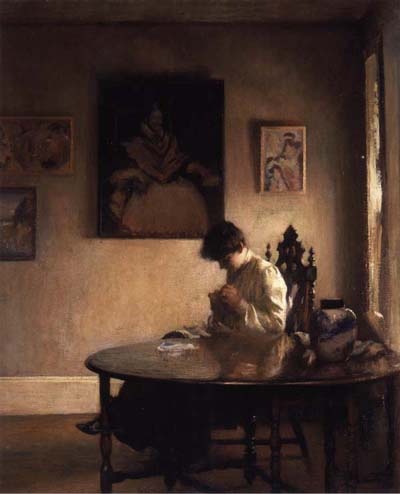 painters such as Thomas Wilmer Dewing, Frederick C.
Frieseke, Edmund C. Tarbell and J. Alden Weir continued to depict women
at home quietly occupied with reading, sewing, playing music and admiring
fine objets d'art. The interior spaces their feminine subjects occupied
contained colonial furniture such as gate-leg tables, Windsor chairs and
spinning wheels that recall the virtue and refinement of America's vanishing
Puritan past. (left: Edmund Charles Tarbell (1862-1938), Girl
Crocheting, 1904, oil on canvas, 30 x 24 in. Canajoharie Library and
Art Gallery.)
painters such as Thomas Wilmer Dewing, Frederick C.
Frieseke, Edmund C. Tarbell and J. Alden Weir continued to depict women
at home quietly occupied with reading, sewing, playing music and admiring
fine objets d'art. The interior spaces their feminine subjects occupied
contained colonial furniture such as gate-leg tables, Windsor chairs and
spinning wheels that recall the virtue and refinement of America's vanishing
Puritan past. (left: Edmund Charles Tarbell (1862-1938), Girl
Crocheting, 1904, oil on canvas, 30 x 24 in. Canajoharie Library and
Art Gallery.)
By the early twentieth century, the genteel woman signified a longed-for stability in changing times. At this time, women began to play a significant role as patrons and collectors of fine art. It is not a coincidence, therefore, that the Museum's founder Charlotte Pruyn Hyde (1867-1963) dedicated her life to amassing the fine and decorative art objects that now form The Hyde Collection.
The "Picturing Gentility" catalogue published to accompany the exhibition will include three essays that will provide valuable and groundbreaking new research on this topic. The authors include Erin M. Budis, Curator, The Hyde Collection, Dr. Marian Wardle, Curator, Museum of Art, Brigham Young University, and Dr. Catherine J. Golden, Associate Professor of English, Skidmore College.
The exhibition and fall lecture series is funded in part by the New York Council for the Humanities, and is part October State Humanities Month, as well as National Arts and Humanities Month celebrating the many individuals and organizations whose contributions to the visual and performing arts and to the study of history, literature and philosophy have made this country a better place to live.
Read more about the Hyde Collection in Resource Library Magazine.
Please click on thumbnail images bordered by a red line to see enlargements.
For further biographical information on selected artists cited above please see America's Distinguished Artists, a national registry of historic artists.
This page was originally published in Resource Library Magazine. Please see Resource Library's Overview section for more information. rev. 3/18/11
Search Resource Library for thousands of articles and essays on American art.
Copyright 2011 Traditional Fine Arts Organization, Inc., an Arizona nonprofit corporation. All rights reserved.