Noyes Museum of Art
Oceanville, NJ
609-652-8848
http://www.noyesmuseum.org
Birds and Men: Sculpture by Brian Meunier
October 17, 1999 to January 9, 2000
This exhibition features ten of Brian
Meunier's large-scale wood and metal assemblages reflecting the artist's
respect for sculptural tradition, with a light-hearted contemporary flair.
The works inspired by birds are stylized and whimsical, yet evoke a sense
of the creatures in their natural habitat.
Meunier cites the lower Delaware River and southern New
Jersey regions, as well as the upper reaches of the Chesapeake Bay, as the
influences for many of the bird sculptures. His most recent body of work
also reflects an increasing interest in plants, marine life, birds, and
the relationship of culture to nature. These natural themes contrast his
earlier work which was inspired by technology, in particular, agricultural
and nautical devices from the beginning stages of the Industrial Revolution.
Meunier currently serves as Chair and Professor of the
Studio Art Department at Swarthmore College in Pennsylvania. He holds an
M.F.A. from Tyler School of Art, and, since the 1970s has been featured
in solo as well as group exhibitions in Philadelphia, New York, Massachusetts,
Chicago, and St. Louis. He has received numerous awards, including two Pennsylvania
Council on the Arts Fellowships, an NEA Fellowship, and a Ford Foundation
Grant.
Brian Meunier said about Full Moon, one of the sculptures
in the exhibition, "After reading Mary Shelley's Frankenstein,
I wanted to make a sculpture that incorporated the look of Victorian laboratory
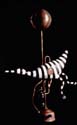 equipment.
I was also inspired by a book I had of the Automatons of Monte Carlo,
a group of amazing mechanical dolls that were created in the early 18th
century. I added the round copper plate to one side of the body to suggest
that the body of the bird might be hollow and might hold secret working
mechanisms. I was thinking of the term "lunacy " and its relationship
to the tides--water and moon--hence, the pipes and blue bottle....I love
ancient ceramics, particularly examples where pictorial decoration alters
the reading of the three-dimensional form. I was also looking at several
images of airplanes and battleships that were painted in stripes as a way
of camouflaging [dazzle painting was used during World War I in an effort
to camouflage American and British military vessels.] To make a bird striped
seemed to me to be a "loony " thing to do. A camouflaged bird
in the antithesis of the decoy...The bird form was borrowed from a specific
painting of a Limpkin by John James Audubon. However, I replaced the Limpkin's
feet with a duck's webbed feet." (left: Full Moon, 1996,
wood, oil enamel, copper, brass and glass, 40 x 31 x 10 inches)
equipment.
I was also inspired by a book I had of the Automatons of Monte Carlo,
a group of amazing mechanical dolls that were created in the early 18th
century. I added the round copper plate to one side of the body to suggest
that the body of the bird might be hollow and might hold secret working
mechanisms. I was thinking of the term "lunacy " and its relationship
to the tides--water and moon--hence, the pipes and blue bottle....I love
ancient ceramics, particularly examples where pictorial decoration alters
the reading of the three-dimensional form. I was also looking at several
images of airplanes and battleships that were painted in stripes as a way
of camouflaging [dazzle painting was used during World War I in an effort
to camouflage American and British military vessels.] To make a bird striped
seemed to me to be a "loony " thing to do. A camouflaged bird
in the antithesis of the decoy...The bird form was borrowed from a specific
painting of a Limpkin by John James Audubon. However, I replaced the Limpkin's
feet with a duck's webbed feet." (left: Full Moon, 1996,
wood, oil enamel, copper, brass and glass, 40 x 31 x 10 inches)
Read more about the Noyes Museum of
Art in Resource Library Magazine
rev. 11/22/10
Search Resource
Library for thousands of articles and essays on American art.
Copyright 2010 Traditional Fine Arts Organization, Inc., an Arizona nonprofit corporation. All rights
reserved.
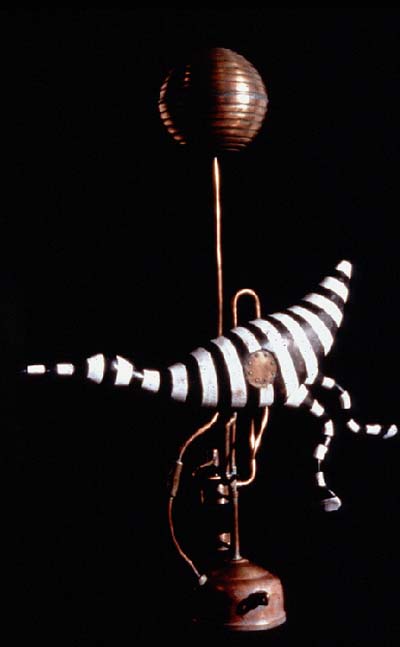 equipment.
I was also inspired by a book I had of the Automatons of Monte Carlo,
a group of amazing mechanical dolls that were created in the early 18th
century. I added the round copper plate to one side of the body to suggest
that the body of the bird might be hollow and might hold secret working
mechanisms. I was thinking of the term "lunacy " and its relationship
to the tides--water and moon--hence, the pipes and blue bottle....I love
ancient ceramics, particularly examples where pictorial decoration alters
the reading of the three-dimensional form. I was also looking at several
images of airplanes and battleships that were painted in stripes as a way
of camouflaging [dazzle painting was used during World War I in an effort
to camouflage American and British military vessels.] To make a bird striped
seemed to me to be a "loony " thing to do. A camouflaged bird
in the antithesis of the decoy...The bird form was borrowed from a specific
painting of a Limpkin by John James Audubon. However, I replaced the Limpkin's
feet with a duck's webbed feet." (left: Full Moon, 1996,
wood, oil enamel, copper, brass and glass, 40 x 31 x 10 inches)
equipment.
I was also inspired by a book I had of the Automatons of Monte Carlo,
a group of amazing mechanical dolls that were created in the early 18th
century. I added the round copper plate to one side of the body to suggest
that the body of the bird might be hollow and might hold secret working
mechanisms. I was thinking of the term "lunacy " and its relationship
to the tides--water and moon--hence, the pipes and blue bottle....I love
ancient ceramics, particularly examples where pictorial decoration alters
the reading of the three-dimensional form. I was also looking at several
images of airplanes and battleships that were painted in stripes as a way
of camouflaging [dazzle painting was used during World War I in an effort
to camouflage American and British military vessels.] To make a bird striped
seemed to me to be a "loony " thing to do. A camouflaged bird
in the antithesis of the decoy...The bird form was borrowed from a specific
painting of a Limpkin by John James Audubon. However, I replaced the Limpkin's
feet with a duck's webbed feet." (left: Full Moon, 1996,
wood, oil enamel, copper, brass and glass, 40 x 31 x 10 inches)