Museum of Indian Arts and Culture
Santa Fe, NM
505-476-1250
http://www.museumofnewmexico.org
Master Pueblo Painters, 1900-1930
 "Master Pueblo Painters, 1900-1930," opening Sunday, October
1, 2000 at the Museum of Indian Arts & Culture, reveals a painting style
that merged ancient Pueblo traditions with the aesthetic principles of Euro-American
modernism, and reflects the changing relationship between the two cultures.
In this exhibition, 66 paintings (42 paintings from the School of American
Research and 24 from the Museum of New Mexico collection) show Pueblo life
in an idealistic way, but is also a very realistic look at Pueblo ceremonial
life during the period. The works on display are featured in the book Pueblo
Indian Painting: Tradition and Modernism in New Mexico, 1900-1930 by
J.J. Brody published by SAR press. (left: Fred Kabotie (Naqavoy'ma);
Navajo Mask Ceremony; ca. 1921)
"Master Pueblo Painters, 1900-1930," opening Sunday, October
1, 2000 at the Museum of Indian Arts & Culture, reveals a painting style
that merged ancient Pueblo traditions with the aesthetic principles of Euro-American
modernism, and reflects the changing relationship between the two cultures.
In this exhibition, 66 paintings (42 paintings from the School of American
Research and 24 from the Museum of New Mexico collection) show Pueblo life
in an idealistic way, but is also a very realistic look at Pueblo ceremonial
life during the period. The works on display are featured in the book Pueblo
Indian Painting: Tradition and Modernism in New Mexico, 1900-1930 by
J.J. Brody published by SAR press. (left: Fred Kabotie (Naqavoy'ma);
Navajo Mask Ceremony; ca. 1921)
"This art began at a time when Pueblo culture was
being threatened by a government intent on acculturating Indian people,"
said Duane Anderson, director of the Museum of Indian Arts & Culture.
"These works are important in their literal ethnographic accuracy and
are sure to captivate the viewer, just as they did when they were first
exhibited by the Museum of New Mexico in 1919."
 The
genre of painting began as a result of the archaeological work of Edgar
Lee Hewett. founder of the Museum of New Mexico and the School of American
Research. Hewett hired Pueblo people from San Ildefonso to work on the sites
and field camps of his 1907 excavations on the Pajarito Plateau. The new
art began there, with the work of Alfredo Montoya (1892-1913) and Crescencio
Martinez (1879-1918), who sold their paintings to anthropologists and set
the style on its course, working on the new medium of paper instead of the
traditional pictograph and hide paintings. In 1918 Elizabeth DeHuff, wife
of the Santa Fe Indian School superintendent, invited homesick boarding
school students to paint pictures of the students' ritual dances. Inspiration
for the art from its beginnings, dances were held for many reasons, among
them, as a call for rain, to ensure a bountiful harvest, or to give thanks
for a successful hunt. Dances were a means to carry prayers to the gods,
thus necessitating extreme sensitivity to what could and could not be painted
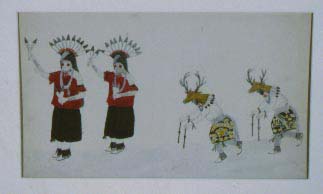
out of respect for the group culture. (left: Tonita Peña,
(Quah Ah) Deer Dances, Two Lady & Two Man, ca. 1920-21)
The
genre of painting began as a result of the archaeological work of Edgar
Lee Hewett. founder of the Museum of New Mexico and the School of American
Research. Hewett hired Pueblo people from San Ildefonso to work on the sites
and field camps of his 1907 excavations on the Pajarito Plateau. The new
art began there, with the work of Alfredo Montoya (1892-1913) and Crescencio
Martinez (1879-1918), who sold their paintings to anthropologists and set
the style on its course, working on the new medium of paper instead of the
traditional pictograph and hide paintings. In 1918 Elizabeth DeHuff, wife
of the Santa Fe Indian School superintendent, invited homesick boarding
school students to paint pictures of the students' ritual dances. Inspiration
for the art from its beginnings, dances were held for many reasons, among
them, as a call for rain, to ensure a bountiful harvest, or to give thanks
for a successful hunt. Dances were a means to carry prayers to the gods,
thus necessitating extreme sensitivity to what could and could not be painted
out of respect for the group culture. (left: Tonita Peña,
(Quah Ah) Deer Dances, Two Lady & Two Man, ca. 1920-21)
 In
the era between World War I and II, exhibitions and acquisitions of both
traditional Pueblo art and the new painting by museums across the country
paralleled popular European aesthetic principles of formalism and metaphor,
making the art attractive to modernists. When the Santa Fe art community
encouraged Pueblo artists to paint more imaginatively, the work became increasingly
abstract and individualized. In Pueblo culture, any art made in isolation
from daily life was philosophically disharmonious, for it reduced art making
to a private, egocentric act outside the scope of traditional values. Thus,
this style of painting evolved uneasily as both artists and patrons tried
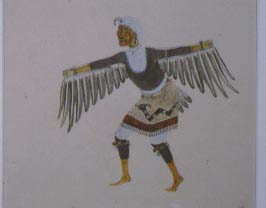
to maintain a state of balance in a disharmonious new world. (left:
Crescencio Martinez (Tá e), Tewa Eagle Dancer, 1918)
In
the era between World War I and II, exhibitions and acquisitions of both
traditional Pueblo art and the new painting by museums across the country
paralleled popular European aesthetic principles of formalism and metaphor,
making the art attractive to modernists. When the Santa Fe art community
encouraged Pueblo artists to paint more imaginatively, the work became increasingly
abstract and individualized. In Pueblo culture, any art made in isolation
from daily life was philosophically disharmonious, for it reduced art making
to a private, egocentric act outside the scope of traditional values. Thus,
this style of painting evolved uneasily as both artists and patrons tried
to maintain a state of balance in a disharmonious new world. (left:
Crescencio Martinez (Tá e), Tewa Eagle Dancer, 1918)
By 1941, the Pueblo painting tradition was already overshadowed
by a new Pan-Indian one taught at Indian Schools nationwide and the early
Pueblo painters and their art slipped into obscurity. Master Pueblo Painters,
1900 - 1930 highlights the best young Pueblo artists of the era and
features the work of Fred Kabotie, Hopi (1900-1986), Otis Polelonema, Hopi
(1902-1981), Alfonso Roybal, San Ildefonso (1898-1955), Velino Herrera,
Zia (1902-1973), and two other San Ildefonsans - Tonita Peña (1893-1949),
who lived at Cochiti Pueblo, and Abel Sanchez (1899-1971).
The Women's Board of the Museum of New Mexico hosts the
opening reception from 2 - 4 pm, on Sunday, October 1. The exhibition closes
January 1, 2001.
rev. 8/25/00
Read more about the Museum
of Indian Arts and Culture in Resource
Library Magazine
Please click on thumbnail images bordered by a red line
to see enlargements.
For further biographical information on selected artists
cited above please see America's Distinguished
Artists, a national registry of historic artists.
This page was originally published in Resource
Library Magazine. Please see Resource Library's Overview section for
more information. rev. 3/23/11
Search Resource
Library for thousands of articles and essays on American art.
Copyright 2011 Traditional Fine Arts Organization, Inc., an Arizona nonprofit corporation. All rights
reserved.
 "Master Pueblo Painters, 1900-1930," opening Sunday, October
1, 2000 at the Museum of Indian Arts & Culture, reveals a painting style
that merged ancient Pueblo traditions with the aesthetic principles of Euro-American
modernism, and reflects the changing relationship between the two cultures.
In this exhibition, 66 paintings (42 paintings from the School of American
Research and 24 from the Museum of New Mexico collection) show Pueblo life
in an idealistic way, but is also a very realistic look at Pueblo ceremonial
life during the period. The works on display are featured in the book Pueblo
Indian Painting: Tradition and Modernism in New Mexico, 1900-1930 by
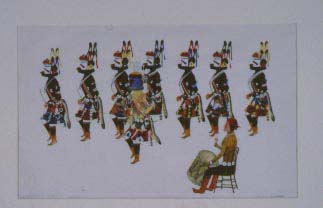
J.J. Brody published by SAR press. (left: Fred Kabotie (Naqavoy'ma);
Navajo Mask Ceremony; ca. 1921)
"Master Pueblo Painters, 1900-1930," opening Sunday, October
1, 2000 at the Museum of Indian Arts & Culture, reveals a painting style
that merged ancient Pueblo traditions with the aesthetic principles of Euro-American
modernism, and reflects the changing relationship between the two cultures.
In this exhibition, 66 paintings (42 paintings from the School of American
Research and 24 from the Museum of New Mexico collection) show Pueblo life
in an idealistic way, but is also a very realistic look at Pueblo ceremonial
life during the period. The works on display are featured in the book Pueblo
Indian Painting: Tradition and Modernism in New Mexico, 1900-1930 by
J.J. Brody published by SAR press. (left: Fred Kabotie (Naqavoy'ma);
Navajo Mask Ceremony; ca. 1921)