Oakland Museum of California
Oakland, CA
510-238-2200 or toll free at 888-625-6873
http://www.museumca.org
California Species: Biological Art &
Illustration
 Science and art meet in the exhibition California Species: Biological
Art & Illustration, on view at the Oakland Museum of California
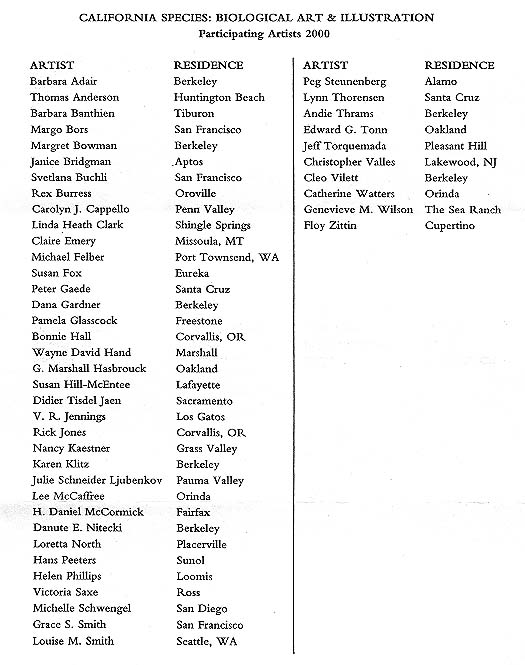
Sept. 30, 2000 - May 13, 2001. This juried exhibition of 60 recent, original
works by 46 artists celebrates the
diversity of plant and animal species native to California. (left:
Hans Peeters, Mountain Lion (Felis concolor), acrylic on panel, 33
x 57 inches)
Science and art meet in the exhibition California Species: Biological
Art & Illustration, on view at the Oakland Museum of California
Sept. 30, 2000 - May 13, 2001. This juried exhibition of 60 recent, original
works by 46 artists celebrates the
diversity of plant and animal species native to California. (left:
Hans Peeters, Mountain Lion (Felis concolor), acrylic on panel, 33
x 57 inches)
 The
artworks were chosen by a panel of professional artists, illustrators and
scientists. In addition to being aesthetically appealing and technically
accomplished, they had to show native California species and habitats, and
details shown had to be accurate. A wide variety of plant and animal species
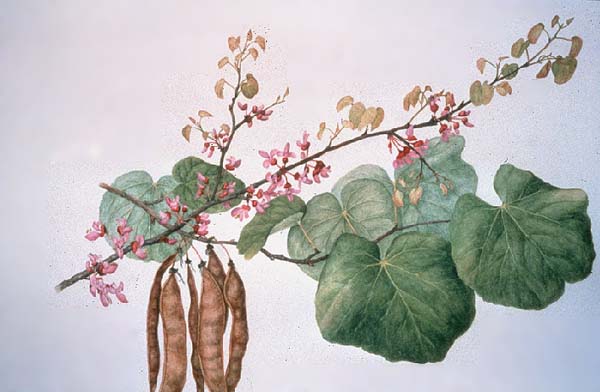
are represented, from delicate blossoms of redbud to the cobralike stalks
of a pitcher plant, from a bulbous sea hare to a mountain lion observing
possible prey. The artists employ a variety of media: acrylic, batik, colored
pencil, graphite, gouache, linocut, computer-generated illustration, oil,
pastel, scratchboard, serigraph, sculpture and watercolor. (left:
Lee McCaffree, Redbud (Cercis occidentalis), watercolor, 18 x 21
inches)
The
artworks were chosen by a panel of professional artists, illustrators and
scientists. In addition to being aesthetically appealing and technically
accomplished, they had to show native California species and habitats, and
details shown had to be accurate. A wide variety of plant and animal species
are represented, from delicate blossoms of redbud to the cobralike stalks
of a pitcher plant, from a bulbous sea hare to a mountain lion observing
possible prey. The artists employ a variety of media: acrylic, batik, colored
pencil, graphite, gouache, linocut, computer-generated illustration, oil,
pastel, scratchboard, serigraph, sculpture and watercolor. (left:
Lee McCaffree, Redbud (Cercis occidentalis), watercolor, 18 x 21
inches)
 This
is the seventh exhibition of its kind presented by the Natural Sciences
Department of the museum. The exhibition is curated by Gail Binder, Natural
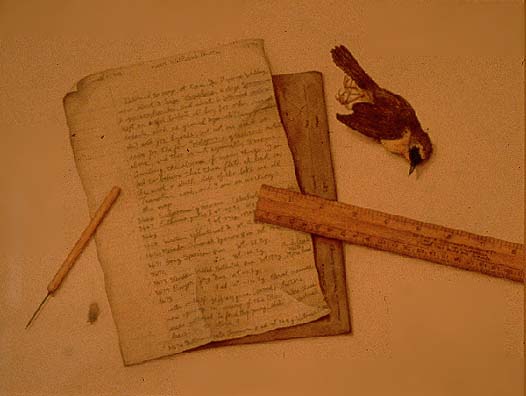
Sciences Preparator at the Oakland Museum of California. (left: Peter
Gaede, Common Yellowthroat (Geothlypis trichas), gouache on Arches
watercolor paper, 20 x 30 inches)
This
is the seventh exhibition of its kind presented by the Natural Sciences
Department of the museum. The exhibition is curated by Gail Binder, Natural
Sciences Preparator at the Oakland Museum of California. (left: Peter
Gaede, Common Yellowthroat (Geothlypis trichas), gouache on Arches
watercolor paper, 20 x 30 inches)
The panel of judges included Ann Caudle, freelance illustrator
and coordinator of the Science Illustration program at U.C. Santa Cruz;
Carolynne Griffin, an artist and nature illustrator who teaches at the California
Academy of Sciences, San Francisco and Oakland Zoos and the Strybing Arboretum;
Katherine Gyorfi, graphic artist and freelance natural science illustrator
whose clients have included Chevron, The Nature Conservancy, The University
of Utah Press and the U.S. Forest Service; and Linda Kulik, designer, photographer,
and Exhibits Department Chair at the California Academy of Sciences.
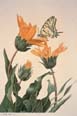 High
quality scientific illustration and wildlife art brings the species to life.
The biological illustrator must be an excellent observer, able to truly
"see" the subject, and to clearly represent it with minimal interpretation.
Because the work demands such close, considered, and often prolonged observation,
it results in a particularly intimate relationship between the illustrator
and the subject. The intensity of this relationship - the commitment of
the artist - can be seen in the composition, expressiveness, detail and
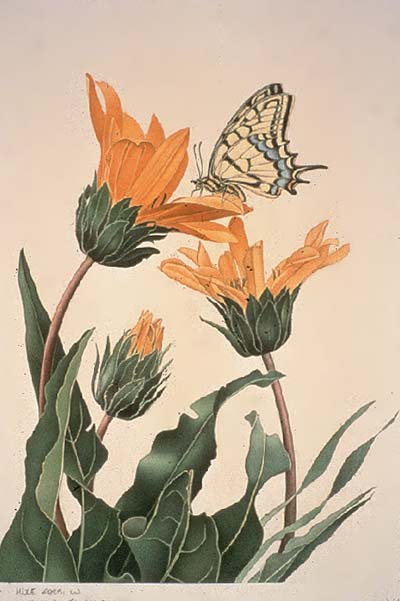
elegance of the artworks. (left: Barbara Banthien, Mule ears,
Tiger swallowtail (Wyethia sp.; Papillo sp.), gouache and pencil, 18
x 15.5 inches framed)
High
quality scientific illustration and wildlife art brings the species to life.
The biological illustrator must be an excellent observer, able to truly
"see" the subject, and to clearly represent it with minimal interpretation.
Because the work demands such close, considered, and often prolonged observation,
it results in a particularly intimate relationship between the illustrator
and the subject. The intensity of this relationship - the commitment of
the artist - can be seen in the composition, expressiveness, detail and
elegance of the artworks. (left: Barbara Banthien, Mule ears,
Tiger swallowtail (Wyethia sp.; Papillo sp.), gouache and pencil, 18
x 15.5 inches framed)
Biological illustration is more useful than photography
for some purposes. Illustrations can often clarify anatomy and other details
that remain obscure in photographs. They are ideal for presenting a composite
image, as in a field guide illustration. They are also used to show relationships
in space and time within a scene, situations that are impossible or difficult
to document through photography.
One of the best methods of learning about an organism is
to draw or paint it. The challenge of accurately rendering an organism progressively
focuses attention on all aspects of that organism. With this in mind, a
drawing table at the back of the gallery will allow visitors to the exhibition
to try their hand at drawing specimens. The exhibition will also be accompanied
by public programs including hands-on family workshops and in-depth illustration
technique classes for adults.
California Species: Biological Art & Illustration is made possible by the generous support of the Anne Macpherson/Ruth
Williams Endowment for Biological Art & Illustration.
Read more in Resource Library
Magazine about the Oakland Museum
of California.
Please click on thumbnail images bordered by a red line
to see enlargements.
This page was originally published in Resource
Library Magazine. Please see Resource Library's Overview section for
more information. rev. 3/23/11
Search Resource
Library for thousands of articles and essays on American art.
Copyright 2011 Traditional Fine Arts Organization, Inc., an Arizona nonprofit corporation. All rights
reserved.
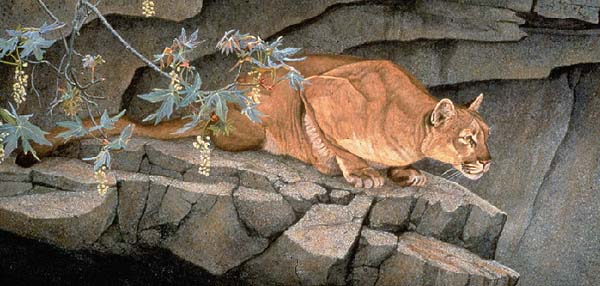 Science and art meet in the exhibition California Species: Biological
Art & Illustration, on view at the Oakland Museum of California
Sept. 30, 2000 - May 13, 2001. This juried exhibition of 60 recent, original
works by 46 artists celebrates the
diversity of plant and animal species native to California. (left:
Hans Peeters, Mountain Lion (Felis concolor), acrylic on panel, 33
x 57 inches)
Science and art meet in the exhibition California Species: Biological
Art & Illustration, on view at the Oakland Museum of California
Sept. 30, 2000 - May 13, 2001. This juried exhibition of 60 recent, original
works by 46 artists celebrates the
diversity of plant and animal species native to California. (left:
Hans Peeters, Mountain Lion (Felis concolor), acrylic on panel, 33
x 57 inches)