Dubuque Museum of Art
Dubuque, IA
319-557-1851
http://www.dbqart.com/
8/26/04 RL note: At the time of publishing
of this article the Museum had a previous URL which was misused by a third
party and caused the Museum to obtain the present Web address. We have substituted
the current URL at the Museum's request.
James D. Butler: "Views Along the
Mississippi River"
September 1 to November 15, 2000
 Today as throughout history, the Mississippi River is intrinsically
linked with the lives of the people living in the center of the United States.
Bloomington, Illinois artist James Butler produces oil paintings which observe
the links between agricultural, industrial, and commercial infrastructure
with the Mississippi River as a vital transportation resource.
Today as throughout history, the Mississippi River is intrinsically
linked with the lives of the people living in the center of the United States.
Bloomington, Illinois artist James Butler produces oil paintings which observe
the links between agricultural, industrial, and commercial infrastructure
with the Mississippi River as a vital transportation resource.
Although commercial development and the Civil Corps of
Engineer's manipulations of this central water way brings prosperity and
growth to the region, it: also poses environmental risks. Butler records
the sublime organic beauty of the wilderness juxtaposed against the geometries
of civilization. Additionally, the tragically deceptive confidence of the
human's control over nature is captured through several depictions of flooded
communities. Throughout Butler's broad panoramic compositions observers
will realize the vital and complex relationships between the Mississippi
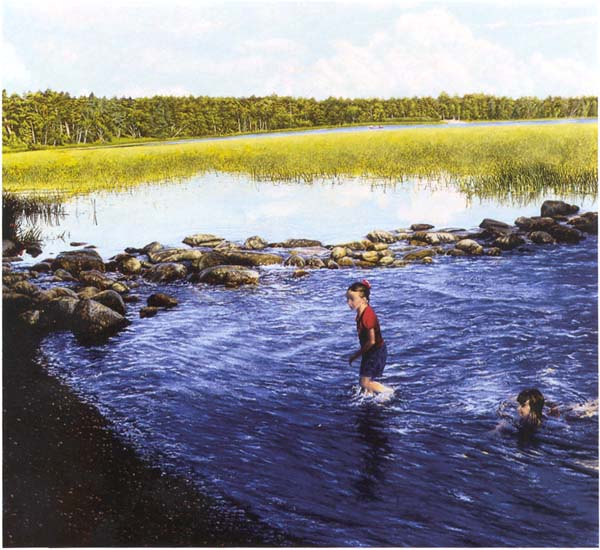
and the people who live along it's course. (left: Lake Itasca
(Headwaters of the Mississippi River), 1997-1998, oil on panel, 21 x
24 inches)
 Choosing
sites from Lake Itasca, Minnesota, where the river begins, to the Gulf of
Mexico where it ends, Butler presents 11 panoramas of the mighty Mississippi.
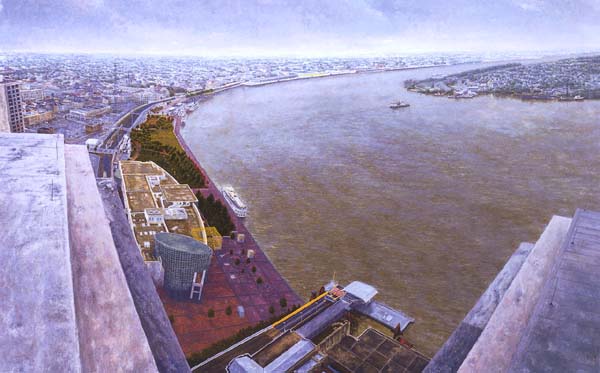
(left: The Crescent City (New Orleans), 1995-1998, oil on
panel, 48 x 75 inches)
Choosing
sites from Lake Itasca, Minnesota, where the river begins, to the Gulf of
Mexico where it ends, Butler presents 11 panoramas of the mighty Mississippi.
(left: The Crescent City (New Orleans), 1995-1998, oil on
panel, 48 x 75 inches)
In connection with the "James D. Butler: Views Along
the Mississippi River" exhibition, the museum is pleased to welcome
guest lecturer, Joni L. Kinsey, Associate Professor of Art History at the
University of Iowa on Friday, October 13, 2000 at 5:30 p.m. Ms. Kinsey will
present a slide lecture, "James Butler's Panoramic Mississippi,"
exploring the relationship of his paintings to the history of American art.
Remarks Kinsey, "The river itself has long been a focus of national
attention, but Butler's recent series offer opportunities for new insights
and perspectives." Directed to the general public as well as committed
art lovers, this talk will range from our developing perspectives of landscape
to Butler's working methods.


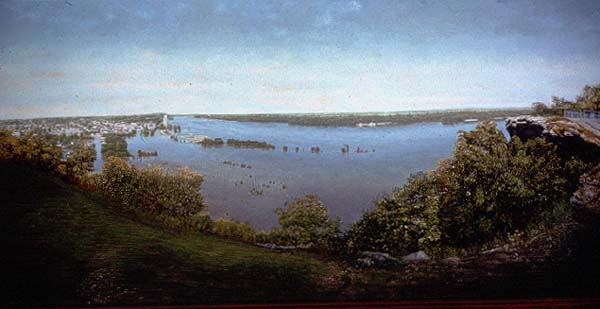
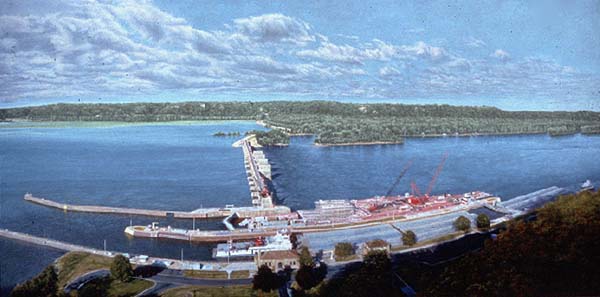
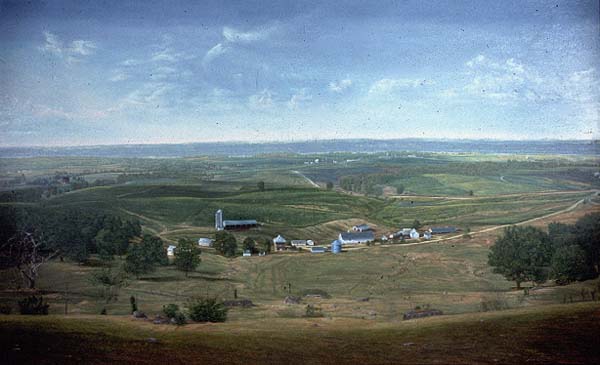
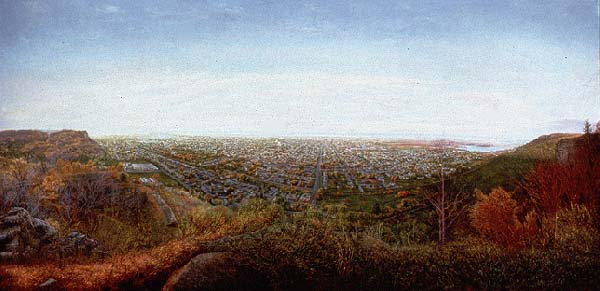
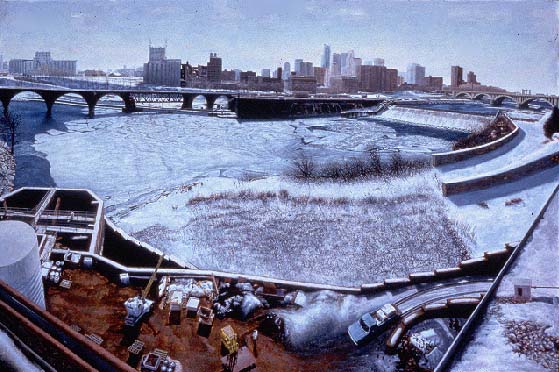
left to right: Hannibal Flooded, 1993, 1993-98, oil on
canvas, 66 x 132 inches; Mississippi River Lock and Dam #11, 1991-98,
oil on canvas, 66 x 132 inches; Threshold, 1990-91, oil on canvas,
7 x 11 1/2 feet; A View from Grandad Bluff, 1994-98, oil on canvas,
66 x 132 inches; The Falls of St. Anthony, 1995-97, oil on panel,
48 x 72 inches
Ms. Kinsey received her Ph.D. from Washington University
in St. Louis in 1989 and her research interests focus on the art of the
American landscape. Ms. Kinsey has written three books, Thomas Moran
and the Surveying of the American West (1992), Plain Pictures: Images
of the American Prairie (1996), and The Majesty of the Grand Canyon:
150 Years in Art (1998) as well as numerous articles and catalogue contributions.
 James
Butler was born in Fort Dodge, Iowa, received his BS from the University
of Nebraska, Omaha, and his MFA from the University of Nebraska, Lincoln.
Butler has received numerous awards and honors. His works are in selected
public collections including Art Institute of
Chicago, the Butler Institute of American
Art, the Metropolitan Museum of Art
in New York, and the Smithsonian American
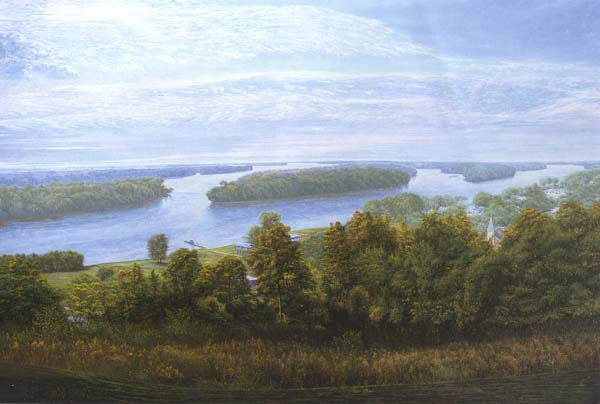
Art Museum, Washington, D.C. (left: Tara (Grafton, Illinois
- confluence of the Illinois and Mississippi Rivers), 1991-1998, oil
on canvas, 66 x 96 inches)
James
Butler was born in Fort Dodge, Iowa, received his BS from the University
of Nebraska, Omaha, and his MFA from the University of Nebraska, Lincoln.
Butler has received numerous awards and honors. His works are in selected
public collections including Art Institute of
Chicago, the Butler Institute of American
Art, the Metropolitan Museum of Art
in New York, and the Smithsonian American
Art Museum, Washington, D.C. (left: Tara (Grafton, Illinois
- confluence of the Illinois and Mississippi Rivers), 1991-1998, oil
on canvas, 66 x 96 inches)
rev. 9/21/00
Read more about the Dubuque
Museum of Art in Resource Library
Magazine
Please click on thumbnail images bordered by a red line
to see enlargements.
This page was originally published in Resource
Library Magazine. Please see Resource Library's Overview section for
more information. rev. 3/23/11
Search Resource
Library for thousands of articles and essays on American art.
Copyright 2011 Traditional Fine Arts Organization, Inc., an Arizona nonprofit corporation. All rights
reserved.
 Today as throughout history, the Mississippi River is intrinsically
linked with the lives of the people living in the center of the United States.
Bloomington, Illinois artist James Butler produces oil paintings which observe
the links between agricultural, industrial, and commercial infrastructure
with the Mississippi River as a vital transportation resource.
Today as throughout history, the Mississippi River is intrinsically
linked with the lives of the people living in the center of the United States.
Bloomington, Illinois artist James Butler produces oil paintings which observe
the links between agricultural, industrial, and commercial infrastructure
with the Mississippi River as a vital transportation resource.