Neuberger Museum of Art
Purchase, New York
(914) 251-6100
Women of Stone
The Neuberger Museum of Art's exhibition
Women of Stone highlights the work of two sculptors who carve stone
in distinctive styles. Part I, Barbara Segal's Staged in Stone depicts
everyday items-a cloth-covered table, a garment draped casually from a chair,
and framed portraits-sculpted from colored marble. Ms, Segal's exhibition
will run through October 29, 2000.
Part II, Harriet Feigenbaum's This is Not a Ruin, It's
a Theater, is dedicated to ancient and on-going Middle East conflicts.
This exhibition opens November 12, 2000 and will be on view at the Neuberger
through January 14, 2000.
 "Typically,
marble sculptures are thought of as serious, somber, idealized images. We
have come to regard classical sculptures as pure and pristine," says
Judy Collischan, Ph.D., Neuberger Museum of Art Associate Director for Curatorial
Affairs, who curated the exhibition. Barbara Segal bursts through these
traditional assumptions with aplomb and gusto. Through the inlaying of colored
ornamental stone and the use of pattern effects, she depicts everyday subjects
with humor and wit. Paired with her quirky subject matter, Segal's remarkable
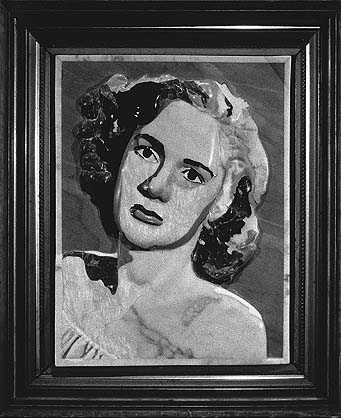
technical skill excites, fascinates, and astonishes. (left Barbara
Segal, Portrait of the Artist's Mother, 1989, inlaid black, white
and grey marbles, with gold leaf wood antique frame, 26 x 22 x 3 inches,
Courtesy of the artist)
"Typically,
marble sculptures are thought of as serious, somber, idealized images. We
have come to regard classical sculptures as pure and pristine," says
Judy Collischan, Ph.D., Neuberger Museum of Art Associate Director for Curatorial
Affairs, who curated the exhibition. Barbara Segal bursts through these
traditional assumptions with aplomb and gusto. Through the inlaying of colored
ornamental stone and the use of pattern effects, she depicts everyday subjects
with humor and wit. Paired with her quirky subject matter, Segal's remarkable
technical skill excites, fascinates, and astonishes. (left Barbara
Segal, Portrait of the Artist's Mother, 1989, inlaid black, white
and grey marbles, with gold leaf wood antique frame, 26 x 22 x 3 inches,
Courtesy of the artist)
 One
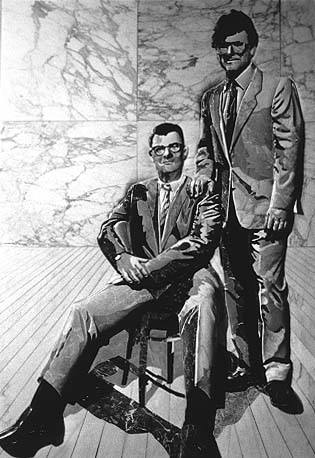
views Barbara Segal's Neuberger Museum of Art "living room" installation
by walking around the entryway. Past the entry figure, the viewer walks
about the furniture and views the pictures as though visiting the artist's
home. Segal has created a commonplace environment filled with familiar objects
rendered in marble. She paid tribute to family members by incorporating
portraits of her mother, father, husband and son. (left Barbara Segal,
First Meeting, 1989, inlaid black, white and grey marbles, with aluminum
frame, 84 x 60 x 36 inches)
One
views Barbara Segal's Neuberger Museum of Art "living room" installation
by walking around the entryway. Past the entry figure, the viewer walks
about the furniture and views the pictures as though visiting the artist's
home. Segal has created a commonplace environment filled with familiar objects
rendered in marble. She paid tribute to family members by incorporating
portraits of her mother, father, husband and son. (left Barbara Segal,
First Meeting, 1989, inlaid black, white and grey marbles, with aluminum
frame, 84 x 60 x 36 inches)
Segal trained in Europe and was inspired by Italian artisans.
She has adapted Renaissance intarsia (inlay) techniques to achieve
tonalities, textures and patterns. In 1985, Ms. Segal began a fascinating
foray into depicting American cultural issues in sculpted, colored stone.
"Harriet Feigenbaum's interpretation of the conflict
between Arabs and Jews hints at the timeless drama of their homeland,"
says Dr. Collischan. Ms. Feigenbaum's installation consists of several solid
and fossilized limestone components lying close to the earth and suggesting
the ruins of a civilization collapsed into decay.
Visitors observe the artist's carvings, inspired by the
sunken relief style of ancient Egyptians and Greeks, on both sides of the
blocks as they walk among the "ruins". By positioning words and
images opposite each other on a block, Ms. Feigenbaum depicts the feeling
of taking sides. By arranging pieces in arcing rows, she has developed a
dialogue suggestive of amphitheater seating.
This is Not a Ruin, It's a Theater
is a metaphor for the "theater of war." Feigenbaum is especially
sensitive to the plight of women caught-up in hostilities beyond their control.
She provides clues to her impressions of war's fundamental despair and combat's
devastating destruction in the veils of her subjects. She has employed flowing
headdresses in Veiled Women Tried to Flee to depict the appalling
terror of a ghastly moment frozen in time.
The exhibition is funded, in part, by the Friends of the
Neuberger Museum of Art and the Westchester Arts Council.
Read more about the Neuberger
Museum of Art in Resource Library
Magazine
Please click on thumbnail images bordered by a red line
to see enlargements.
This page was originally published in Resource
Library Magazine. Please see Resource Library's Overview section for
more information. rev. 3/23/11
Search Resource
Library for thousands of articles and essays on American art.
Copyright 2011 Traditional Fine Arts Organization, Inc., an Arizona nonprofit corporation. All rights
reserved.
 "Typically,
marble sculptures are thought of as serious, somber, idealized images. We
have come to regard classical sculptures as pure and pristine," says
Judy Collischan, Ph.D., Neuberger Museum of Art Associate Director for Curatorial
Affairs, who curated the exhibition. Barbara Segal bursts through these
traditional assumptions with aplomb and gusto. Through the inlaying of colored
ornamental stone and the use of pattern effects, she depicts everyday subjects
with humor and wit. Paired with her quirky subject matter, Segal's remarkable
technical skill excites, fascinates, and astonishes. (left Barbara
Segal, Portrait of the Artist's Mother, 1989, inlaid black, white
and grey marbles, with gold leaf wood antique frame, 26 x 22 x 3 inches,
Courtesy of the artist)
"Typically,
marble sculptures are thought of as serious, somber, idealized images. We
have come to regard classical sculptures as pure and pristine," says
Judy Collischan, Ph.D., Neuberger Museum of Art Associate Director for Curatorial
Affairs, who curated the exhibition. Barbara Segal bursts through these
traditional assumptions with aplomb and gusto. Through the inlaying of colored
ornamental stone and the use of pattern effects, she depicts everyday subjects
with humor and wit. Paired with her quirky subject matter, Segal's remarkable
technical skill excites, fascinates, and astonishes. (left Barbara
Segal, Portrait of the Artist's Mother, 1989, inlaid black, white
and grey marbles, with gold leaf wood antique frame, 26 x 22 x 3 inches,
Courtesy of the artist)