Hofstra Museum
Hofstra University
Hempstead, NY
516-463-5672
http://www.hofstra.edu/
Fine Art and Paper Money in Jacksonian
America, 1820-1860
September 5 - December 22, 2000
Until the early 19th century, artists
and engravers served an elite aristocracy usually providing their patrons
with flattering portraiture. Art, much like everything else, was limited
to and for a very few. During the Jacksonian period, a democratic fervor
swept the country, due in part by limiting frustrations of the past and
a recognized need for the nation to become part of a rapidly changing world.
Past leadership and values were wanting. New leadership would come from
the "common man." Democracy, nationalism, industrialism and an
urban-agrarian revolution created new vistas, new visions and new questions.
 In
the center of this burgeoning, free enterprise capitalism were the rapidly
expanding state banks. When the United States Bank charter, first mandated
in 1791 and again in 1816, lapsed in 1836, a limiting fiscal agency disappeared.
State banks chartered by state legislatures grew from 330 in that year to
788 by the time of the Civil War. Paper notes during that period increased
in value from $49 million to $149 million. It is examples of these notes
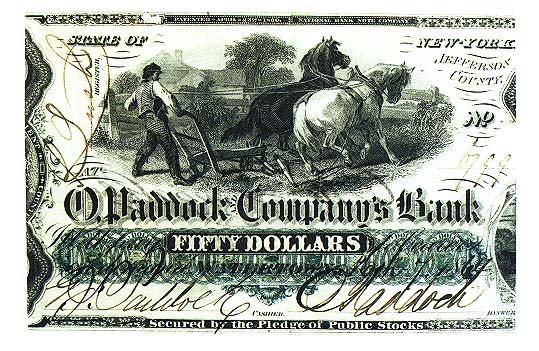
that are shown here. (left: O. Paddock and Company Bank, Watertown,
New York, Fifty Dollars, 1864)
In
the center of this burgeoning, free enterprise capitalism were the rapidly
expanding state banks. When the United States Bank charter, first mandated
in 1791 and again in 1816, lapsed in 1836, a limiting fiscal agency disappeared.
State banks chartered by state legislatures grew from 330 in that year to
788 by the time of the Civil War. Paper notes during that period increased
in value from $49 million to $149 million. It is examples of these notes
that are shown here. (left: O. Paddock and Company Bank, Watertown,
New York, Fifty Dollars, 1864)
With the development of modern printing machines such as
Robert Hoe's rotary or circular press and new methods of transferring images
to steel cylinders, art could now be supplied inexpensively and in large
quantity. Currier & Ives are classic examples, providing "colored
engravings for the people," while firms like Rawdon, Hatch and Wright,
American Bank Note Company and Bowne and Co. produced images not quite as
large or colorful as Currier and Ives, but often more detailed, more real
and less romantic. They also produced paper money.
 Bank
notes, however, would not normally be framed, not usually placed on a wall
as an admired object - the business of money was still basically business.
Still, for those who were more inquisitive and more observant, many of these
bills contained messages not only of financial value, but they were, indeed,
works of fine art by some of America's best artists such as Asher Durand,
Henry Inman and Peter Maverick. Their early work in this medium prepared
them for future careers as recognized painters. While most of the notes
were not attributed, they were, nevertheless, done by highly professional,
highly skilled engravers. In fact, these notes were among the best this
nation has produced and were widely admired abroad. They promoted America,
paper money and banking to an often hostile public who questioned the value
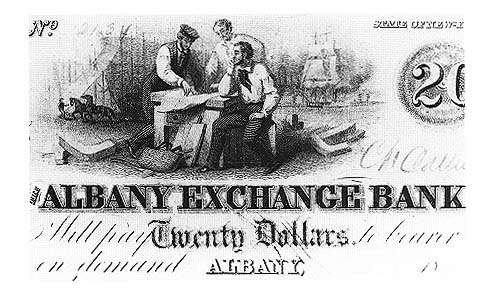
of paper as currency. (left: Albany Exchange Bank, New York, Twenty
Dollars, 1847, 3 x 7 1/8 inches)
Bank
notes, however, would not normally be framed, not usually placed on a wall
as an admired object - the business of money was still basically business.
Still, for those who were more inquisitive and more observant, many of these
bills contained messages not only of financial value, but they were, indeed,
works of fine art by some of America's best artists such as Asher Durand,
Henry Inman and Peter Maverick. Their early work in this medium prepared
them for future careers as recognized painters. While most of the notes
were not attributed, they were, nevertheless, done by highly professional,
highly skilled engravers. In fact, these notes were among the best this
nation has produced and were widely admired abroad. They promoted America,
paper money and banking to an often hostile public who questioned the value
of paper as currency. (left: Albany Exchange Bank, New York, Twenty
Dollars, 1847, 3 x 7 1/8 inches)
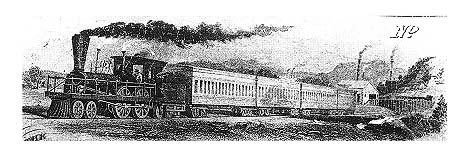
 In
this exhibition are views that are original and unique. Depicted scenes
of early railroads or steamboats, for example, are to be found only on these
notes. Details of steam engines, passenger cars, tenders and ships deserve
to be in any history of transportation, but, in fact, are seldom, if ever,
included. Enlarging specific areas helps reveal the careful, painstaking
effort, as well as a myriad of detail. (left: Clinton Bank, Westernport,
New York, Five Dollars, c. 1860, 3 1/8 x 7 1/8 inches)
In
this exhibition are views that are original and unique. Depicted scenes
of early railroads or steamboats, for example, are to be found only on these
notes. Details of steam engines, passenger cars, tenders and ships deserve
to be in any history of transportation, but, in fact, are seldom, if ever,
included. Enlarging specific areas helps reveal the careful, painstaking
effort, as well as a myriad of detail. (left: Clinton Bank, Westernport,
New York, Five Dollars, c. 1860, 3 1/8 x 7 1/8 inches)
Jacksonian America, with its newfound energy and passion,
almost springs to life in these notes. It is America at work. Here are iron
producers, cobblers, mill-rights, all busily engaged at their tasks. Work
produces bounty from the fields - an ex-soldier now the farmer, toiling
at his plow, helping to feed a hungry nation. There are morals in these
images - labor, sobriety and thrift - Puritan values to build a nation.
In their own way, these notes are romantic, perhaps just
as romantic as the works of such transcendental artists as William S. Mount
or Thomas Cole or Frederic Church, because there is little hint of the costs
of progress - pollution, disease, poverty. Here, images sing of the glory
of capitalism. Critics are left to wonder. Pictures of an advancing America
presented ideals of solidity, value and esteem. Social criticism is absent.
This was paper money backed by railroads, factories, fertile fields. There
was merit in each bill, art to publicize America and American production
and sound paper currency.
 These
bank notes, often known as "shinplasterers," were the center of
a bitter political debate. Jacksonians saw them as a form of theft with
as many counterfeits in circulation as sound money. They often depreciated
in value or became worthless as state banks defaulted "cheating"
an honest workman of his wages. Debtors, farmers and bankers generally opposed
Jackson's bullionist policy, desiring a more fluid, available currency.
In the end, sound money advocates won the battle with the help of the engraver
and succeeded in having the federal government become the sole issuing authority.
By 1861 Congress authorized printing of interest-bearing national Treasury
notes. In 1865 a 10 percent tax was placed on outstanding state bank notes,
and this was upheld by the Supreme Court in 1868 and led to a national banking
system and permanent national bank notes. The halcyon days of free enterprise
currency were over, but so too was the widespread depiction on bills of
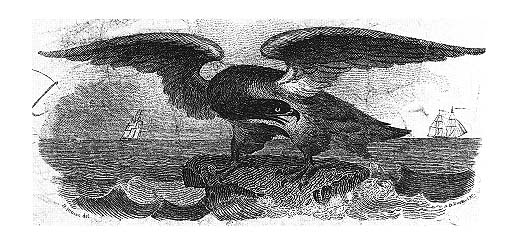
the drama and beauty of advancing America. (left: Chemical Bank,
New York, Three Dollars, 1830, 2 3/4 x 6 3/4 inches)
These
bank notes, often known as "shinplasterers," were the center of
a bitter political debate. Jacksonians saw them as a form of theft with
as many counterfeits in circulation as sound money. They often depreciated
in value or became worthless as state banks defaulted "cheating"
an honest workman of his wages. Debtors, farmers and bankers generally opposed
Jackson's bullionist policy, desiring a more fluid, available currency.
In the end, sound money advocates won the battle with the help of the engraver
and succeeded in having the federal government become the sole issuing authority.
By 1861 Congress authorized printing of interest-bearing national Treasury
notes. In 1865 a 10 percent tax was placed on outstanding state bank notes,
and this was upheld by the Supreme Court in 1868 and led to a national banking
system and permanent national bank notes. The halcyon days of free enterprise
currency were over, but so too was the widespread depiction on bills of
the drama and beauty of advancing America. (left: Chemical Bank,
New York, Three Dollars, 1830, 2 3/4 x 6 3/4 inches)
Each bill is a story in itself, and it is hoped that this
exhibition will provide the viewer a special insight and a further appreciation
of the meaning of fine art and paper money.
From the exhibition catalogue, by Leo Hershkowitz and
Theodore Cohen
Read more about the Hofstra
Museum in Resource Library Magazine
Please click on thumbnail images bordered by a red line
to see enlargements.
For further biographical information on selected artists
cited above please see America's Distinguished
Artists, a national registry of historic artists.
This page was originally published in Resource
Library Magazine. Please see Resource Library's Overview section for
more information. rev. 4/4/11
Search Resource
Library for thousands of articles and essays on American art.
Copyright 2011 Traditional Fine Arts Organization, Inc., an Arizona nonprofit corporation. All rights
reserved.
 In
the center of this burgeoning, free enterprise capitalism were the rapidly
expanding state banks. When the United States Bank charter, first mandated
in 1791 and again in 1816, lapsed in 1836, a limiting fiscal agency disappeared.
State banks chartered by state legislatures grew from 330 in that year to
788 by the time of the Civil War. Paper notes during that period increased
in value from $49 million to $149 million. It is examples of these notes
that are shown here. (left: O. Paddock and Company Bank, Watertown,
New York, Fifty Dollars, 1864)
In
the center of this burgeoning, free enterprise capitalism were the rapidly
expanding state banks. When the United States Bank charter, first mandated
in 1791 and again in 1816, lapsed in 1836, a limiting fiscal agency disappeared.
State banks chartered by state legislatures grew from 330 in that year to
788 by the time of the Civil War. Paper notes during that period increased
in value from $49 million to $149 million. It is examples of these notes
that are shown here. (left: O. Paddock and Company Bank, Watertown,
New York, Fifty Dollars, 1864)