Virginia Historical Society
Richmond, VA
804-342-9665
http://www.vahistorical.org
The Virginia Landscape
 Thomas Jefferson once boasted to a friend
in England, "Our own country . . . is made on an improved plan. Europe
is a first idea, a crude production, before the [M]aker knew his trade."
He was talking about the landscape of Virginia, and an exhibition which
opened July 13, 2000, at the Virginia Historical Society may provide compelling
evidence to support his notion. "The Virginia Landscape," the
largest assembly of Virginia landscape images ever exhibited, illustrates
the importance of the landscape in shaping the commonwealth and creating
its identity. More than 240 landscape paintings, drawings, prints, and photographs,
dating from the colonial period to the present, reveal much about Virginia's
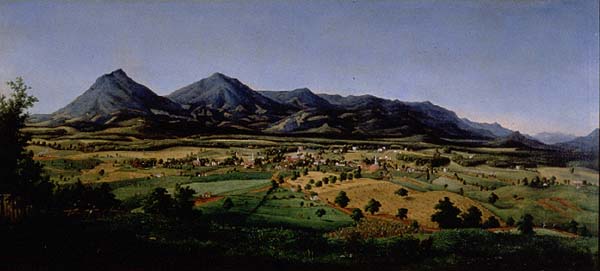
natural history and the attitudes of its citizens.(left: Edward Beyer,
The Peaks of Otter and the Town of Liberty, 1855, The Virginia Historical
Society)
Thomas Jefferson once boasted to a friend
in England, "Our own country . . . is made on an improved plan. Europe
is a first idea, a crude production, before the [M]aker knew his trade."
He was talking about the landscape of Virginia, and an exhibition which
opened July 13, 2000, at the Virginia Historical Society may provide compelling
evidence to support his notion. "The Virginia Landscape," the
largest assembly of Virginia landscape images ever exhibited, illustrates
the importance of the landscape in shaping the commonwealth and creating
its identity. More than 240 landscape paintings, drawings, prints, and photographs,
dating from the colonial period to the present, reveal much about Virginia's
natural history and the attitudes of its citizens.(left: Edward Beyer,
The Peaks of Otter and the Town of Liberty, 1855, The Virginia Historical
Society)
 Initially,
the commonwealth was best known for its natural landmarks like the Dismal
Initially,
the commonwealth was best known for its natural landmarks like the Dismal
 Swamp,
the Peaks of Otter, and Natural Bridge. Visitors traveled great distances
- even across oceans - just to see these wonders. With the fame of such
historic landmarks as Mount Vernon, Monticello, Jamestown, and Yorktown,
Virginia soon became known also as a place where significant American history
unfolded. Artists painted these sites as a way to remember history. Other
canvases illustrate the effect of twentieth-century patterns of growth on
the natural environment. "Never before has such a body of work been
displayed or critically examined," remarks Charles F. Bryan, Jr., director
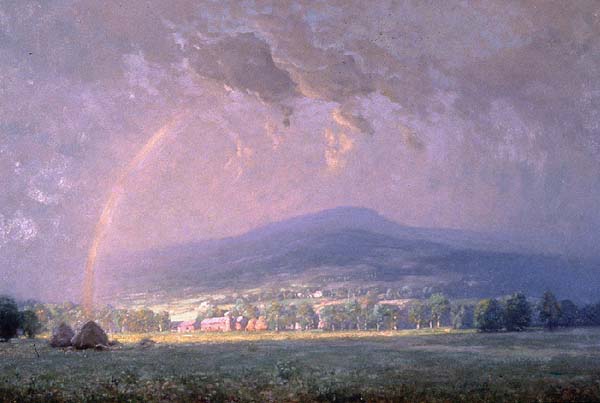
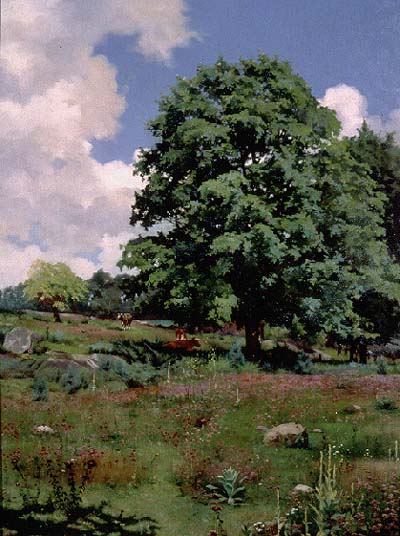
of the Virginia Historical Society. (left: Alexis Fournier, The
Passing Storm, Shenandoah Valley, 1923, The Virginia Historical Society;
right: Hubert Vos, Mossy Creek, c. 1900, The Virginia Historical
Society)
Swamp,
the Peaks of Otter, and Natural Bridge. Visitors traveled great distances
- even across oceans - just to see these wonders. With the fame of such
historic landmarks as Mount Vernon, Monticello, Jamestown, and Yorktown,
Virginia soon became known also as a place where significant American history
unfolded. Artists painted these sites as a way to remember history. Other
canvases illustrate the effect of twentieth-century patterns of growth on
the natural environment. "Never before has such a body of work been
displayed or critically examined," remarks Charles F. Bryan, Jr., director
of the Virginia Historical Society. (left: Alexis Fournier, The
Passing Storm, Shenandoah Valley, 1923, The Virginia Historical Society;
right: Hubert Vos, Mossy Creek, c. 1900, The Virginia Historical
Society)
 "The
Virginia Landscape" is about the land and the cultural and historic
changes that have occurred in the commonwealth during the last four centuries.
It traces the rural settlement of the colony and state along the models
of the plantation and market town,
"The
Virginia Landscape" is about the land and the cultural and historic
changes that have occurred in the commonwealth during the last four centuries.
It traces the rural settlement of the colony and state along the models
of the plantation and market town,  and examines the meaning of progress in Virginia by
following the visual record of urban growth and the construction of canals
and railroads. It surveys Virginia's Civil War landscape, which in 1864
inspired Walt Whitman's interest: "Dilapidated, fenceless, and trodden
with war as Virginia is, wherever I move across her surface, I find myself
rous'd to surprise and admiration. What capacity for production, improvements,
human life, nourishment and expansion." The exhibit follows the path
of landscape imagery to the end of the twentieth century, when a tradition
of nature painting finally was established in the state, in defiance of
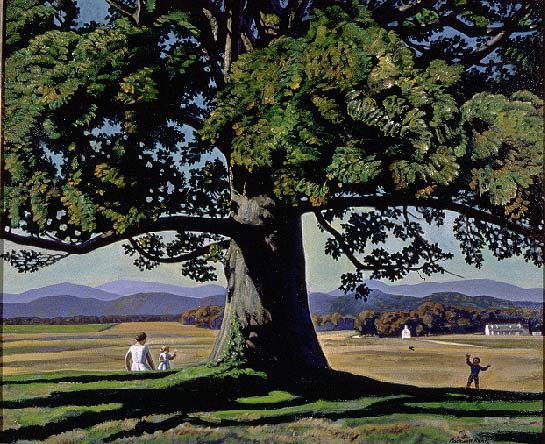
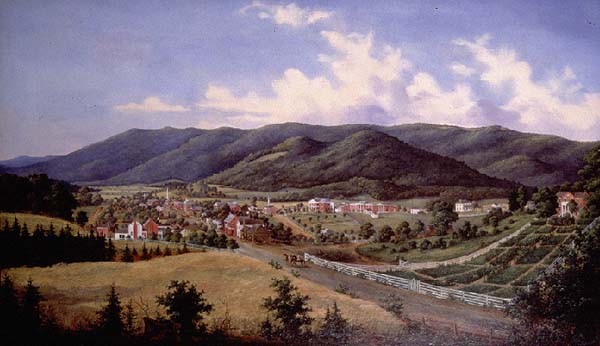
environmental threats to the land. (left: Rockwell Kent, Child
Under Tree, Virginia, 1956, The Virginia Historical Society; right:
Edward Beyer, A View of Salem, 1855, The Virginia Historical Society)
and examines the meaning of progress in Virginia by
following the visual record of urban growth and the construction of canals
and railroads. It surveys Virginia's Civil War landscape, which in 1864
inspired Walt Whitman's interest: "Dilapidated, fenceless, and trodden
with war as Virginia is, wherever I move across her surface, I find myself
rous'd to surprise and admiration. What capacity for production, improvements,
human life, nourishment and expansion." The exhibit follows the path
of landscape imagery to the end of the twentieth century, when a tradition
of nature painting finally was established in the state, in defiance of
environmental threats to the land. (left: Rockwell Kent, Child
Under Tree, Virginia, 1956, The Virginia Historical Society; right:
Edward Beyer, A View of Salem, 1855, The Virginia Historical Society)
 Scattered
throughout this multi-gallery landmark exhibit are works by well-known figures
such as Albert Bierstadt, George Inness , David Johnson, Rockwell Kent Gari
Melchers, Charles Sheeler, William Louis Sonntag, Wayne Thiebaud, Wordsworth
Thompson, and Thomas Worthington Whittredge, as well as a number of lesser
known but highly competent artists like Edward Beyer, Alexis Fournier, and
Theresa Pollack. "The Virginia Landscape," on view through November
12, 2000, is underwritten by generous grants from the National Endowment
for the Arts, the E. Rhodes and Leona B. Carpenter Foundation, the Robins
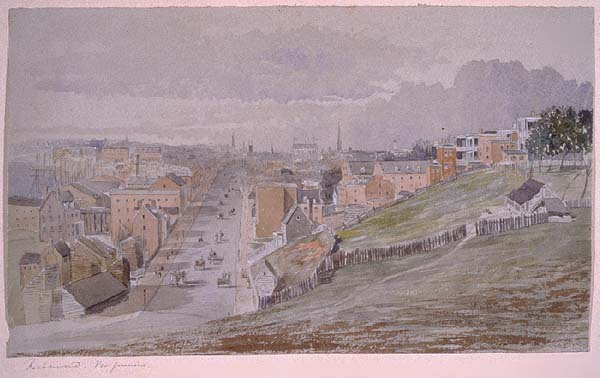
Foundation, and the Virginia Commission for the Arts. (left: Lefevre
Cranstone, Richmond, Virginia, 1859, The Virginia Historical Society)
Scattered
throughout this multi-gallery landmark exhibit are works by well-known figures
such as Albert Bierstadt, George Inness , David Johnson, Rockwell Kent Gari
Melchers, Charles Sheeler, William Louis Sonntag, Wayne Thiebaud, Wordsworth
Thompson, and Thomas Worthington Whittredge, as well as a number of lesser
known but highly competent artists like Edward Beyer, Alexis Fournier, and
Theresa Pollack. "The Virginia Landscape," on view through November
12, 2000, is underwritten by generous grants from the National Endowment
for the Arts, the E. Rhodes and Leona B. Carpenter Foundation, the Robins
Foundation, and the Virginia Commission for the Arts. (left: Lefevre
Cranstone, Richmond, Virginia, 1859, The Virginia Historical Society)
"The Virginia Landscape: A Cultural History,"
the 224-page exhibition catalog containing hundreds of color images of the
landscape paintings, is co-authored by the exhibition co-curators Dr. James
C. Kelly and Dr. William M. S. Rasmussen. The catalog is available in the
Museum Shop.
Read more about the Virginia
Historical Society in Resource Library Magazine
Please click on thumbnail images bordered by a red line to
see enlargements.
For further biographical information on selected artists
cited above please see America's Distinguished
Artists, a national registry of historic artists.
This page was originally published in Resource
Library Magazine. Please see Resource Library's Overview section for
more information. rev. 3/18/11
Search Resource
Library for thousands of articles and essays on American art.
Copyright 2011 Traditional Fine Arts Organization, Inc., an Arizona nonprofit corporation. All rights
reserved.
 Thomas Jefferson once boasted to a friend
in England, "Our own country . . . is made on an improved plan. Europe
is a first idea, a crude production, before the [M]aker knew his trade."
He was talking about the landscape of Virginia, and an exhibition which
opened July 13, 2000, at the Virginia Historical Society may provide compelling
evidence to support his notion. "The Virginia Landscape," the
largest assembly of Virginia landscape images ever exhibited, illustrates
the importance of the landscape in shaping the commonwealth and creating
its identity. More than 240 landscape paintings, drawings, prints, and photographs,
dating from the colonial period to the present, reveal much about Virginia's
natural history and the attitudes of its citizens.(left: Edward Beyer,
The Peaks of Otter and the Town of Liberty, 1855, The Virginia Historical
Society)
Thomas Jefferson once boasted to a friend
in England, "Our own country . . . is made on an improved plan. Europe
is a first idea, a crude production, before the [M]aker knew his trade."
He was talking about the landscape of Virginia, and an exhibition which
opened July 13, 2000, at the Virginia Historical Society may provide compelling
evidence to support his notion. "The Virginia Landscape," the
largest assembly of Virginia landscape images ever exhibited, illustrates
the importance of the landscape in shaping the commonwealth and creating
its identity. More than 240 landscape paintings, drawings, prints, and photographs,
dating from the colonial period to the present, reveal much about Virginia's
natural history and the attitudes of its citizens.(left: Edward Beyer,
The Peaks of Otter and the Town of Liberty, 1855, The Virginia Historical
Society)