The Long Island Museum of American Art,
History and Carriages
formerly The Museums at Stony Brook
Stony Brook, NY
631-751-0066
http://www.longislandmuseum.org
From Cradle to Grave: The
Works of William Sidney Mount
 A new exhibition exploring the depiction of
the human life cycle in the paintings of American genre painter William
Sidney Mount opens January 13, 2001 at the Long Island Museum of American
Art, History & Carriages. From Cradle to Grave: The Works of William
Sidney Mount features 15 original works by the renowned artist. Organized
by The Long Island Museum and drawn from its collection, the exhibition
will be on view through June 17, 2001 in the Members Gallery of the Art
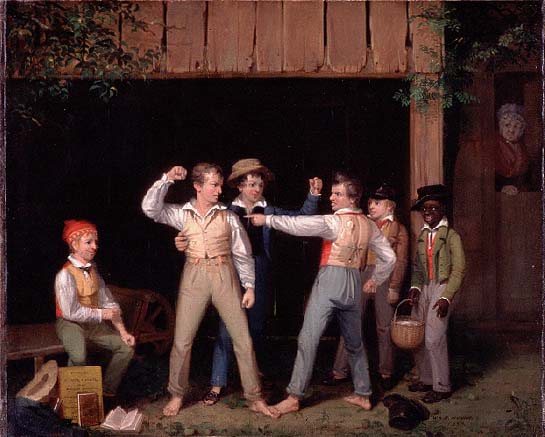
Museum. (left: School Boys Quarreling, 1830, oil on canvas,
Museum purchase)
A new exhibition exploring the depiction of
the human life cycle in the paintings of American genre painter William
Sidney Mount opens January 13, 2001 at the Long Island Museum of American
Art, History & Carriages. From Cradle to Grave: The Works of William
Sidney Mount features 15 original works by the renowned artist. Organized
by The Long Island Museum and drawn from its collection, the exhibition
will be on view through June 17, 2001 in the Members Gallery of the Art
Museum. (left: School Boys Quarreling, 1830, oil on canvas,
Museum purchase)
Nineteenth-century Americans had distinct ideas of how
each stage of life should be rendered. The classical  depictions in the prints The Life & Age of
Man and The Life & Age of Woman, published by James Baillie
in 1848, are used in the exhibition as a springboard for discussion of the
19th-century perception of aging as recorded and interpreted by Mount. (right:
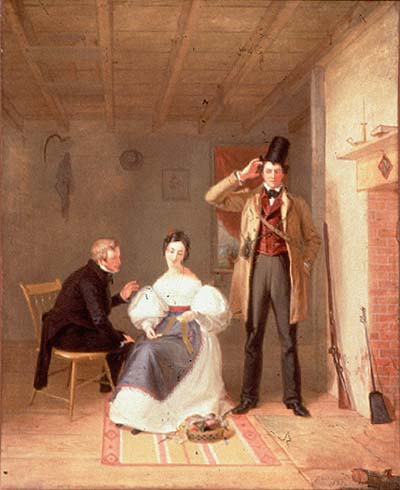
The Sportsman's Last Visit, 1835, oil on canvas, Gift of Mr. and
Mrs. Ward Melville, 1958)
depictions in the prints The Life & Age of
Man and The Life & Age of Woman, published by James Baillie
in 1848, are used in the exhibition as a springboard for discussion of the
19th-century perception of aging as recorded and interpreted by Mount. (right:
The Sportsman's Last Visit, 1835, oil on canvas, Gift of Mr. and
Mrs. Ward Melville, 1958)
 The
exhibition begins with the portrayal of childhood in Mount's works School
Boys Quarreling (1830) and Mischievous Drop (1857). The rituals of adolescence
and young adulthood are also included, as in The Sportsman's Last Visit
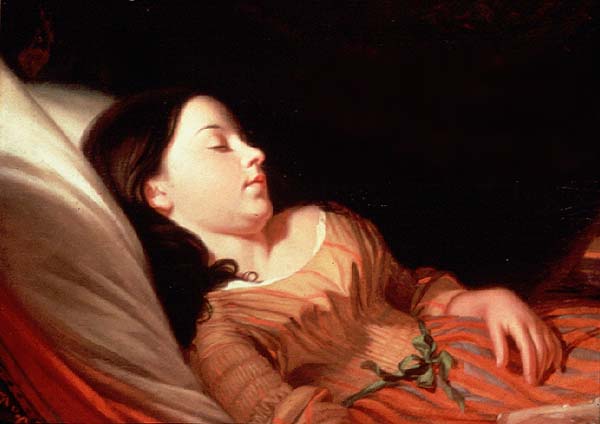
(1835) where courtship is the focal subject. (left: Girl Asleep
(Maria Seabury), 1843, oil on canvas mounted on panel, Museum purchase,
1956)
The
exhibition begins with the portrayal of childhood in Mount's works School
Boys Quarreling (1830) and Mischievous Drop (1857). The rituals of adolescence
and young adulthood are also included, as in The Sportsman's Last Visit
(1835) where courtship is the focal subject. (left: Girl Asleep
(Maria Seabury), 1843, oil on canvas mounted on panel, Museum purchase,
1956)
"Middle age" was held to be the most productive
period of 19th-century life. Frequently Mount used local residents as subjects
for his works, depicting the gentleman farmer working or discussing politics,
for example. Long Island Farmer Husking Corn (1834) and Herald
in the Country (1853) are two wonderful portrayals of the prosperity,
energy and intellect of the 19th-century adult figure.
Mount used elderly models as subjects for many of his works.
The rather gaunt portrait of his mother, Julia Ann Hawkins Mount
(1830), is a good example. Painted when Mrs. Mount was only 43, she had
by that time endured eight pregnancies - five children lived past infancy
- and had been a widow for over 15 years. In this work, her son sensitively
captures the effect on her of this difficult life.
Finally, Mount's interest in spiritualism, combined with
19th-century mourning rites, led to his production of posthumous paintings.
Among the best known are his portraits of Jedidiah Wlliamson (1837)
and Susie T. Marsh (1860), who both died in childhood. Although Mount
realized that commissioning a death portrait of a child was part of the
mourning and grieving process for families who could afford it, he disliked
this type of work and was known to charge more than double his regular fee
for such paintings.
rev. 1/3/01
Related articles in this magazine:
Plus other articles on 18-19th
Century American Genre Art.
Read more about the Long
Island Museum of American Art, History and Carriages in Resource Library Magazine
Please click on thumbnail images bordered by a red line
to see enlargements.
For further biographical information please see America's Distinguished Artists, a national
registry of historic artists.
This page was originally published in Resource
Library Magazine. Please see Resource Library's Overview section for
more information. rev. 4/27/11
Search Resource
Library for thousands of articles and essays on American art.
Copyright 2011 Traditional Fine Arts Organization, Inc., an Arizona nonprofit corporation. All rights
reserved.
 A new exhibition exploring the depiction of
the human life cycle in the paintings of American genre painter William
Sidney Mount opens January 13, 2001 at the Long Island Museum of American
Art, History & Carriages. From Cradle to Grave: The Works of William
Sidney Mount features 15 original works by the renowned artist. Organized
by The Long Island Museum and drawn from its collection, the exhibition
will be on view through June 17, 2001 in the Members Gallery of the Art
Museum. (left: School Boys Quarreling, 1830, oil on canvas,
Museum purchase)
A new exhibition exploring the depiction of
the human life cycle in the paintings of American genre painter William
Sidney Mount opens January 13, 2001 at the Long Island Museum of American
Art, History & Carriages. From Cradle to Grave: The Works of William
Sidney Mount features 15 original works by the renowned artist. Organized
by The Long Island Museum and drawn from its collection, the exhibition
will be on view through June 17, 2001 in the Members Gallery of the Art
Museum. (left: School Boys Quarreling, 1830, oil on canvas,
Museum purchase)