The Long Island Museum of American Art,
History and Carriages
formerly The Museums at Stony Brook
Stony Brook, NY
631-751-0066
http://www.longislandmuseum.org
Uncle Sam and Lady Liberty:
Faces of a Nation
The evolution of two
central icons in the American identity is the focus of Uncle Sam and
Lady Liberty: Faces of a Nation, opening Feb. 3, 2001 at the Long Island
Museum of American Art, History & Carriages.
Featuring color lithographs, posters, political cartoons,
drawings and advertising ephemera, the exhibition explores the historical
depictions of the nation's best-known personifications: Uncle Sam and Lady
Liberty. Organized by the New -York Historical Society, circulated by Museum
Presentation Association, and drawn from the New -York Historical Society's
collection, the exhibition continues through May 13, 2001.
 In
times of war and peace, through prosperity and poverty, the figure of Uncle
Sam has been a constant of the American political landscape. Legend has
it that "Uncle Sam" was the nickname of Samuel Wilson (1766-1854),
head of a meat-packing plant in Troy, New York. Shortly after the War of
1812 began, Wilson and Elbert Anderson, a federal agent, supplied meat for
the troops. The shipping crates were marked "E.A. - U.S." A workman
quipped that it stood for "Uncle Sam" Wilson. The joke quickly
circulated among the troops and stuck. (left: James Flagg, Side
by Side- Britannia, n.d., Collection of New -York Historical Society)
In
times of war and peace, through prosperity and poverty, the figure of Uncle
Sam has been a constant of the American political landscape. Legend has
it that "Uncle Sam" was the nickname of Samuel Wilson (1766-1854),
head of a meat-packing plant in Troy, New York. Shortly after the War of
1812 began, Wilson and Elbert Anderson, a federal agent, supplied meat for
the troops. The shipping crates were marked "E.A. - U.S." A workman
quipped that it stood for "Uncle Sam" Wilson. The joke quickly
circulated among the troops and stuck. (left: James Flagg, Side
by Side- Britannia, n.d., Collection of New -York Historical Society)
Uncle Sam was eventually utilized by both the political
left and right for different causes, featured in military recruitment posters,
and used to sell everything from Ex-Lax to Liberty Bonds. Today the face
and name of Uncle Sam is recognized, both at home and abroad, as the face
of America.
His female counterpart has undergone several transformations
in identity, clothing, and style. Long before we bad the Statue of Liberty
in New York Harbor, the Indian Princess symbolized the New World. Over time
the Princess became less "native" and more European. Her skin
grew lighter, her features became less "Indian," and her dress
was adapted to the mode of the moment.
As America matured, the image of Columbia was used to symbolize
America, and she was usually depicted wearing a red-white-and-blue dress
with a star studded crown. The French Revolution introduced Liberty as the
definitive symbol for the overthrow of oppression, and by the end of the
19th century, Lady Liberty became the undisputed female emblem of the United
States - as portrayed bearing the torch of freedom by Auguste Bartholdi
in the Statue of Liberty.
See other articles on 18-19th
Century American Genre Art.
Read more about the Long
Island Museum of American Art, History and Carriages in Resource Library Magazine
Please click on thumbnail images bordered by a red line
to see enlargements.
For further biographical information please see America's Distinguished Artists, a national
registry of historic artists.
This page was originally published in Resource
Library Magazine. Please see Resource Library's Overview section for
more information. rev. 4/27/11
Search Resource
Library for thousands of articles and essays on American art.
Copyright 2011 Traditional Fine Arts Organization, Inc., an Arizona nonprofit corporation. All rights
reserved.
 In
times of war and peace, through prosperity and poverty, the figure of Uncle
Sam has been a constant of the American political landscape. Legend has
it that "Uncle Sam" was the nickname of Samuel Wilson (1766-1854),
head of a meat-packing plant in Troy, New York. Shortly after the War of
1812 began, Wilson and Elbert Anderson, a federal agent, supplied meat for
the troops. The shipping crates were marked "E.A. - U.S." A workman
quipped that it stood for "Uncle Sam" Wilson. The joke quickly
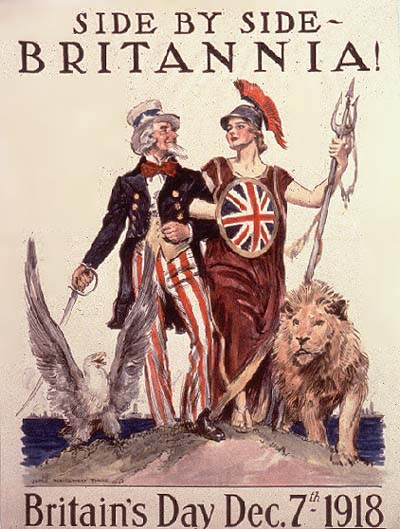
circulated among the troops and stuck. (left: James Flagg, Side
by Side- Britannia, n.d., Collection of New -York Historical Society)
In
times of war and peace, through prosperity and poverty, the figure of Uncle
Sam has been a constant of the American political landscape. Legend has
it that "Uncle Sam" was the nickname of Samuel Wilson (1766-1854),
head of a meat-packing plant in Troy, New York. Shortly after the War of
1812 began, Wilson and Elbert Anderson, a federal agent, supplied meat for
the troops. The shipping crates were marked "E.A. - U.S." A workman
quipped that it stood for "Uncle Sam" Wilson. The joke quickly
circulated among the troops and stuck. (left: James Flagg, Side
by Side- Britannia, n.d., Collection of New -York Historical Society)