Bruce Museum
Greenwich, CT
203-869-0376
Space 2001: To the Moon
and Beyond
January 14, 2001 - April 15, 2001
 The Bruce Museum of Arts and Science presents
its major winter exhibition Space 2001: To the Moon and Beyond from
January 14, 2001, through April 15, 2001. The exhibition showcases life
and travel in outer space as conceived by the visions of artists, photographers
and writers, and through the contributions of scientists and astronauts
who made the spectacular realities of space exploration possible. The exhibition
presents paintings, drawings, photographs, technical drawings, books, sculptures,
artifacts, scale models, video clips and hardware, as well as an authentic
moon rock brought back during the historic U.S. Apollo space missions. Divided
into three segments, Space 2001: To the Moon and Beyond covers the
past, present and future of space exploration in segments titled Prelude
to Space Travel, The Race for the Moon and The Solar System and Beyond.
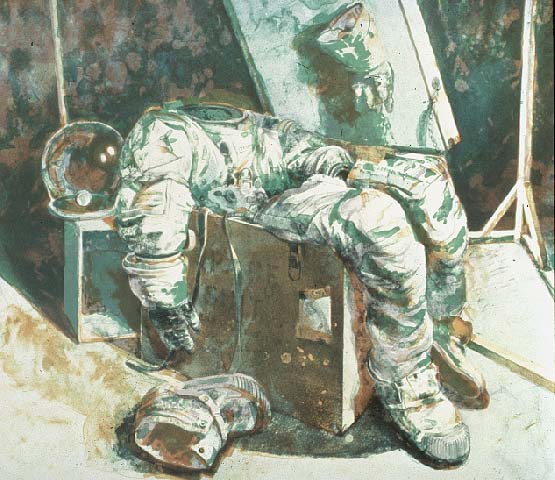
(left: Charles Schmidt, The Moon Suit, lithograph, Courtesy of
NASA Art Program)
The Bruce Museum of Arts and Science presents
its major winter exhibition Space 2001: To the Moon and Beyond from
January 14, 2001, through April 15, 2001. The exhibition showcases life
and travel in outer space as conceived by the visions of artists, photographers
and writers, and through the contributions of scientists and astronauts
who made the spectacular realities of space exploration possible. The exhibition
presents paintings, drawings, photographs, technical drawings, books, sculptures,
artifacts, scale models, video clips and hardware, as well as an authentic
moon rock brought back during the historic U.S. Apollo space missions. Divided
into three segments, Space 2001: To the Moon and Beyond covers the
past, present and future of space exploration in segments titled Prelude
to Space Travel, The Race for the Moon and The Solar System and Beyond.
(left: Charles Schmidt, The Moon Suit, lithograph, Courtesy of
NASA Art Program)
 The
Bruce Museum's science and exhibition staff and guest curators Tess Kissinger
and Bob Walters have assembled a broad collection of exhibition display
materials, including loans from such distinguished organizations and institutions
as the National Aeronautics and Space Administration, NASA Art Program,
Smithsonian Institution's National Air and Space Museum, Museum of Fine
Arts, Boston, and Orlando Museum of Art, as well as private collectors and
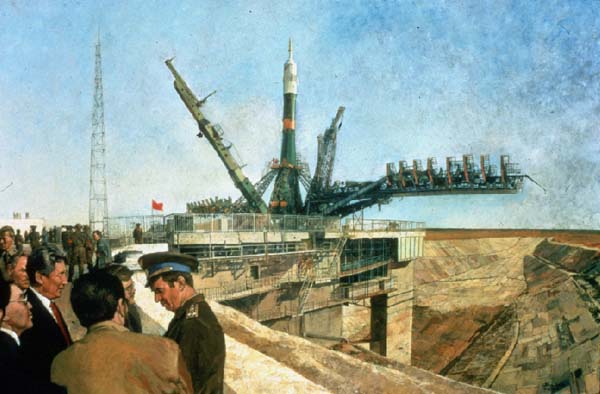
individual artists. (left: John Solie, Launch of Proton Rocket,
oil, Courtesy of NASA Art Program)
The
Bruce Museum's science and exhibition staff and guest curators Tess Kissinger
and Bob Walters have assembled a broad collection of exhibition display
materials, including loans from such distinguished organizations and institutions
as the National Aeronautics and Space Administration, NASA Art Program,
Smithsonian Institution's National Air and Space Museum, Museum of Fine
Arts, Boston, and Orlando Museum of Art, as well as private collectors and
individual artists. (left: John Solie, Launch of Proton Rocket,
oil, Courtesy of NASA Art Program)
The exhibition opens with Prelude to Space Travel,
featuring works by the early dreamers of space from the 19th to mid-20th
centuries. Representing a long-running human fascination with other worlds,
examples include Winslow Homer's Rocket Ship (1849), an early edition
of Jules Verne's De La Terre a la Lune (From the Earth to the
Moon) and sequel Autour La Lune (Around The Moon), dated
1870, and a 19th century lithograph by French astronomer E. Leopold Trouvelot,
on loan from the Fairfield County Astronomical Society of Stamford Museum.
The section also includes more recent art and artifacts leading to the development
of national space programs in the United States and the Soviet Union. Illustrations
from the late 1940s through the 1950s by Chesley Bonestell had more than
just a profound influence on the space artists that came after him - he
essentially invented the field. His work  also had a direct influence in developing public acceptance
and enthusiasm for the U.S. manned space program. Original illustrations
by Bonestell and others are on view, along with original issues of magazines
such as Popular Science Monthly, Collier's Magazine and Science
+ Invention, which published the art. During the 1950s the dreams of
space travel became a reality beginning with the launch of the first satellite
in space, the Soviet's Sputnik. Items as diverse as science fiction film
clips, the hood ornament from a 1950's Oldsmobile Rocket 88, and a Sputnik
music box demonstrate the building interest in space as a destination.
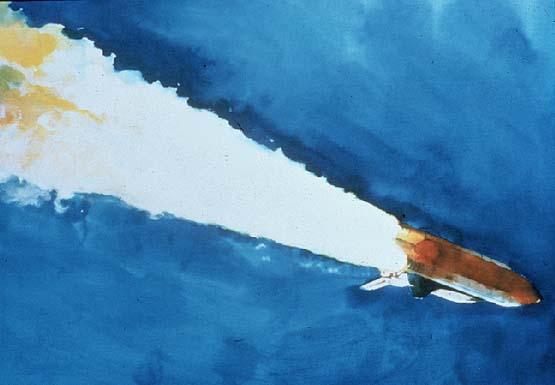
(left: Chet Jezierski, Pitchover, watercolor on board, Courtesy of
NASA Art Program)
also had a direct influence in developing public acceptance
and enthusiasm for the U.S. manned space program. Original illustrations
by Bonestell and others are on view, along with original issues of magazines
such as Popular Science Monthly, Collier's Magazine and Science
+ Invention, which published the art. During the 1950s the dreams of
space travel became a reality beginning with the launch of the first satellite
in space, the Soviet's Sputnik. Items as diverse as science fiction film
clips, the hood ornament from a 1950's Oldsmobile Rocket 88, and a Sputnik
music box demonstrate the building interest in space as a destination.
(left: Chet Jezierski, Pitchover, watercolor on board, Courtesy of
NASA Art Program)
As American-Soviet competition for supremacy in space heated
up, the United States' manned space program began documenting its efforts
through the National Aeronautics and Space Administration's (NASA) formal
space art program. The second section, Race for the Moon, features
art commissioned through the NASA Art Program, which began in 1963, including
paintings and drawings by Robert Rauschenberg, Ron Miller, Vincent di Fate,
Henry Caselli, Jamie Wyeth, Paul Calle, Robert McCall, and  many others
who were eyewitnesses to the events. Their interpretations are particularly
valued in their ability to convey to future generations some of the wonder
and excitement of the space age. NASA photographs of Apollo missions and
images from the Hubble Space Telescope provide contrast between artistic
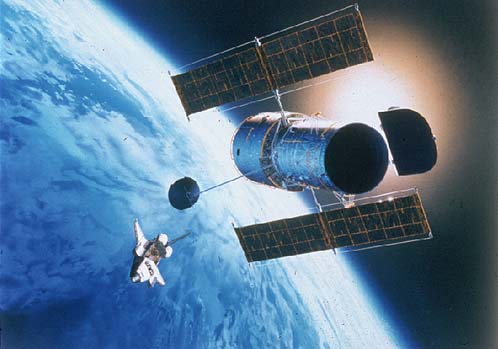
interpretation and photo documentation. (left: Paul Hudson, Space
Telescope in Orbit, acrylic, Courtesy of NASA Art Program)
many others
who were eyewitnesses to the events. Their interpretations are particularly
valued in their ability to convey to future generations some of the wonder
and excitement of the space age. NASA photographs of Apollo missions and
images from the Hubble Space Telescope provide contrast between artistic
interpretation and photo documentation. (left: Paul Hudson, Space
Telescope in Orbit, acrylic, Courtesy of NASA Art Program)
Looking at the future of space exploration, The Solar
System and Beyond presents the concept that, just as early visionaries
prophesied the reality of space travel, contemporary artists describe space
adventures that may come true. The final section features a large-scale
painting, A Vision of the Future,by artist Robert T. McCall. Works
by contemporary sculptors such as Josh Simpson and Robert Perless, a Greenwich,
CT, resident are also included.
Read more about the Bruce
Museum in Resource Library Magazine.
Please click on thumbnail images bordered by a red line
to see enlargements.
This page was originally published in Resource
Library Magazine. Please see Resource Library's Overview section for
more information. rev. 5/23/11
Search Resource
Library for thousands of articles and essays on American art.
Copyright 2011 Traditional Fine Arts Organization, Inc., an Arizona nonprofit corporation. All rights
reserved.
 The Bruce Museum of Arts and Science presents
its major winter exhibition Space 2001: To the Moon and Beyond from
January 14, 2001, through April 15, 2001. The exhibition showcases life
and travel in outer space as conceived by the visions of artists, photographers
and writers, and through the contributions of scientists and astronauts
who made the spectacular realities of space exploration possible. The exhibition
presents paintings, drawings, photographs, technical drawings, books, sculptures,
artifacts, scale models, video clips and hardware, as well as an authentic
moon rock brought back during the historic U.S. Apollo space missions. Divided
into three segments, Space 2001: To the Moon and Beyond covers the
past, present and future of space exploration in segments titled Prelude
to Space Travel, The Race for the Moon and The Solar System and Beyond.
(left: Charles Schmidt, The Moon Suit, lithograph, Courtesy of
NASA Art Program)
The Bruce Museum of Arts and Science presents
its major winter exhibition Space 2001: To the Moon and Beyond from
January 14, 2001, through April 15, 2001. The exhibition showcases life
and travel in outer space as conceived by the visions of artists, photographers
and writers, and through the contributions of scientists and astronauts
who made the spectacular realities of space exploration possible. The exhibition
presents paintings, drawings, photographs, technical drawings, books, sculptures,
artifacts, scale models, video clips and hardware, as well as an authentic
moon rock brought back during the historic U.S. Apollo space missions. Divided
into three segments, Space 2001: To the Moon and Beyond covers the
past, present and future of space exploration in segments titled Prelude
to Space Travel, The Race for the Moon and The Solar System and Beyond.
(left: Charles Schmidt, The Moon Suit, lithograph, Courtesy of
NASA Art Program)