Museum of Fine Arts, Houston
Houston, TX
713-639-7300
http://www.mfah.org
American Spectrum: Paintings
and Sculpture from the Smith College Museum of Art
March 4 - May 27, 2001
A rare
opportunity to trace the development of American art across more than 200
years is offered in American
Spectrum: Paintings and Sculpture from the Smith College Museum of Art,
on view March 4-May 27 at the Museum of Fine Arts, Houston. The collection
of 62 works dating from 1733  to 1948 will be shown in the Lovett Gallery of the
Caroline Wiess Law Building, 1001 Bissonnet. The exhibition is traveling
to eight venues in the United States while the Smith College Museum of Art
in Northampton, Massachusetts is closed for renovation and expansion. America's
leading masters are represented in this show, including the painters Thomas
Cole, John Singleton Copley, John Singer Sargent, Winslow Homer, and Childe
Hassam, and the sculptors Alexander Calder, Daniel Chester French, Elie
Nadelman, and Augustus Saint-Gaudens. (left: Winslow Homer, Shipyard
at Gloucester, 1871, oil on canvas, Smith College Museum of Art, Purchased
1950.99)
to 1948 will be shown in the Lovett Gallery of the
Caroline Wiess Law Building, 1001 Bissonnet. The exhibition is traveling
to eight venues in the United States while the Smith College Museum of Art
in Northampton, Massachusetts is closed for renovation and expansion. America's
leading masters are represented in this show, including the painters Thomas
Cole, John Singleton Copley, John Singer Sargent, Winslow Homer, and Childe
Hassam, and the sculptors Alexander Calder, Daniel Chester French, Elie
Nadelman, and Augustus Saint-Gaudens. (left: Winslow Homer, Shipyard
at Gloucester, 1871, oil on canvas, Smith College Museum of Art, Purchased
1950.99)
"The Smith College Museum of Art is world-renowned
for its impressive holdings, particularly in American art," said Peter
C. Marzio, director of the MFAH. "This collection is a visual treat
not often experienced outside of New England. The MFAH is pleased to bring
it to Houston."
The Smith collection
began to take shape in 1879 when the college's first president L. Clarke
Seelye  decided
he wanted students to have an art gallery where they could "be made
directly familiar with the famous masterpieces." His early strategy
was to acquire reproductive prints and casts of historic pieces, and to
buy original contemporary art. Works in this exhibition that he bought directly
from the artists include Thomas Eakins's In Grandmother's Time and
Albert Pinkham Ryder's Perrette, and possibly William Merritt Chase's
Woman in Black. The collection grew in succeeding years through the
astute purchases of museum directors and their curators, and through the
generosity of Smith alumnae. After 1905, the collection was expanded to
include the work of past and present European and American artists.
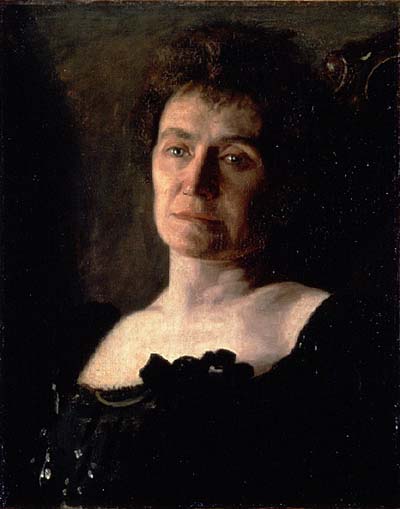
(left: Thomas Eakins, Edith Mahon, 1904, oil on canvas, Smith College
Museum of Art, Purchased, Drayton Hillyer Fund 1931.2)
decided
he wanted students to have an art gallery where they could "be made
directly familiar with the famous masterpieces." His early strategy
was to acquire reproductive prints and casts of historic pieces, and to
buy original contemporary art. Works in this exhibition that he bought directly
from the artists include Thomas Eakins's In Grandmother's Time and
Albert Pinkham Ryder's Perrette, and possibly William Merritt Chase's
Woman in Black. The collection grew in succeeding years through the
astute purchases of museum directors and their curators, and through the
generosity of Smith alumnae. After 1905, the collection was expanded to
include the work of past and present European and American artists.
(left: Thomas Eakins, Edith Mahon, 1904, oil on canvas, Smith College
Museum of Art, Purchased, Drayton Hillyer Fund 1931.2)
"This show is important on several levels," said
Emily Ballew Neff, curator of American art and  sculpture at the MFAH. "It tells us much about
the development of American art and culture from the 18th to the 20th centuries.
By its very presence, this collection also shows us the extraordinary commitment
and vision of the people associated with Smith College. On a purely visual
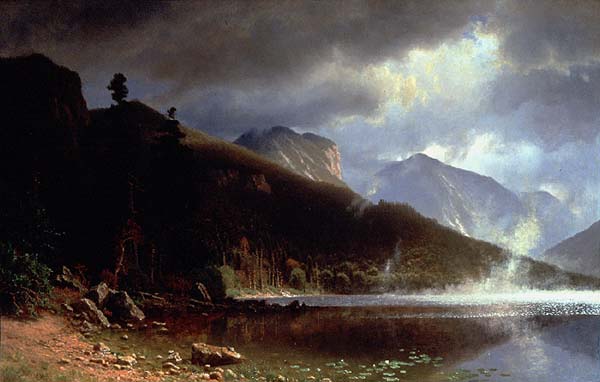
level, it is enticing and enchanting." (left: Albert Bierstadt,
Echo Lake, Franconia Mountains, New Hampshire, 1861, oil on canvas,
Smith College Museum of Art, Purchased with the assistance of funds given
by Mrs. John Stewart Dalrymple (Bernice Barber, class of 1910), 1960.37)
sculpture at the MFAH. "It tells us much about
the development of American art and culture from the 18th to the 20th centuries.
By its very presence, this collection also shows us the extraordinary commitment
and vision of the people associated with Smith College. On a purely visual
level, it is enticing and enchanting." (left: Albert Bierstadt,
Echo Lake, Franconia Mountains, New Hampshire, 1861, oil on canvas,
Smith College Museum of Art, Purchased with the assistance of funds given
by Mrs. John Stewart Dalrymple (Bernice Barber, class of 1910), 1960.37)
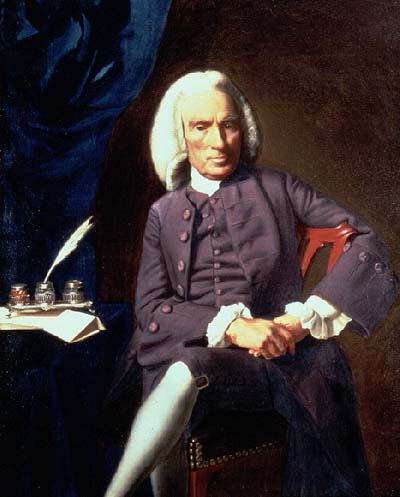
 One
of the highlights of the exhibition is Copley's portrait of the Boston merchant,
The Honorable John Erving (c. 1772), given to the museum by his descendant,
Alice Erving (Smith class of 1929). Copley's dignified, carefully rendered
likeness captures Erving's stern features even as the subject strikes a
relaxed pose. By the early 1760s, Copley was Boston's leading artist and
his portraits of prominent Bostonians, including Erving, were a high point
of his American career. (left: John Singleton Copley, The Honorable
John Erving, c. 1772, oil on canvas, Smith College Museum of Art, Bequest
of Alice Rutherford Erving, class of 1929, 1975.52-1)
One
of the highlights of the exhibition is Copley's portrait of the Boston merchant,
The Honorable John Erving (c. 1772), given to the museum by his descendant,
Alice Erving (Smith class of 1929). Copley's dignified, carefully rendered
likeness captures Erving's stern features even as the subject strikes a
relaxed pose. By the early 1760s, Copley was Boston's leading artist and
his portraits of prominent Bostonians, including Erving, were a high point
of his American career. (left: John Singleton Copley, The Honorable
John Erving, c. 1772, oil on canvas, Smith College Museum of Art, Bequest
of Alice Rutherford Erving, class of 1929, 1975.52-1)
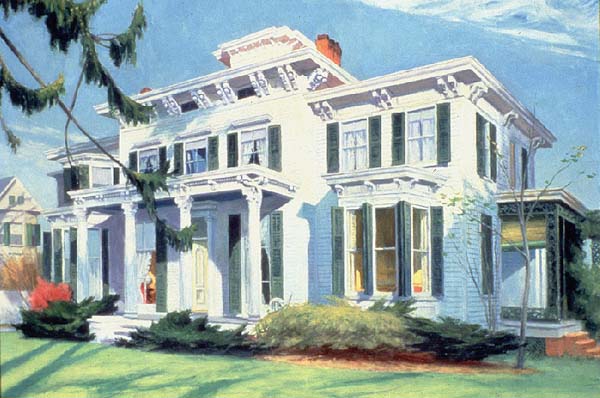
Stories behind some of the works make them all the more
intriguing. Edward Hopper's Pretty Penny (1939) is a joyous, light-filled
portrait of the house of the actress Helen Hayes.  Hopper was commissioned to do the painting, but was
reluctant to accept at first because he considered it tradesman's work.
He eventually relented, creating a work without the darkness and alienation
so common in his paintings of American houses. Hayes, who received an honorary
doctorate from Smith in 1940, gave the painting to the museum in 1964. (left:
Edward Hopper, Pretty Penny, 1939, oil on canvas, Smith College Museum
of Art, Gift of Charles MacArthur (Helen Hayes L.H.D., class of 1949), 1965.4)
Hopper was commissioned to do the painting, but was
reluctant to accept at first because he considered it tradesman's work.
He eventually relented, creating a work without the darkness and alienation
so common in his paintings of American houses. Hayes, who received an honorary
doctorate from Smith in 1940, gave the painting to the museum in 1964. (left:
Edward Hopper, Pretty Penny, 1939, oil on canvas, Smith College Museum
of Art, Gift of Charles MacArthur (Helen Hayes L.H.D., class of 1949), 1965.4)
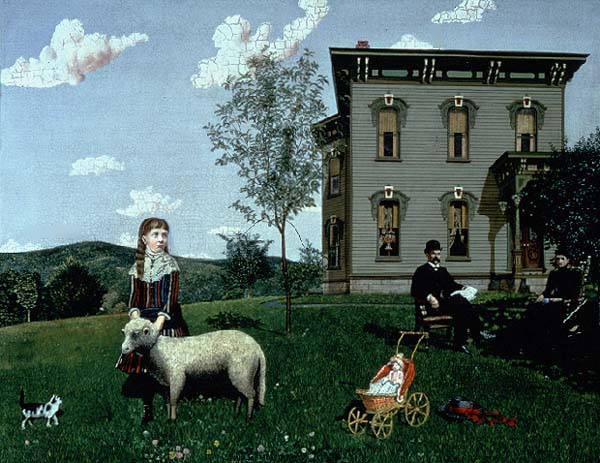
Edwin Romanzo Elmer, a painter who died unknown, is represented
by two paintings
in the exhibition, Mourning Picture (1890) and A Lady of Baptist
Corner, Ashfield, Massachusetts (the Artist's Wife), (1892). Mourning
Picture is a family portrait of the artist, his wife, and their daughter,
who had died not long before, and a pet sheep against the backdrop of a
Victorian house. It was first  shown in a post office in 1890 and then was not seen
again until 1950 when the artist's niece showed it to Henry-Russell Hitchcock,
then director of the Smith Museum. Hitchcock recognized its value at once.
It became one of the most popular and most frequently reproduced paintings
in the collection. In the portrait of his wife operating a machine he invented
to make whip snaps (the braided end of horsewhips), Elmer shows his love
of detail - from the design of the carpet to the play of light and shadow
in the scene. (left: Edwin Romanzo Elmer, Mourning Picture,
1890, oil on canvas, Smith College Museum of Art, Purchased 1953.129)
shown in a post office in 1890 and then was not seen
again until 1950 when the artist's niece showed it to Henry-Russell Hitchcock,
then director of the Smith Museum. Hitchcock recognized its value at once.
It became one of the most popular and most frequently reproduced paintings
in the collection. In the portrait of his wife operating a machine he invented
to make whip snaps (the braided end of horsewhips), Elmer shows his love
of detail - from the design of the carpet to the play of light and shadow
in the scene. (left: Edwin Romanzo Elmer, Mourning Picture,
1890, oil on canvas, Smith College Museum of Art, Purchased 1953.129)
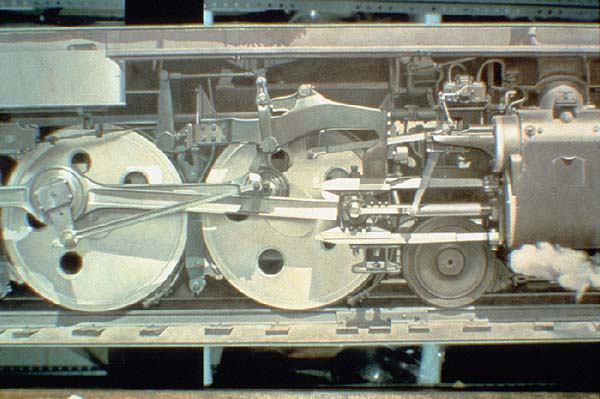
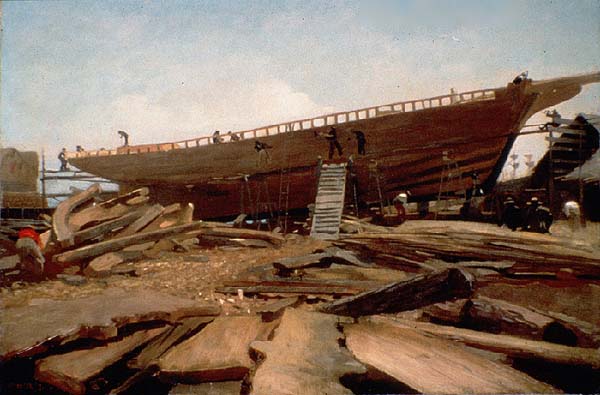
 Other
paintings in the exhibition gloriously document man's achievements in transportation
and industry. Winslow Homer's Shipyard at Gloucester (1871) captures
a crew building a schooner so accurately that a historian has been able
to determine the hull type and the details of the ship under construction.
Charles Sheeler's Rolling Power (1939) is one of a series of paintings
he made focusing on sources of power. Sheeler's interest in photography
paralleled his interest in painting, and is particularly evident in this
beautiful detail of a New York Central locomotive. (left: Charles
Sheeler's Rolling Power, 1939, oil on canvas, Smith College Museum
of Art, Purchased, Drayton Hillyer Fund 1940.18)
Other
paintings in the exhibition gloriously document man's achievements in transportation
and industry. Winslow Homer's Shipyard at Gloucester (1871) captures
a crew building a schooner so accurately that a historian has been able
to determine the hull type and the details of the ship under construction.
Charles Sheeler's Rolling Power (1939) is one of a series of paintings
he made focusing on sources of power. Sheeler's interest in photography
paralleled his interest in painting, and is particularly evident in this
beautiful detail of a New York Central locomotive. (left: Charles
Sheeler's Rolling Power, 1939, oil on canvas, Smith College Museum
of Art, Purchased, Drayton Hillyer Fund 1940.18)
Among the dozen sculptures in the exhibition are Elie Nadelman's
elegantly designed Resting Stag (c. 1915) and Augustus Saint-Gaudens's
Diana of the Tower (1899). Nadelman's deer, in gold-leafed veneer
and a wood-veneered base, was created at the height of his career. Saint-Gaudens's
bronze sculpture is one of a number of reductions the artist made of Diana,
an 18-foot figure that sat atop a 330-foot-high tower at Madison Square
Garden in New York at the turn of the century. The sculpture was created
as weathervane. The Smith Museum's variant is 36 inches high and the only
known kinetic version.
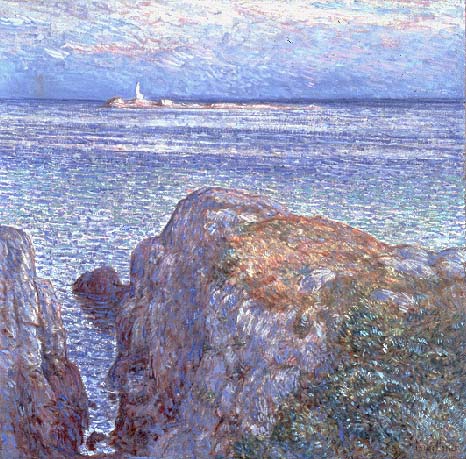
 A
307-page catalogue, Masterworks of American Painting and Sculpture from
the Smith College Museum of Art, accompanies the exhibition. In the
book, 79 of the museum's most important American works are illustrated in
full color and discussed in comprehensive essays. An illustrated checklist
with 85 additional works from the museum is included. Linda Muehling, associate
curator of painting and sculpture at Smith Museum, is the editor and principal
author. (left: Childe Hassam, White Island Light, Isles of Shaoals,
at Sundown, 1899, oil on canvas, Smith College Museum of Art, Gift of
Mr. and Mrs. Harold D. Hodgkinson (Laura White Cabot, class of 1922), 1965.4)
A
307-page catalogue, Masterworks of American Painting and Sculpture from
the Smith College Museum of Art, accompanies the exhibition. In the
book, 79 of the museum's most important American works are illustrated in
full color and discussed in comprehensive essays. An illustrated checklist
with 85 additional works from the museum is included. Linda Muehling, associate
curator of painting and sculpture at Smith Museum, is the editor and principal
author. (left: Childe Hassam, White Island Light, Isles of Shaoals,
at Sundown, 1899, oil on canvas, Smith College Museum of Art, Gift of
Mr. and Mrs. Harold D. Hodgkinson (Laura White Cabot, class of 1922), 1965.4)
American Spectrum: Paintings and Sculpture from the
Smith College Museum of Art was organized by the
Smith College Museum of Art, Northampton, Massachusetts. Funding in Houston
was generously provided by The Brown Foundation, Inc., Charles Butt, and
Isabel and Wallace Wilson.
The eight venues for this exhibition are: Faulconer Gallery
at Grinnell College in Grinnell, Iowa, February 5-April 23, 2000; National
Academy of Design Museum, New York, June 21-September 10, 2000; Norton Museum
of Art, West Palm Beach, Florida, October 28, 2000-January 7, 2001; the
MFAH, March 4-May 28, 2001; Pennsylvania Academy of the Fine Arts, Philadelphia,
June 29-September 30, 2001; Memorial Art Gallery of the University of Rochester,
Rochester, New York, October 28, 2001-January 13, 2002; Tucson Museum of
Art, Tucson, Arizona, February 16-April 28, 2002; and Katonah Museum of
Art, Katonah, New York, June 23-September 15, 2002.
Also see American Spectrum: Paintings
and Culture from the Smith College Museum of Art (5/30/00) which covers
the exhibition at The National Academy of Design Museum, New York, June
21-September 10, 2000
rev. 2/21/01
Read more in Resource Library Magazine
about the Museum of Fine Arts, Houston
Please click on thumbnail images bordered by a red line
to see enlargements.
For further biographical information on selected artists
cited above please see America's Distinguished
Artists, a national registry of historic artists.
Links to sources of information outside of our web site
are provided only as referrals for your further consideration. Please use
due diligence in judging the quality of information contained in these and
all other web sites. Information from linked sources may be inaccurate or
out of date. TFAO neither recommends or endorses these referenced organizations.
Although TFAO includes links to other web sites, it takes no responsibility
for the content or information contained on those other sites, nor exerts
any editorial or other control over them. For more information on evaluating
web pages see TFAO's General Resources
section in Online Resources for Collectors and Students of Art History.
This page was originally published in Resource
Library Magazine. Please see Resource Library's Overview section for
more information. rev. 5/23/11
Search Resource
Library for thousands of articles and essays on American art.
Copyright 2011 Traditional Fine Arts Organization, Inc., an Arizona nonprofit corporation. All rights
reserved.
 to 1948 will be shown in the Lovett Gallery of the
Caroline Wiess Law Building, 1001 Bissonnet. The exhibition is traveling
to eight venues in the United States while the Smith College Museum of Art
in Northampton, Massachusetts is closed for renovation and expansion. America's
leading masters are represented in this show, including the painters Thomas
Cole, John Singleton Copley, John Singer Sargent, Winslow Homer, and Childe
Hassam, and the sculptors Alexander Calder, Daniel Chester French, Elie
Nadelman, and Augustus Saint-Gaudens. (left: Winslow Homer, Shipyard
at Gloucester, 1871, oil on canvas, Smith College Museum of Art, Purchased
1950.99)
to 1948 will be shown in the Lovett Gallery of the
Caroline Wiess Law Building, 1001 Bissonnet. The exhibition is traveling
to eight venues in the United States while the Smith College Museum of Art
in Northampton, Massachusetts is closed for renovation and expansion. America's
leading masters are represented in this show, including the painters Thomas
Cole, John Singleton Copley, John Singer Sargent, Winslow Homer, and Childe
Hassam, and the sculptors Alexander Calder, Daniel Chester French, Elie
Nadelman, and Augustus Saint-Gaudens. (left: Winslow Homer, Shipyard
at Gloucester, 1871, oil on canvas, Smith College Museum of Art, Purchased
1950.99)