Georgia Museum of Art
University of Georgia
Athens, GA
706-542-GMOA
http://www.uga.edu/gamuseum/
A Bountiful Plenty from
the Shelburne Museum: Folk Art Traditions in America
"A Bountiful
Plenty from the Shelburne Museum: Folk Art Traditions in America" will
be on view at the Georgia Museum of Art from May 12 until July 1, 2001.
The Shelburne Museum in Shelburne, Vermont,  houses one of American's premier collections of folk
art. The collection was brought together by Electra Havemeyer Webb (1888-1960),
who began acquiring before World War I, long before folk art was recognized
as anything more than everyday objects. Mrs. Webb's flair for collecting
these special objects, which include trade and tavern signs, cigar store
figures, weathervanes, ships' carvings, carousel figures, decoys, scrimshaw
(carved or engraved articles made by whalers usually from baleen or whale
ivory), quilts, primitive paintings, and sculpture, continued throughout
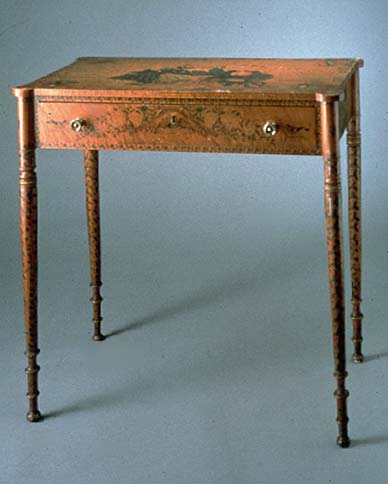
her life and led to the museum's founding in 1947, (left: Elizabeth
Lombard Paine, Table, 1816, painted birch, maple and white pine,
33 1/2 x 32 1/4 inches)
houses one of American's premier collections of folk
art. The collection was brought together by Electra Havemeyer Webb (1888-1960),
who began acquiring before World War I, long before folk art was recognized
as anything more than everyday objects. Mrs. Webb's flair for collecting
these special objects, which include trade and tavern signs, cigar store
figures, weathervanes, ships' carvings, carousel figures, decoys, scrimshaw
(carved or engraved articles made by whalers usually from baleen or whale
ivory), quilts, primitive paintings, and sculpture, continued throughout
her life and led to the museum's founding in 1947, (left: Elizabeth
Lombard Paine, Table, 1816, painted birch, maple and white pine,
33 1/2 x 32 1/4 inches)
A Bountiful Plenty will explore
folk art of the 18th and 19th centuries. Mrs. Webb selected her pieces for
the maximum impression of their richly decorated surfaces, and the 85 objects
in the exhibition reflect this richness well. The makers and artists in
this exhibition were not factors of selection for Mrs. Webb, and while some
were  well-known,
most were undiscovered, Interestingly, their reputations and importance
continue to grow. Of particular interest are some notable names from the
18th, 19th, and 20th centuries: Edward Hicks, Erastus Salisbury Field, William
Matthew Prior, Anna Robertson (Grandma) Moses, Samuel Robb, John Cromwell,
Louis Jobin, Gustav Dentzel, Wilhelm Schimmel, and James Lobard, who are
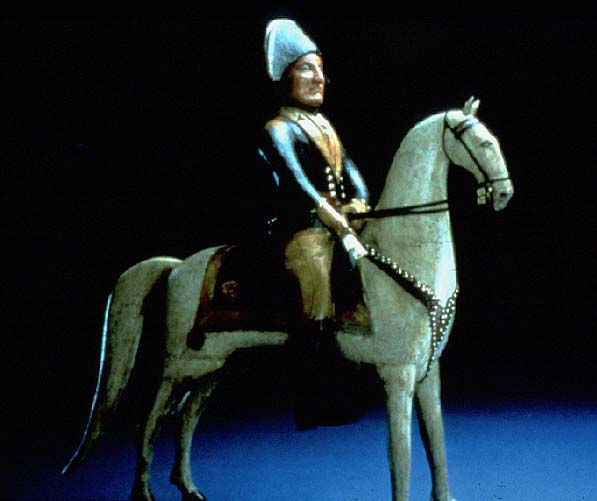
experiencing increased interest in their work. (left: Coolidge, George
Washington on Horseback, c. 1780, carved polychromed wood and leather,
23 x 22 x 7 inches)
well-known,
most were undiscovered, Interestingly, their reputations and importance
continue to grow. Of particular interest are some notable names from the
18th, 19th, and 20th centuries: Edward Hicks, Erastus Salisbury Field, William
Matthew Prior, Anna Robertson (Grandma) Moses, Samuel Robb, John Cromwell,
Louis Jobin, Gustav Dentzel, Wilhelm Schimmel, and James Lobard, who are
experiencing increased interest in their work. (left: Coolidge, George
Washington on Horseback, c. 1780, carved polychromed wood and leather,
23 x 22 x 7 inches)
Organized by the Trust for Museum Exhibitions, A Bountiful
Plenty from the Shelburne Museum will look beyond the current argument
between folklorists and anthropologists on one hand and art historians on
the other. The aesthetics that drove Mrs. Webb to collect will offer a more
complete social and art historical understanding of the 18th- and 19th-century
American culture that shaped this art. She was one of the first to answer
the question, "is it art?" Folk art's role in the development
of modern American art will be on full view, and its artistic merit, or
why Mrs. Webb knew such objects to be art, will be easily understood.
Prior articles on this traveling exhibition:
Read more about the Georgia
Museum of Art in Resource Library Magazine
Please click on thumbnail images bordered by a red line
to see enlargements.
For further biographical information on selected artists
cited above please see America's Distinguished
Artists, a national registry of historic artists.
This page was originally published in Resource
Library Magazine. Please see Resource Library's Overview section for
more information. rev. 5/23/11
Search Resource
Library for thousands of articles and essays on American art.
Copyright 2011 Traditional Fine Arts Organization, Inc., an Arizona nonprofit corporation. All rights
reserved.
 houses one of American's premier collections of folk
art. The collection was brought together by Electra Havemeyer Webb (1888-1960),
who began acquiring before World War I, long before folk art was recognized
as anything more than everyday objects. Mrs. Webb's flair for collecting
these special objects, which include trade and tavern signs, cigar store
figures, weathervanes, ships' carvings, carousel figures, decoys, scrimshaw
(carved or engraved articles made by whalers usually from baleen or whale
ivory), quilts, primitive paintings, and sculpture, continued throughout
her life and led to the museum's founding in 1947, (left: Elizabeth
Lombard Paine, Table, 1816, painted birch, maple and white pine,
33 1/2 x 32 1/4 inches)
houses one of American's premier collections of folk
art. The collection was brought together by Electra Havemeyer Webb (1888-1960),
who began acquiring before World War I, long before folk art was recognized
as anything more than everyday objects. Mrs. Webb's flair for collecting
these special objects, which include trade and tavern signs, cigar store
figures, weathervanes, ships' carvings, carousel figures, decoys, scrimshaw
(carved or engraved articles made by whalers usually from baleen or whale
ivory), quilts, primitive paintings, and sculpture, continued throughout
her life and led to the museum's founding in 1947, (left: Elizabeth
Lombard Paine, Table, 1816, painted birch, maple and white pine,
33 1/2 x 32 1/4 inches)