Mint Museum of Craft + Design
Mint Museum of Art
Mint Museum of Craft + Design
Charlotte, NC
704-337-2000
On the Surface: Late 19th
Century Decorative Arts
May 26 - August 12, 2001
 The embellished surface was the defining element
of late nineteenth century American
The embellished surface was the defining element
of late nineteenth century American decorative arts. Cabinetmakers covered their objects
with inlays and marquetry that glowed like the walls of a Persian mosque.
Silversmiths hammered delicate reliefs of sunflowers and chrysanthemums
into the bodies of coffeepots and serving pieces. Walls appeared to bloom
with paper gardens of wildflowers and floors were covered with woven images
of acanthus leaves and intricate arabesque patterns. The bodies of ceramic
wares became highly pictorial, much like a painted canvas, with their images
of dazzling floral bouquets or scenes of a nation's natural beauty. Everything
of visual beauty was literally and exuberantly reproduced "on the surface."
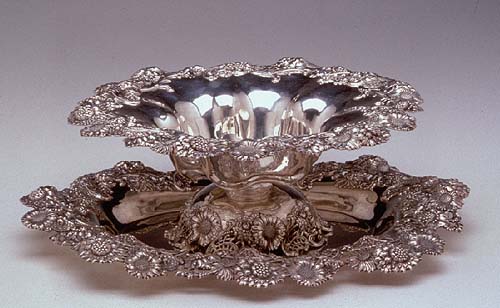
(left: Tiffany & Company, Chrysanthenum Service, Right:
detail of Tiffany & Company, Chrysanthenum Service)
decorative arts. Cabinetmakers covered their objects
with inlays and marquetry that glowed like the walls of a Persian mosque.
Silversmiths hammered delicate reliefs of sunflowers and chrysanthemums
into the bodies of coffeepots and serving pieces. Walls appeared to bloom
with paper gardens of wildflowers and floors were covered with woven images
of acanthus leaves and intricate arabesque patterns. The bodies of ceramic
wares became highly pictorial, much like a painted canvas, with their images
of dazzling floral bouquets or scenes of a nation's natural beauty. Everything
of visual beauty was literally and exuberantly reproduced "on the surface."
(left: Tiffany & Company, Chrysanthenum Service, Right:
detail of Tiffany & Company, Chrysanthenum Service)
The exquisite patterns and surface ornamentation that were
an integral part of the aesthetics of the late Victorian era, the Aesthetic
Movement and the early Arts and Crafts Movement, are featured in the exhibition
On the Surface: Late Nineteenth Century Decorative Arts, May 26th
through August 12th at  Charlotte, NC's Mint Museum of Art. The exhibition
and catalogue present a unique opportunity to explore the artful, and oftentimes
highly fanciful, treatment of surfaces created by late nineteenth century
artists and craftsmen in response to social, cultural and aesthetic exchanges
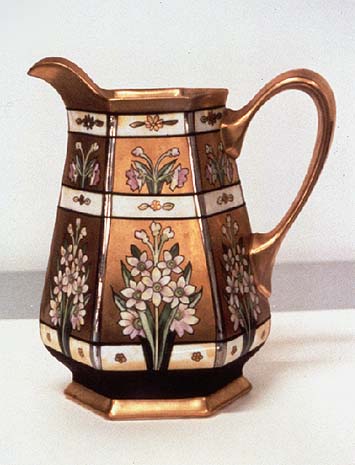
that developed across the globe between 1870 and 1900. (left: Pickard,
China Pitcher, c. 1895-98)
Charlotte, NC's Mint Museum of Art. The exhibition
and catalogue present a unique opportunity to explore the artful, and oftentimes
highly fanciful, treatment of surfaces created by late nineteenth century
artists and craftsmen in response to social, cultural and aesthetic exchanges
that developed across the globe between 1870 and 1900. (left: Pickard,
China Pitcher, c. 1895-98)
It was an age of visual and sensory indulgences that embraced
perceptions of the 'exotic' while promoting the beauty of a handcrafted
and hand-finished object. In America, these developments were incorporated
into the themes of national expositions and artistic movements as cottage
industries grew and productivity in the decorative arts flourished.
"The exhibition explores the central issues and movements
that contributed to a public passion for the highly embellished surfaces
that invaded the late decades of the nineteenth century" stated Dr.
Barbara Ferry, Mint curator of Decorative Arts. "On the Surface
brings together outstanding examples of furniture, ceramics, glass, silver
and textile design that demonstrate the great talent and entrepreneurial
spirit of America's creative forces of this era."
Exhibition highlights include a previously undocumented
Adelaide Alsop Robineau porcelain Covered Jar; a stunning (22.5"h
x 15") Dragon Vase, created in l892 by Rookwood Pottery decorator
Kataro Shirayamadani; a William Morris and Company wooven wool Panel
from 1878-79; an electroplated silver  Tilt-top Table designed
by Frank Shaw for Tiffany and Company; a Herter Brothers Side Chair
produced in 1881; and an exquisite cut lead glass Sultana Punch Bowl
made by Blackmer Cut Glass Company in 1898. Loans to the exhibition
come from outstanding private and public decorative arts collections, including
the Cooper-Hewitt National Design Museum, Columbia (SC) Museum of Art, Corning
Museum of Glass, Dallas Museum of Art, Everson Museum of Art, High Museum
of Art, Minneapolis Institute of Arts, Munson-Williams-Proctor Institute,
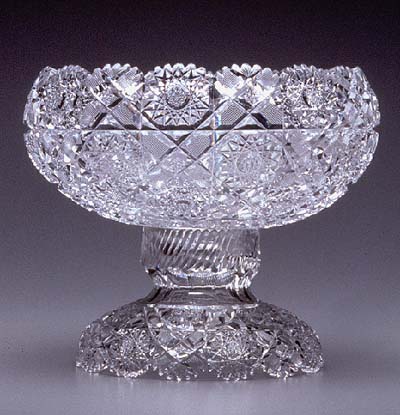
Oakland Museum of Art, and the Toledo Museum of Art. (left: H. L.
Blackmer Cut Glass Company, Sultana Punch Bowl, 1898)
Tilt-top Table designed
by Frank Shaw for Tiffany and Company; a Herter Brothers Side Chair
produced in 1881; and an exquisite cut lead glass Sultana Punch Bowl
made by Blackmer Cut Glass Company in 1898. Loans to the exhibition
come from outstanding private and public decorative arts collections, including
the Cooper-Hewitt National Design Museum, Columbia (SC) Museum of Art, Corning
Museum of Glass, Dallas Museum of Art, Everson Museum of Art, High Museum
of Art, Minneapolis Institute of Arts, Munson-Williams-Proctor Institute,
Oakland Museum of Art, and the Toledo Museum of Art. (left: H. L.
Blackmer Cut Glass Company, Sultana Punch Bowl, 1898)
"The late Victorian style was not so much one of form,
but rather of decoration, ornamentation and embellishment," remarked
Perry. "Surface ornamentation was the name of the game. During the
last three decades of the 19th century, there was a change in sensibility
that resulted in new stylistic approaches in American decorative arts, a
departure from the previous era of Rococo and Renaissance Revival excess"
 Shapes
became more angular, smoother and less flamboyant. The popular carvings
and deep modeling of earlier years disappeared as ornamentation became more
linear and lighter in appearance. Decoration focused on the surface with
rich and elegant patterns adorning furniture, objects of every sort, and
architectural and interior decorations. An abundance of vines, chrysanthemums,
rosettes, acanthus leaves, sunflowers, cherubs, eagles, lizards, fish, seashells,
and insects all graced the surfaces of objects. Carpets, upholstery, draperies,
and furnishings displayed a profusion of ornamentation. Nothing escaped
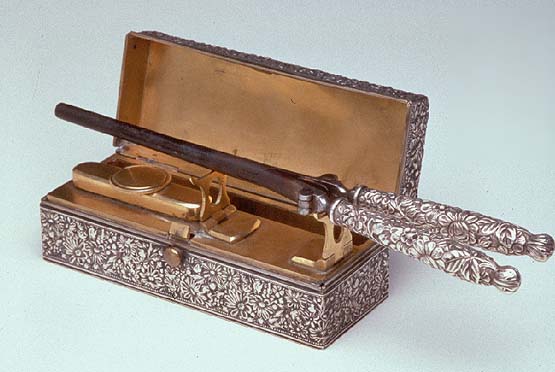
the decorator's design or consideration. (left: Gorham Manufacturing
Company, Travel Curling Iron)
Shapes
became more angular, smoother and less flamboyant. The popular carvings
and deep modeling of earlier years disappeared as ornamentation became more
linear and lighter in appearance. Decoration focused on the surface with
rich and elegant patterns adorning furniture, objects of every sort, and
architectural and interior decorations. An abundance of vines, chrysanthemums,
rosettes, acanthus leaves, sunflowers, cherubs, eagles, lizards, fish, seashells,
and insects all graced the surfaces of objects. Carpets, upholstery, draperies,
and furnishings displayed a profusion of ornamentation. Nothing escaped
the decorator's design or consideration. (left: Gorham Manufacturing
Company, Travel Curling Iron)
Styles were just as prolific with more than a hint of the
exotic. Attention shifted to Japanese, Egyptian, Middle Eastern, and even
Mesoamerican motifs while references to the classic, gothic, and renaissance
eras  remained
popular, although under a new guise. These were freely intermingled, often
creating something quite indescribable yet, more often than not, completely
successful. The overall effect usually resulted in a sense of the exotic
and the dramatic, albeit with much more restraint in comparison to the early
years of the century. Colors were lighter and subtle. Decorative motifs
shifted to flat, conventionalized (stylized) designs. The overall effect
was a refreshing departure from the dark, heavy interiors that were so common
around the mid-nineteenth century. (left: Adelaide Alsop Robineau,
Covered Jar, 1928, porcelain)
remained
popular, although under a new guise. These were freely intermingled, often
creating something quite indescribable yet, more often than not, completely
successful. The overall effect usually resulted in a sense of the exotic
and the dramatic, albeit with much more restraint in comparison to the early
years of the century. Colors were lighter and subtle. Decorative motifs
shifted to flat, conventionalized (stylized) designs. The overall effect
was a refreshing departure from the dark, heavy interiors that were so common
around the mid-nineteenth century. (left: Adelaide Alsop Robineau,
Covered Jar, 1928, porcelain)
This artistic reawakening was prompted by effects of the
industrial revolution on contemporary design. When objects were mass-produced,
the machine was often allowed to run amok, churning out overly decorated
objects whose surface ornamentation camouflaged basic design flaws. And
yet, lower-priced goods allowed the growing middle class to fill their homes
with artful objects much like the wealthy upper class had done. These factors
of over production and poor design contributed to a revolution in taste
and aesthetic values.
 This
new attitude, with its focus on ornament and the decorative, is now referred
to as the Aesthetic Movement, but also encompasses the early Arts and Crafts
Movement as well. The purpose of this movement was to bring a refined sensibility
and components of "good taste" (an important term by its adherents)
to the domestic interior. This was an art of the home and signifier of good
living that conveyed a certain moral undertone. Art and good taste not only
denoted good character, but also could be used to induce proper moral conduct
and actions. In other words, an acceptable aesthetic environment contributed
to the moral betterment of society. This placed a heavy burden on the designers/decorators
as well as on women as keepers of the home. (left: Herter Brothers,
Side Chair, 1881)
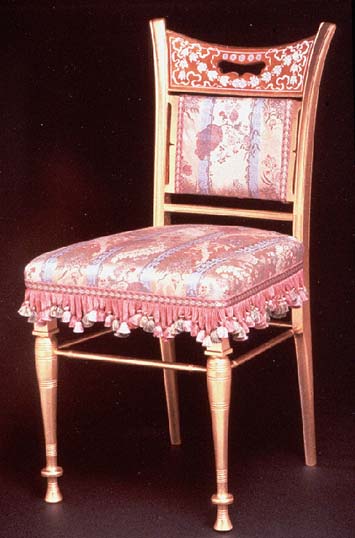
This
new attitude, with its focus on ornament and the decorative, is now referred
to as the Aesthetic Movement, but also encompasses the early Arts and Crafts
Movement as well. The purpose of this movement was to bring a refined sensibility
and components of "good taste" (an important term by its adherents)
to the domestic interior. This was an art of the home and signifier of good
living that conveyed a certain moral undertone. Art and good taste not only
denoted good character, but also could be used to induce proper moral conduct
and actions. In other words, an acceptable aesthetic environment contributed
to the moral betterment of society. This placed a heavy burden on the designers/decorators
as well as on women as keepers of the home. (left: Herter Brothers,
Side Chair, 1881)
Americans drew inspiration from the writing and work of
English artists Augustus Welby Northmore Pugin (1812-1852), John Ruskin
(1819-1900) and especially William Morris (1834-1896). Morris advocated
"nature and history" as design motifs. Another influence was Charles
Locke Eastlake, whose directive on proper decoration entitled Hints on
Household Taste in Furniture, Upholstery, and Other Details, examined
the entire house, giving opinions on matters of taste and design for everything
from carpets and pottery to wallpaper and dining rooms.
 It
is obvious that this was a period of great eclecticism. Tastes ranged from
the Modern Gothic through the Persian, Greek and Islamic to the Japanese,
with more than a nod to Mother Nature and Uncle Sam. Yet regardless of the
influence, surface pattern reigned supreme. In a single room setting, different
but interrelated patterns would be found on dados, walls, in draperies (including
portieres), carpets, upholstery, furniture, tea sets, vases, pianos and
any other object deemed part of the coordinated design scheme. English reformers
dictated that ornament should be derived from nature and pattern should
be flat and stylized. Forms were accented by colored outlines, or often
with touches of gold, with. the colors subdued. It was really a style of
interior decoration, an attempt to bring unity and elegance to the contemporary
home. The emphasis was on art and on the development of a refined sensibility.
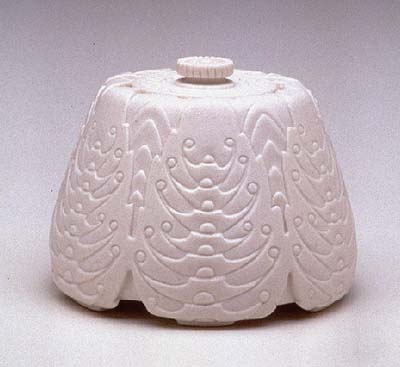
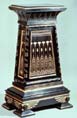
It was all a matter of taste. (left: Unknown Maker, Pedestal,
c. 1875)
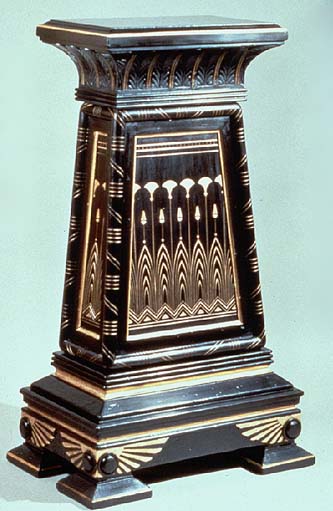
It
is obvious that this was a period of great eclecticism. Tastes ranged from
the Modern Gothic through the Persian, Greek and Islamic to the Japanese,
with more than a nod to Mother Nature and Uncle Sam. Yet regardless of the
influence, surface pattern reigned supreme. In a single room setting, different
but interrelated patterns would be found on dados, walls, in draperies (including
portieres), carpets, upholstery, furniture, tea sets, vases, pianos and
any other object deemed part of the coordinated design scheme. English reformers
dictated that ornament should be derived from nature and pattern should
be flat and stylized. Forms were accented by colored outlines, or often
with touches of gold, with. the colors subdued. It was really a style of
interior decoration, an attempt to bring unity and elegance to the contemporary
home. The emphasis was on art and on the development of a refined sensibility.
It was all a matter of taste. (left: Unknown Maker, Pedestal,
c. 1875)
Read more Resource Library Magazine articles
on Mint Museum of Art / Mint Museum of
Craft+Design
Please click on thumbnail images bordered by a red line
to see enlargements.
This page was originally published in Resource
Library Magazine. Please see Resource Library's Overview section for
more information. rev. 5/23/11
Search Resource
Library for thousands of articles and essays on American art.
Copyright 2011 Traditional Fine Arts Organization, Inc., an Arizona nonprofit corporation. All rights
reserved.
 The embellished surface was the defining element
of late nineteenth century American
The embellished surface was the defining element
of late nineteenth century American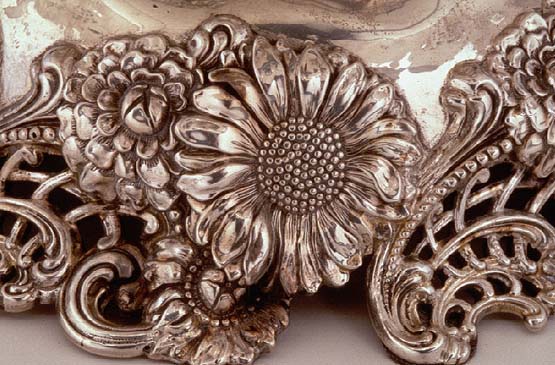 decorative arts. Cabinetmakers covered their objects
with inlays and marquetry that glowed like the walls of a Persian mosque.
Silversmiths hammered delicate reliefs of sunflowers and chrysanthemums
into the bodies of coffeepots and serving pieces. Walls appeared to bloom
with paper gardens of wildflowers and floors were covered with woven images
of acanthus leaves and intricate arabesque patterns. The bodies of ceramic
wares became highly pictorial, much like a painted canvas, with their images
of dazzling floral bouquets or scenes of a nation's natural beauty. Everything
of visual beauty was literally and exuberantly reproduced "on the surface."
(left: Tiffany & Company, Chrysanthenum Service, Right:
detail of Tiffany & Company, Chrysanthenum Service)
decorative arts. Cabinetmakers covered their objects
with inlays and marquetry that glowed like the walls of a Persian mosque.
Silversmiths hammered delicate reliefs of sunflowers and chrysanthemums
into the bodies of coffeepots and serving pieces. Walls appeared to bloom
with paper gardens of wildflowers and floors were covered with woven images
of acanthus leaves and intricate arabesque patterns. The bodies of ceramic
wares became highly pictorial, much like a painted canvas, with their images
of dazzling floral bouquets or scenes of a nation's natural beauty. Everything
of visual beauty was literally and exuberantly reproduced "on the surface."
(left: Tiffany & Company, Chrysanthenum Service, Right:
detail of Tiffany & Company, Chrysanthenum Service)